
Developing marketing strategies using LDA topic modeling based on Chinese tourists' reviews of Russian attractions
Ли Т.1  , Сюй В.1 , Чжан Д.1
1 Уральский федеральный университет им. первого Президента России Б.Н. Ельцина, Екатеринбург, Россия
Скачать PDF | Загрузок: 8
Статья в журнале
Маркетинг и маркетинговые исследования (РИНЦ, ВАК)
опубликовать статью
Том 31, Номер 3 (Июль-сентябрь 2026)
Аннотация:
Быстрое возвращение туристов из Китая в Россию поставило перед нами ключевую задачу: как решить структурные проблемы цифрового маркетинга и сервисной инфраструктуры в условиях резкого роста числа туристов. Поэтому крайне важно решить сложную когнитивную модель и изучить особенности впечатлений китайских туристов, чтобы преобразовать большой поток туристов в устойчивую экономическую ценность. В данной статье предлагается стратегическая маркетинговая модель, основанная на анализе больших данных текста, для решения этих структурных проблем. В работе используется Python для сбора большого количества комментариев с сайта Ctrip, а также применяется тематическое моделирование LDA и эмоциональный анализ для деконструкции впечатлений туристов в Москве, Санкт-Петербурге и Владивостоке. Результаты показывают двойственную психологическую структуру «красной ностальгии» и «эстетического поклонения», демонстрирующую значительный разрыв между высокой эстетической удовлетворенностью и низким функциональным уровнем сервиса. Поэтому предлагается использовать такие стратегии, как интеграция цифровой экосистемы, межпоколенческая сегментация и оптимизация услуг, для повышения конкурентоспособности отрасли
Ключевые слова: китайские туристы в России; туристический опыт; анализ больших данных текста; тематическое моделирование LDA; маркетинговая стратегия
JEL-классификация: L83, M31, Z32, C80, F14
1. Introduction: The shift of Policy and Structural Challenges and the progress of tourism facilitation for structural problems - from visa-free group tours to a wider visa-free policy-are double-edged swords for the Russian tourism market. Although the economic forecast in 2025 shows that the number of tourists will exceed 2 million from China because of these visa-free policies, this explosive growth has also exposed serious structural problems. The influx of tourists highlights key bottlenecks, including revenue loss, pressure on infrastructure, and the inability of digital marketing to keep up. Tourism faces an urgent task: to turn high "flow" into real "economic growth" instead of simply dealing with congestion. The Impact of the Pandemic Epidemic In recent years, China and Russia's tourism industry have been trying to cope with the severe impact brought by the COVID-19 epidemic. [1]
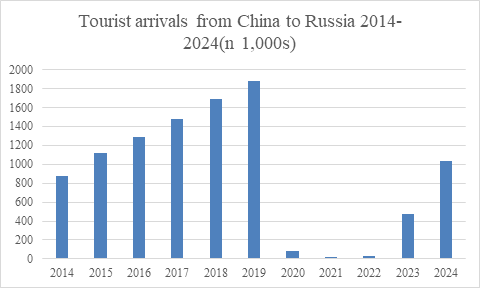
Figure 1 Tourist arrivals from China to Russia 2014-2024(n 1,000s)
Based on the Figure 1, the number of tourist arrivals from China to Russia experienced significant fluctuations between 2014 and 2024.
From 2014 to 2019, the number of Chinese tourists visiting Russia showed a steady and rapid increase. Tourist arrivals rose from approximately 900 thousand in 2014 to around 1.9 million in 2019, indicating a strong growth trend in outbound tourism from China to Russia. This period reflects the increasing popularity of Russian destinations among Chinese travelers
However, the trend changed dramatically in 2020–2022, when tourist arrivals dropped sharply to almost negligible levels. This decline can be largely attributed to global travel restrictions and border closures associated with the COVID-19 pandemic, which severely disrupted international tourism.
Starting in 2023, the number of Chinese visitors began to recover as international travel gradually resumed. Tourist arrivals increased to around 500 thousand in 2023, and further rebounded to over 1 million in 2024. Although this recovery has not yet reached the pre-pandemic peak of 2019, the upward trend indicates a gradual restoration of tourism flows between China and Russia. At the same time, the distribution map of tourists in China has also undergone tremendous changes. Before the pandemic, about 80% tourists concentrated on the classic Moscow-St. Petersburg tourist route. Since China lifted the COVID-19 restriction in 2022, the tourism exchange between China and Russia has been strengthened. [2] [3] By 2024, this proportion has dropped to about 50%, and the rest of the tourist flow has been replaced by the Far East region of Russia. [4] Primorsky Krai (Vladivostok Region) has become the third largest destination for tourists from China, with more than 400,000 tourists in 2024-accounting for 80% of all foreign tourists in the region. There are several reasons for this eastward shift: first, the geographical location is close, and you can fly directly from the cities in the northeast of China, or even take a bus From Hunchun City and Suifenhe City to Vladivostok; Second, security issues related to drone attacks and geopolitical instability have made tourists who want to avoid risks shift their attention from central Russia to Lake Baikal and the Pacific coast. Finally, some new modes of transportation, such as the package service from Shanhaiguan to Vladivostok, which opened in April 2024, have opened up new travel routes. [5] In the first quarter of 2025, 106,800 tourists from China went to Russia. [6] The Ministry of Economic Development of Russia predicts that thanks to the visa-free policy, more than 2 million China tourists will visit Russia next year (which is about 54% higher than the previous year). [7] However, behind this explosive growth, there are still some structural problems, such as income bottlenecks, inadequate digital marketing, and insufficient reception capacity of infrastructure. This makes us think about how to improve the marketing effect through capacity building and turn "people flow" into "economic growth". [2]
Under the background of the rapid recovery of China-Russia tourism market, the region we studied still faces some practical difficulties, such as few digital marketing tools, obvious conflicts between services and cultures, and insufficient attention to tourists' tiny psychological feelings. In order to solve these problems, this paper uses Python big data text mining technology. Through in-depth analysis of massive multidimensional data, it can effectively make up for the shortcomings of traditional survey methods in real-time and fineness, and provide more accurate decision support for the Russian tourism market.
In order to better understand the reasons why Russian tourists travel to China, this study introduces the core concepts such as "tourist gaze" and "nostalgia tourism", focusing on the importance of historical collective memory and cross-cultural aesthetic cognition in the construction of tourist destinations. [8] Although the research on "red tourism" (tourism with revolutionary history as the theme) has made great progress, there are still few studies on the interaction between "dual nostalgia" psychology and modern digital consumption behavior under the background of digital transformation. [9] Taking Theory of Three Represents cities like Moscow, St. Petersburg and Vladivostok as examples, this study depicts the psychological picture of China tourists intertwined with "red memories" and "aesthetic worship" through emotional classification and semantic network analysis. By analyzing China tourists' online comments on these cities, we can not only understand their tourist satisfaction, but also see how modern Chinese shapes its cultural identity and historical consciousness through Russia, and make marketing strategies based on these findings. [1]
2. Theoretical Framework
2.1 Tourism Destination Image Theory
Destination image theory stands as one of the most mature theoretical foundations in tourism research. Crompton (1979) was the first to systematically define destination image as "the sum total of all beliefs, thoughts, and impressions a person holds about a specific travel destination." [10] Destination image research traditionally distinguishes between cognitive, affective, and overall evaluative components. In this view, tourists form judgments not only about tangible attributes such as attractions, transport, and accommodation, but also about more diffuse emotional reactions such as excitement, romance, prestige, or authenticity. For urban destinations with strong historical symbolism, image is therefore never purely functional.
Frontiersinnih commonly employs the four-dimensional semantic differential scale developed by Russell and Pratt (1980): pleasant-unpleasant, boring-exciting, gloomy-inspiring, tense-relaxing. [11] In contemporary tourism markets, online word-of-mouth has become one of the primary mechanisms through which destination images are circulated and stabilized. Reviews do not simply describe places; they select salience, rank experience components, and transform individual impressions into collective reputations. This is particularly relevant for Chinese outbound tourism, where platforms such as Ctrip, Xiaohongshu, Mafengwo, and Douyin increasingly mediate the entire travel cycle—from inspiration to booking, navigation, post-trip evaluation, and peer recommendation. A destination that lacks digital localization, payment convenience, or Chinese-language guidance may therefore be punished not only by direct dissatisfaction but also by cascading reputational effects.
For Russia, this digital mediation matters because its tourism appeal often exceeds its service standardization. Iconic attractions are visually and symbolically strong, yet the digital service environment remains uneven. The theoretical implication is that destination image should be interpreted as a layered construct in which symbolic assets and service systems may move in different directions. A destination can be highly admired and still be experienced as inconvenient.
A series of studies by Ehtner and Richie enabled the construction of a three-dimensional structure for tourism destination image: Attributes—Holistic, Functional—Psychological, and Commonality—Uniqueness. Their article in the Journal of Tourism Research established the conceptual foundation, and provided empirical measurement methods. [12] Gartner (1994) proposed an image-forming agency typology (inductive agencies, autonomous agencies, organic agencies) in the Journal of Tourism and Tourism Marketing, offering a framework for under-standing the influence of information sources. [13]
Wang et al. (2023) introduced the concept of "online word-of-mouth image" in Cogent Social Science, analyzing new mechanisms for shaping tourism destination images in the social media era. [14] Guo et al. (2021) published in Information Technology and Tourism, revealing significant image discrepancies for Finland across five Chinese travel platforms—Ctrip, Qyer, Mafengwo, etc.—demonstrating platform characteristics' impact on image formation. [15]
2.2 Tourist Gaze Theory
John Urry's theory of the tourist gaze directly stems from Foucault's concepts of power/knowledge. [16] In his work The Tourist Gaze (1990, London: Sage), Urry argues that the gaze is not merely an act of "seeing," but an institutionalized mode of "knowing" socially constructed through factors such as media, class, and cultural traditions. This theory underwent three major iterations: the first edition in 1990; the second edition in 2002, which added a chapter on "The Globalization of the Gaze"; and The Tourist Gaze 3.0 (2011, London: Sage), [17] co-authored with Jonas-Larsen, which includes discussions on embodiment, performativity, and the digital turn. [18] Uri categorizes gazes into several types, as shown in Table 1, each providing strong explanatory power for analyzing Chinese tourists.
Table 1: Multiple Logics of the Gaze in Sino-Russian Cross-Cultural Communication
|
Type
of Gaze
|
Key
Characteristics
|
Application
in Sino-Russian Tourism
|
|
Romantic
Perspective
|
Emphasizes
secretive, semi-spiritual encounters with nature
|
Lake
Baikal, Siberian coniferous forests
|
|
Collective
Contemplation
|
Collective,
social, carnivalesque
|
Red
Square military parades, festive celebrations
|
|
Media
perspective
|
Visiting
Film Locations
|
Locations
associated with the film An Evening in the Suburbs of Moscow
|
|
Nostalgic
perspective
|
Intergenerational
Collective Memory
|
Soviet
Heritage, Lenin's Mausoleum
|
Wu and Pearce (2013) introduced the concept of the "Three Cs Gaze" (Culture, Change, Comparison) in Tourism Recreation Research, [22] , emphasizing that understanding Chinese tourists requires consideration of their unique cultural background and rapidly changing social environment. Zheng et al. (2024) explored in the Journal of Hospitality and Tourism Studies how the uniquely Chinese aesthetic concept of "Yijing" (意境) influences ways of seeing, offering a localized perspective for understanding Chinese tourists' aesthetic perceptions. [23]
This perspective has also evolved in the digital era. Shakeela & Weaver (2016) [24] introduced the concept of "social media gaze" in the Journal of Tourism Studies. Findings revealed that 81% of travelers use social media to research destinations, with 46% of Gen Z travelers stating Instagram directly influenced their travel decisions. G. V. Astratova similarly examined the information gathering and decision-making processes of Chinese tourists visiting Lake Baikal. Under the background of Sino-Russian relationship getting better and better, she used questionnaire survey and in-depth chat, combined with a five-step consumer decision-making model. [25]
2.3 Nostalgia Tourism Theory “Red Tourism”
Nostalgia tourism theory provides an important perspective for us to understand the emotional motivation of Russian tourists to go to China. The concept of collective memory was first put forward by Maurice Halbwachs, a French sociologist. His works "On Collective Memory" (University of Chicago Press) [26] and "Memory" [27] tell us that memory is actually social-human memory can only play a role in a collective environment, and different groups have different collective memories, which will make them behave differently.
In 1996, the term "red tourism" entered the Chinese public consciousness and was institutionalized in the National Red Tourism Development Plan (2004-2010), becoming a distinct category blending revolutionary education with leisure travel. In China, Zhou and Gao's (2008) [28]seminal work Foundational Research on Red Tourism provided the theoretical foundation for this discipline.
In contrast, the international academic community has approached this phenomenon through the lens of "socialist heritage tourism." Duncan Light's pioneering research played a crucial role in shaping this discourse, particularly his investigations into the commodification of the communist past and the reconstruction of post-communist identities in Central and Eastern Europe [29, 30, 31]:
Table 2: Stratification of Generational Memory and Nostalgia Mechanisms
|
Types
of Nostalgia
|
Definition
|
Applicable
Groups
|
|
Personal
Nostalgia
|
Autobiographical
memories directly linked to personal experiences
|
Individuals
born in the 1950s and 1960s who experienced the influence of the Soviet Union
|
|
Collective
Nostalgia
|
Collective
emotional longing for the past
|
The
generations of the 70s and 80s as inheritors of collective memory
|
|
Substitute
nostalgia
|
Nostalgia
for historical periods not directly experienced
|
Generations
of the 90s and 00s: Memory groups shaped by media
|
From the 1960s to the present, each generation has reflected the unique impact of its era on the meaning of tourism.Chi. (2022) first developed the Tourism Substitute Nostalgia Scale in the Journal of Travel Research, conceptualizing it across three dimensions: past-oriented cognition, evoked positive emotions, and evoked negative emotions. The survey found that 40% of Generation Z will miss the era they have never experienced, while 70% people often watch the early media content. [32]
Although existing research, such as the initial proposal of the theoretical framework of "vicarious nostalgia" in the *Journal of Travel Research* and the construction of corresponding scales (including three dimensions: past-oriented cognition, evoking positive emotions, and evoking negative emotions), providing important tools for measuring nostalgia in heritage tourism contexts, still has several shortcomings: First, current nostalgia scales mainly focus on the impact of nostalgia on behavioral intentions (such as willingness to revisit, satisfaction, etc.), lacking explanations for the differences in the mechanisms and pathways of nostalgia generation among different birth generations. Second, existing research is usually limited to specific types of contexts such as heritage tourism, sports tourism, or film tourism, and in-depth exploration of the motivations for nostalgia and its cultural and psychological mechanisms in the specific spatial context of inter-country tourism (such as Sino-Russian tourism) remains lacking. Finally, current theoretical models rarely juxtapose media-constructed memory with traditional first-hand experience memory, thus failing to comprehensively explain how contemporary younger generations construct emotional identification with the historical past through media and symbolic materials. To address these theoretical shortcomings, this study aims to fill the following research gaps: First, by constructing a cross-generational model of nostalgic behavior, it examines the differences in the formation mechanisms of nostalgia motivation and their perceptions, emotional responses, and behavioral intentions regarding tourism among different birth groups (1950s–1960s, 1970s–1980s, and 1990s–2000s). Second, using Sino-Russian tourism as a research context, it explores how to understand the influence of nostalgia as a psychological driving force on tourism preferences and behavioral choices within the context of cross-cultural tourism. Specifically, this study expands the traditional theory of "memory as history" to "memory as aesthetics and media construction," proposing an integrative framework that links generational differences, media consumption-constructed memories, and nostalgic emotional experiences to explain their influence mechanisms on tourism motivation and behavior. In conclusion, the ultimate goal of this research is to develop existing theories of nostalgic tourism, propose a more explanatory cross-generational model of nostalgia mechanisms, and verify the applicability of this model in the Sino-Russian tourism context through empirical analysis, providing a solid theoretical basis and strategic insights for future theoretical research and tourism marketing practices.
3. Research Methodology
3.1 Data Sources and Sample Characteristics
The empirical material for this study consists of publicly available Chinese-language attraction reviews collected from Ctrip. The corpus covers major attractions in Moscow, Saint Petersburg, and Vladivostok, the three destinations that together represent the dominant spatial structure of Chinese travel to Russia. Reviews were selected from high-visibility attraction pages because those pages are the most likely to influence destination choice, itinerary formation, and expectations regarding service quality.
After collection, the corpus was cleaned through standard preprocessing procedures. Duplicate records, obvious spam-like entries, and non-informative symbols were removed. Chinese word segmentation was performed with Jieba, and domain-specific stop words were filtered out so that attraction names, service terms, and experience descriptors could be captured more accurately. The resulting corpus was then used for high-frequency word analysis, semantic network construction, topic modeling, and sentiment scoring.
Because the material consists of public review texts, the study does not rely on personal identification or intervention-based data collection. The unit of analysis is the review text itself rather than the individual tourist. The analytical focus is interpretive and strategic rather than predictive at the individual level.
3.2 Analytical Methodology
Latent Dirichlet Allocation is used to identify recurring semantic themes in the corpus. LDA is appropriate in this context because large-scale review texts are heterogeneous, semi-structured, and rich in latent co-occurrence patterns that are difficult to detect through manual coding alone. Topic modeling allows the study to move from isolated keywords to thematic clusters that can be interpreted in relation to destination image and tourist experience.
Model selection combined coherence, stability, and interpretability criteria. Although higher topic numbers may improve fit mechanically, they may also generate semantic fragmentation and reduce strategic readability. The final solution retains six topics because it balances statistical plausibility with managerial interpretability. In addition to LDA, the study uses a semantic network to visualize keyword associations and a sentiment analysis procedure to compare emotional tendencies across topics. This multi-method design allows topic meanings to be triangulated rather than inferred from keywords alone.
3.3 Word Frequency Statistics
Word frequency statistics provide the first clue to understanding tourists' cognitive world. Based on data analysis, we can construct a cognitive map of Russia in the minds of Chinese tourists (see Table 3).
Table 3: High-Frequency Vocabulary and Their Semiotic Meanings
|
Term
|
Word
Frequency
|
Symbolic
Meaning
|
|
Russia
|
789
|
National
identity, a directional concept at the macro level
|
|
Church
|
502
|
Primary
bearer of exotic religious aesthetics and visual spectacles
|
|
Moscow
|
881
|
Center
of Power, Capital, Political Symbol
|
|
Beauty
|
688
|
Intense
emotional expression, a wonderful experience
|
|
Architecture
|
546
|
Tangible
cultural heritage, primary objects of contemplation
|
|
Museum
|
667
|
Acquiring
knowledge, accumulating cultural capital
|
|
Red
Square
|
1031
|
A
Witness to History and Treasure Trove of Collective Memory
|
|
Kremlin
|
1409
|
Luxury,
History
|
|
The
Kremlin
|
466
|
Primary
Power Spaces: The Tension Between Restricted and Open Zones
|
|
Good
|
530
|
Strong
emotional expression, high satisfaction with Russian travel experiences
|
In the material spatial dimension, "palaces" dominate with an exceptionally high frequency of 1,409 mentions, far surpassing other landscape symbols. This indicates that "Russian history" is the core focus of tourists' attention. Through visual consumption of imperial architecture like the Winter Palace and Summer Palace, tourists engage in the imaginative construction of luxury, class, and historical power. Following closely are "Red Square" (1,031 mentions) and "Moscow" (881 mentions), geographical markers of political power.
Figure 1: Visualization Chart
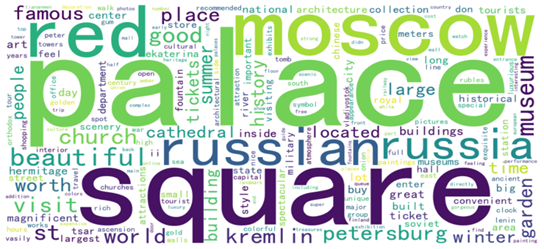
Through the word cloud in Figure 1, we can discern the weight of keywords. Spatially, comment focus is highly concentrated in the two core cities of Moscow and St. Petersburg. Landmark buildings such as palaces, squares, churches, the Kremlin, and the Winter Palace form the core geographic imagery, clearly outlining the spatial structure of classic tourist routes for Chinese visitors.
3.4 Semantic Network Diagram
Figure 2: Semantic Network Diagram
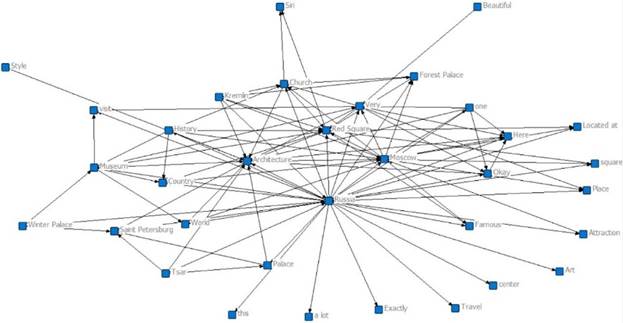
Based on the semantic network diagram in Figure 2: We observe that a network of related phenomena has been constructed and visualized around the two primary nodes "Moscow" and "Red Square," connected through intermediate nodes such as "architecture" and "history," illustrating their associative capabilities. First, the spatial dimension clarifies the geographic hierarchy from the national level (Russia) to core cities (Moscow, St. Petersburg) and specific attractions (The Winter Palace, Red Square), revealing the distribution structure of tourism resources and potential regional linkage pathways. On the cognitive and attribute dimension, labels such as "famous," "attraction," and "center" define the prominent characteristics and functional positioning of these resources within market perception. Finally, on the experiential activity dimension, related terms like "tourism" and "place" point to specific tourism practices and local consumption behaviors.
3.5 Coherence Score and Perplexity Score
Before we study the meaning carefully, this study used two gadgets-Coherence Score and Perplexity Score-to help us decide how many topics (that is, K-values) the LDA model should have. Theoretically, perplexity depends on whether a probability model can guess correctly: the lower its value (or the more negative it is), the more the model understands these data, and the less surprising it is when it guesses wrong. Generally speaking, the more topics, the more complex the model, and the lower the perplexity. However, the "super-accurate guess" in mathematics is often the opposite of whether we can under-stand the result. A model with a particularly low perplexity may produce too many small topics that are too detailed, resulting in a fragmented meaning (this is called overfitting). Therefore, in this study, we mainly choose those points with higher consistency scores in the range where perplexity obviously drops and re-mains stable, so that we can find a balance between accurate guessing and plausible meaning.
Figure 3: Coherence Score
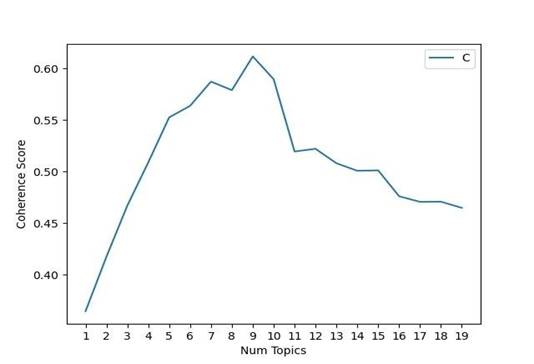
The coherence curve shows that semantic quality rises rapidly as the model moves from one topic to a mid-range solution and then becomes less stable at higher values. Although the global peak occurs at a larger topic number, six topics provide the most defensible balance between coherence, stability, and interpretability. For a strategy-oriented paper, a parsimonious and readable topic solution is preferable to an overly fragmented structure.
4. Empirical Results Analysis
4.1 Feature Analysis Based on LDA Topic Model
Unsupervised clustering analysis based on Latent Dirichlet Allocation (LDA) model shows that the text corpus has significant structural features in semantic dimension. Using the weight data of feature words in the collected data set, this model divides the review text into six potential themes (Themes 1–6), revealing a multi-dimensional picture of tourists' perception.
Figure 4: LDA Model Results
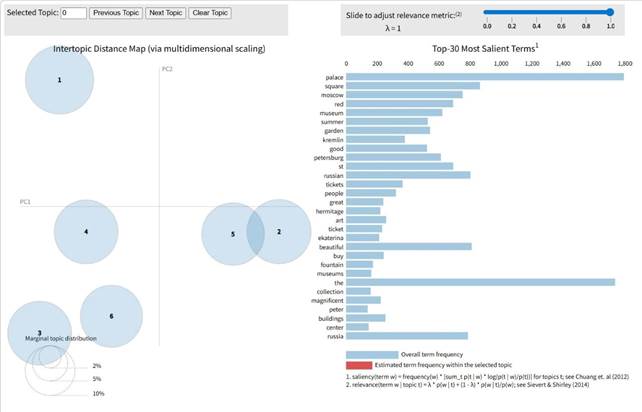
According to the results of LDA clustering, this study found six potential themes. By analyzing the high-frequency characteristic words and their semantic associations under each topic, we have made a deep interpretation of the connotation of each topic (see Table 8 for details).
Topic 1 concentrates on the symbolic core of Russian statehood. Red Square and the Kremlin form the center of gravity in many reviews, and the attraction of these sites lies not only in sightseeing but in proximity to geopolitical and historical meaning. Chinese tourists repeatedly frame these locations as the ‘heart’ of Russia. The experience is therefore highly symbolic, but it is also vulnerable to crowding and formalized visitor flows that reduce emotional intimacy.
Topic 2 captures the operational service layer of the tourism experience. Tourists discuss online booking, entrance procedures, station proximity, waiting times, and scanning-based access. The existence of this topic is strategically important because it shows that service convenience is not peripheral. It is a distinct experiential dimension that directly shapes the quality of destination evaluation.
Topics 3 and 6 correspond to the most strongly aestheticized environments. Peterhof, palace gardens, fountains, and coastal access evoke leisure, visual pleasure, and open-air grandeur, while palace interiors and the Amber Room trigger a more intense sense of luxury and amazement. In these topics, visual immersion and emotional uplift are the main drivers of positive assessment.
Topic 4 shifts attention to museum-based cultural capital. Here tourists describe Russia as an intellectual and civilizational destination through collections, paintings, masterpieces, and historical learning. Yet the museum experience is often moderated by time pressure, route complexity, and the practical limits of large-scale visitation.
Topic 5 functions as the corrective topic in the corpus. It captures the experiential costs of popularity: queues, crowding, fatigue, limited maneuverability, and reduced willingness to spend time at certain attractions. The existence of this topic demonstrates that iconicity alone does not ensure satisfaction. An attraction may be considered ‘worth it’ and still be remembered as inconvenient or exhausting.
Table 4: Topic categories and keywords identified by LDA model
|
Topic
Category
|
Keywords
|
|
Topic
1 Core Landmarks and Political Symbols (583)
|
Square
Moscow Red Square Kremlin Russian Church Buildings City Center Historical
|
|
Topic
2: Ticketing Services and Travel Convenience (515)
|
Tickets
Buy Convenient Entrance Line Station Recommended Time Hours Electronic
|
|
Topic
3 Royal Gardens and Summer Palace Scenery (509)
|
Palace
Garden Summer Palace Petersburg Fountain Peter the Great Royal Sea Area Great
|
|
Topic
4 Museums and Art Collections (509)
|
Museum
Hermitage Art Cathedral Winter Palace Collection History World Largest Visit
|
|
Topic
5: Visitor Density and Experience Cost (489)
|
People
Time Worth Lot Long Chinese Crowd Wait Queue Experience
|
|
Topic
6: Palace Architecture and Lavish Interiors (483)
|
Ekaterina
Interior Magnificent Exquisite Paintings Beautiful Luxury Large Style Design
|
4.2 Sentiment Analysis
LDA-Based Sentiment Analysis of Thematic Tendencies Building upon thematic clustering, this study further calculated the Sentiment Compound Score for comment texts under each theme to quantify variations in visitor satisfaction across different dimensions. Empirical results show that all themes exhibit positive sentiment averages ($>0.5$), indicating an overall positive experience toward Russia's core attractions. However, significant "Aesthetic-Functional Gaps" exist between themes, reflecting divergent sentiment intensities. The sentiment characteristics of each theme are analyzed as follows:
Theme 1 "Core Landmarks and Political Symbols" recorded the lowest average sentiment score of 0.588 among the six themes. Despite involving national symbols like the Kremlin, the frequent occurrence of "Neutral" sentiment tags (58.3%) lowered the overall average. Text analysis reveals that visitor evaluations of such landmarks primarily focus on objective historical descriptions and security check procedures, lacking strong personal emotional expression. This feeling of "respect and a little distance" is because those grand political stories make visitors feel particularly solemn.
Theme 2: The average emotional score of "ticketing services and travel privilege" is 0.613. In particular, this topic received the worst reviews, with a total of 12 articles. By analyzing the keywords, we found that the bad reviews mainly come from some "service troubles", such as the long queue for buying tickets, the troublesome process of changing tickets, and the unclear entrance signs. This shows that although this scenic spot itself is very interesting, the lack of basic service facilities is like the shortest board in the barrel, which directly lowers the overall experience of our tourists. As a tourist complained, "The Museum Herds Visitors Like Ducks. This is Russia's Worst Attribution for Service. You can only use (e-tickets) after entering, making the entry process extremely cumbersome."
Theme 3: The average emotional score of "Royal Gardens and Summer Palace Landscapes" is 0.655, which shows that everyone's feelings are quite high. This theme is mainly about the natural ecology and fountain scenery of Summer Palace. The natural environment itself makes people feel better. When tourists mentioned the words "the sea", "gardens" and "blue skies", they used more words to express their feelings, which showed that they had a relaxed and happy time there.
The average emotional score of theme 4 "Museums and Art Collections" is 0.616. Although there is a world-class art collection in Winter Palace, the emotional score of this theme is not the highest. We carefully read everyone's messages and found that it was actually because everyone felt "a little tired" and "particularly shocked" inside. The vast collection ("enough to last three days") delivers spiritual fulfillment yet simultaneously causes visitor fatigue and information overload, leading some reviews to express complex emotions of "exhaustion yet joy."
The average emotional score for Theme 5, "Visitor Density and Experience Cost," was 0.624. Despite directly addressing negative scenarios like "crowding" and "queuing," the score remained positive. This reveals an intriguing "value compensation mechanism"—while crowding diminishes comfort, the attraction's extraordinary core value (e.g., "one of the world's four great museums") leads visitors to perceive the wait as "Worth it."
Theme 6, "Palace Architecture and Lavish Interiors," achieved the highest average sentiment score of 0.702 among all themes. This theme corresponds to attractions renowned for Baroque style, such as the Catherine Palace. The extreme visual impact (Visual Shock) most readily triggers visitors' instant peak experiences (Peak Experience). Comments overflow with high-arousal positive terms like "staggering," "awe-inspiring," and "unparalleled." Visitors rave: "Stunningly magnificent—truly a masterpiece of craftsmanship. The towering columns reaching for the heavens and the celestial gold ornaments scattered like flowers leave visitors spellbound." Sentiment analysis for each theme is detailed in Table 5 below:
Table 5: Sentiment scores and feature analysis of each topic
|
Topic
Name
|
Average
Sentiment Score (Mean Score)
|
Primary
Sentiment Trend
|
Typical
Features
|
|
Topic
6 Palace Architecture
|
0.702
(Max)
|
Extremely
Positive
|
Visually
stunning, high-arousal vocabulary
|
|
Topic
3 Imperial Gardens
|
0.655
|
Positive
|
Natural
healing, relaxed and pleasant
|
|
Topic
5 Visitor Density
|
0.624
|
Mixed
|
Value
Compensation (Tiring but Worthwhile)
|
|
Topic
4 Museum Collection
|
0.616
|
Mixed
|
Aesthetic
Satisfaction vs Cognitive Fatigue
|
|
Topic
2 Ticketing Services
|
0.613
|
Neutral/Negative
|
Service
friction, concentrated pain points
|
|
Topic
1 Core Landmarks
|
0.588
(Min)
|
Neutral
|
Objective
description, historical solemnity
|
Based on the above analysis, the tourism images of the three cities can be compared according to several parameters (see Table 6).
Table 6: Comparative Analysis of Tourism Images for Three Cities
|
Indicator
|
Moscow
|
Saint
Petersburg
|
Vladivostok
|
|
Primary
Metaphor
|
Heart,
Power, Red
|
Window,
Art, Gold
|
Door,
Boundary, Blue
|
|
Primary
Emotions
|
Admiration,
Respect
|
Passion,
Aesthetic
|
Leisure,
nostalgia
|
|
Architectural
Symbols
|
Red
walls of the Kremlin, onion domes
|
Baroque
palaces, canals
|
Lighthouses,
train stations, glass beaches
|
|
Historical
periods
|
Primarily
the Soviet era, though also including Tsarist Russia
|
Imperial
Era (from Peter the Great to Nicholas II)
|
Far
Eastern history, World War II, modern history
|
|
Unforgettable
Experiences
|
Visiting
Lenin's Mausoleum and the Red Square Military Parade Ground
|
Visiting
museums and attending ballet performances
|
Savoring
Seafood, Gazing at the Sea, Feeding Pigeons
|
|
Challenges
for Tourists
|
Strict
security measures, traffic congestion
|
Long
ticket lines, tiring for the feet
|
Limited
attractions, outdated infrastructure
|
Further analysis shows that China tourists' attitude towards Russia has a special dual structure, which can be explained by Boim's classification of nostalgia. Boim analyzed many kinds of nostalgia, such as national nostalgia, diaspora nostalgia, exile nostalgia, literary nostalgia, personal nostalgia and so on. The first is "red nostalgia", which mainly focuses on things left over from the Soviet era, such as Lenin's Mausoleum, the Tomb of the Unknown Soldier, and C-56 submarine. This kind of emotion is particularly obvious among older tourists, who want to retrieve the memory symbols of their youth through travel-this is a psychological mechanism, trying to "restore" the idealized past in their hearts. The second form is "aesthetic revelation", which targets Russian imperial heritage sites such as Winter Palace, Summer Palace and Catherine Palace. Keywords such as "palace", "golden splendor" and "art" reflect the yearning and consumption of the emerging middle class in China for European classical and elegant culture, and represent the pursuit of "high cultural capital". These two nostalgic forms coexist and interweave in the Russian tourist space, which together shape the unique emotional experience structure of China tourists.
5. Discussion and Strategic Implications
5.1 The aesthetic–functional gap
The paper’s central substantive finding is the coexistence of strong symbolic admiration and persistent service friction. In many destinations, the most visually celebrated attractions are also the most operationally difficult: they require complicated ticketing procedures, generate long lines, and depend on dense visitor control. This pattern is not unique to Russia, but in the Russian case it is intensified by language asymmetry, limited digital localization, and the sheer symbolic centrality of certain attractions.
From a destination-management perspective, the problem is not a lack of attractiveness. The problem is incomplete conversion. Iconic assets successfully draw attention, but that attention is not always converted into smooth visitation, deeper satisfaction, or stronger downstream recommendation. The online review environment magnifies this issue because tourists publicly narrate both the wonder and the inconvenience of the same trip.
5.2 Segmenting the Chinese market
|
Segment
|
Core
motivation
|
Preferred
imagery
|
Suggested
product
|
Main
channels
|
|
Silver
generation (55+)
|
Soviet
memory, safety, guided interpretation
|
Red
history, commemorative sites, orderly touring
|
Moscow
memory route; curated red-tourism packages
|
Ctrip,
WeChat official accounts, travel agencies
|
|
Middle-class
families (35–50)
|
Education,
culture, comfort, value
|
Museums,
palaces, gardens, family-friendly convenience
|
Saint
Petersburg cultural package with timed entry
|
Ctrip,
Xiaohongshu, parent communities
|
|
Gen
Z and young professionals (18–34)
|
Aesthetic
check-ins, novelty, social sharing
|
Aurora,
Vladivostok coast, winter city walks, palace interiors
|
Short-break
visual itineraries; event-led city content
|
Douyin,
Xiaohongshu, Bilibili, influencer collaborations
|
Chinese tourists should not be treated as a single undifferentiated market. Older visitors may respond more strongly to historical memory, guided interpretation, and orderly package design. Family travelers often value comfort, educational content, and efficient route planning. Younger visitors are more responsive to visual novelty, short-form content, and flexible urban experiences that can be documented and shared online. These differences do not invalidate a national strategy, but they require differentiated message design, itinerary packaging, and digital channel choice.
The segmentation logic also clarifies why Vladivostok has become more attractive in the post-pandemic period. For younger and northeastern Chinese travelers, geographic proximity lowers the psychological and logistical threshold of outbound travel, while regional novelty generates social-media value.
5.3 Policy and marketing recommendations
1. First, destinations should develop an integrated Chinese-language digital service chain. This includes attraction information, e-ticketing, route planning, payment guidance, transport tips, emergency contact support, and city-level destination mini-programs or apps.
2. Second, queue management and timed-entry systems should be treated as marketing infrastructure rather than purely operational details. When waiting time dominates memory, attraction value is partially eroded before the tourist enters the site.
3. Third, front-line multilingual service matters. Chinese-language signage, service scripts, menu translation, and basic digital help desks can reduce uncertainty at key friction points without requiring full institutional overhauls.
4. Fourth, Russia should emphasize city-specific storytelling. Moscow should foreground memory, power, and history; Saint Petersburg should foreground imperial beauty, museums, and refined cultural experience; Vladivostok should foreground accessibility, regional adventure, and short-break convenience.
5. Finally, post-visit digital recirculation should be encouraged through official Chinese social-media matrices, campaign hashtags, cooperation with travel creators, and higher-quality visual assets that align with the strongest positive topics identified in the corpus.
6. Conclusion
Using Chinese online reviews of attractions in Moscow, Saint Petersburg, and Vladivostok, this paper demonstrates that Russian destination image in the Chinese market is structured by a durable combination of symbolic admiration and functional friction. Topic modeling identifies six recurrent themes that cluster around landmarks, ticketing, palace landscapes, museums, crowding, and interior magnificence. Sentiment analysis shows that the most positive emotional responses are generated by immersive aesthetics, while weaker evaluations are linked to iconic but operationally difficult sites.
The paper therefore argues that the central challenge for Russian destination managers is not demand generation alone, but experience conversion. The paper therefore argues that the central challenge for Russian destination managers is not demand generation alone, but the conversion of symbolic appeal into smooth visitor experience. Russia already possesses exceptionally strong heritage and visual resources; what it needs is more effective digital localization, better crowd and queue governance, stronger Chinese-language support, and more differentiated city branding. These changes would allow attractions to translate symbolic capital into more stable satisfaction and recommendation outcomes.
The study also has limitations. The study also has several limitations. Review data represent articulated online experience rather than the entire tourist population, and platform users are not necessarily representative of all Chinese visitors. LDA, as a bag-of-words approach, also abstracts from syntax and narrative sequence. Future studies may therefore integrate multimodal material such as images and short videos, compare multiple Chinese platforms, or trace temporal shifts in tourist sentiment as geopolitical conditions and mobility regimes evolve.
[1] The "tourist gaze", coined by British sociologist John Urry, refers to the phenomenon where tourists consume the scenery or culture of a tourist destination with preconceived cultural symbols, desires, and expectations; it is a socially constructed form of visual consumption. "Red tourism," formally proposed at the end of 2004, refers to tourism based on memorial sites related to the history of the Communist Party of China, including various revolutionary holy sites. "Nostalgia tourism" is a form of tourism that involves visiting places related to one's past experiences, collective memories, or specific historical periods to experience bygone eras, find emotional resonance, or relive old memories.
Источники:
2. In 2022, approximately 30,000 Chinese tourists visited Russia, an estimated figure during the pandemic\\\'s low point (based on year-on-year growth data for 2023 and 2024 provided by multiple Russian and Chinese media outlets). [Электронный ресурс]. URL: https://paper.people.com.cn/rmrb/html/2024- 07/08/nwD110000renmrb_20240708 (дата обращения: 10.06.2026).
3. 2023: 477,000 Chinese Tourists Visit Russia (1,490% Year-on-Year Increase) People\\\'s Daily. China and Russia Deepen Tourism Cooperation [N]. People\\\'s Daily, 2024-07-08(16). Retrieved from http://paper.people.com.cn/rmrb/html/2024-07/08/nw.D110000renmrb_20240708_2-16.htm In 2023, 477,000 Chinese citizens visited Russia (approximately +1490% year-on-year). People\\\'s Daily, 2024-07-08 (16). Retrieved from. [Электронный ресурс]. URL: http://paper.people.com.cn/rmrb/html/2024-07/08/nw.D110000renmrb_20240708_2-16.htm (дата обращения: 10.06.2026).
4. In 2024, approximately 1-1.3 million Chinese tourists visited Russia (a year-on-year increase of about +170%). Observer Network.Visa-free travel is not the end! Chinese tourists visiting Russia to exceed 2 million [EB/OL]. Tencent News, 2025-12-01. Retrieved from. [Электронный ресурс]. URL: https://news.qq.com/rain/a/20251202A05PL900) (дата обращения: 25.07.2026).
5. Northeast Border to Vladivostok Short-Distance Travel (Bus/Train) Harbin Travel Agency.Harbin Suifenhe to Vladivostok 4-Day Double Train Tour [EB/OL]. Russian Border Tour, 2024. Retrieved from. [Электронный ресурс]. URL: http://m.kaolawan.com/eluosibianjingyou/75.html Short-distance transportation (bus/train) (дата обращения: 10.07.2026).
6. In Q1 2025, 106,800 Chinese tourists visited Russia (an increase of approximately 8% year-on-year). Baonomin: Q1 tourist arrivals to Russia rose 4.9% year-on-year [EB/OL]. Xinhua Finance, May 15, 2025. Retrieved from. [Электронный ресурс]. URL: https://finance.sina.com.cn/money/bond/2025-05-15/doc-inewrcye0228606.shtml] (дата обращения: 17.07.2026).
7. 2025 Forecast: Over 2 Million Chinese Visitors to Russia (Approx. +54% YoY, Projected Value) Russian Ministry of Economic Development. Benefiting from Visa-Free Policy, Chinese Tourists Visiting Russia to Exceed 2 Million Next Year [EB/OL]. Observer Network, 2025-12-01. Retrieved from. [Электронный ресурс]. URL: https://news.qq.com/rain/a/20251202A05PL900 (дата обращения: 04.08.2026).
8. Global Times. (2015, September 8). Russia\\\'s \\\Red Tourism\\\» immerses Chinese seniors in nostalgia for the Soviet era. Ecns.cn. [Электронный ресурс]. URL: http://www.ecns.cn/2015/09-08/180233.shtml (дата обращения: 07.08.2026).
9. Slusariuc G. C. The Specificity and Development of Red Tourism // Revista de Turism-Studii si Cercetari in Turism. – 2023. – doi: 10.4316/rdt.35.111.
10. Crompton J. L. Motivations for pleasure vacation // Annals of tourism research. – 1979. – № 6. – p. 408-424. – doi: 10.1016/0160-7383(79)90004-5.
11. Russell J. A., Pratt G. Describing environmental affective quality // Journal of Personality and Social Psychology. – 1980. – № 3. – p. 311-322. – doi: 10.1037/0022-3514.38.2.311.
12. Echtner C. M., Ritchie J. R. B. The measurement of destination image: An empirical assessment // Journal of Travel Research. – 1993. – № 4. – p. 3-13. – doi: 10.1177/004728759303100402.
13. Gartner W. C. The image formation process // Journal of Travel & Tourism Marketing. – 1994. – № 2-3. – p. 191-215. – doi: 10.1300/J073v02n02_12.
14. Wang Z., Udomwong P., Fu, J., Onpium P. Destination image: A review from 2012 to 2023 // Cogent Social Sciences. – 2023. – № 9. – p. 2240569. – doi: 10.1080/23311886.2023.2240569.
15. Guo X., Pesonen J., Karamäki P. Comparing online travel review platforms as information agents for destination image: A Finnish case study // Information Technology & Tourism. – 2021. – № 2. – p. 159-187. – doi: 10.1007/s40558-021-00201-w.
16. Urry J. The tourist gaze revisited // American Journal of Behavioral Science. – 1992. – № 2. – p. 172-186. – doi: 10.1177/0002764292036002005.
17. Pomering A. A review of: \\\'The Tourist Gaze 3.0\\\'. - John Urry & Jonas Larsen London, Sage Publications Ltd, 2011. – 282 p.
18. Larsen, J. (2014). The tourist gaze 1.0, 2.0, and 3.0. In A. A. Lew, C. M. Hall, & A. M. Williams (Eds.), The Wiley Blackwell companion to tourism (pp. 304-315). Wiley Blackwell.
19. Maoz D. The mutual gaze // Tourism Research Annual. – 2006. – № 1. – p. 221-239. – doi: 10.1016/j.annals.2005.10.010.
20. Moufakkir O. The stigmatized tourist // Annual Review of Tourism Studies. – 2015. – p. 17-30. – doi: 10.1016/j.annals.2015.04.004.
21. Moufakkir, O., & Reisinger, Y. (Eds.). (2013). The host gaze in global tourism. CABI.
22. Pearce P. L., Wu M. Y., Osmond A. Understanding the Confusion in Chinese Tourist Behavior: Towards a Triple-C Gaze // Tourism Recreation Research. – 2013. – № 2. – p. 145-157. – doi: 10.1080/02508281.2013.11081741.
23. Zheng Y., Wei W., Zhang L., Ying T. The tourist gaze on Chinese classical gardens: Manifestations of tourism aesthetics (I Ching) // Journal of Hospitality and Tourism Research. – 2024. – № 2. – p. 353-379.
24. Shakeela A., Weaver D. Exploratory social-mediated gazing: Virtual tourists\\\' responses to provocative events on YouTube // Journal of Tourism Studies. – 2016. – № 6. – p. 692-705. – doi: 10.1177/0047287514532369.
25. Gao X., Astratova G. V. Information acquisition and decision-making in the digital age: Chinese tourists\\\' travel experiences at Lake Baikal // Communication Studies. – 2024. – № 3. – p. 554-566. – doi: 10.24147/2413-6182.2024.11(3).554-566.
26. Halbwachs M. (1992). On collective memory (L. A. Coser, Ed. & Trans.). [Электронный ресурс]. URL: https://books.google.com.hk/books?hl=zhCN&lr=&id=ejfnDwAAQBAJ&oi=fnd&pg=PP8&dq=25 (дата обращения: 07.08.2026).
27. Halbwachs M. The collective memory (F. J. Ditter Jr. & V. Y. Ditter, Trans.). - Harper & Row, 1980.
28. Zhou Z., Gao H. Research on the Foundational Theory of Red Tourism. - Beijing, 2008.
29. Light D. An unwanted past: Contemporary tourism and Romania\\\'s communist heritage // International Journal of Heritage Studies. – 2000. – № 6. – p. 145-160. – doi: 10.1080/135272500404197.
30. Light D. Gazing on communism: Heritage tourism and post-communist identities in Germany, Hungary and Romania // Tourism Geographies. – 2000. – № 2. – p. 157-176. – doi: 10.1080/14616680050027879.
31. Light, D., Young, C., & Czepczyński, M. (2009). Heritage tourism in Central and Eastern Europe. In D. J. Timothy & G. P. Nyaupane (Eds.), Cultural Heritage and tourism in the developing world: A regional perspective (pp. 224-245). Routledge. https://www.taylorfrancis.com/books/mono/10.4324/9780203877753/cultural-heritage-tourism-developing-world?refId=759e3f50-93d8-4404-849b-0e71b148ad17&context=ubx URL: https://www.taylorfrancis.com/books/mono/10.4324/9780203877753/cultural-heritage-tourism-developing-world?refId=759e3f50-93d8-4404-849b-0e71b148ad17&context=ubx.
32. Chi O. H., Chi C. G. Reminiscing other people\\\'s memories // Journal of Tourism Studies. – 2022. – № 1. – p. 33-49. – doi: 10.1177/0047287520969904.
Страница обновлена: 17.10.2026 в 12:03:39
Download PDF | Downloads: 8
Разработка маркетинговых стратегий для повышения привлечения и удержания китайских туристов: анализ реальных отзывов и предложения для российских туристических агентств и органов управления
Li T., Xu W., Zhang D.Journal paper
Marketing and marketing research
Volume 31, Number 3 (July-september 2026)
Abstract:
The rapid return of tourists from China to Russia has brought a key challenge: how to solve the structural deficiency of digital marketing and service infrastructure while the number of tourists has soared. Therefore, it is very important to solve the complex cognitive model and experience dimension of China tourists in order to transform high traffic into sustainable economic value. This paper proposes a strategic marketing framework based on big data text mining to deal with these structural bottlenecks. This paper uses Python to capture massive comments from Ctrip, and uses LDA theme modeling and emotional analysis to deconstruct tourists' experiences in Moscow, St. Petersburg and Vladivostok. The results reveal the dual psychological structure of "Red Nostalgia" and "Aesthetic Worship", which shows a significant gap between high aesthetic satisfaction and low functional service experience. Therefore, it is suggested to adopt strategies such as digital ecosystem integration, intergenerational segmentation and service optimization to enhance the competitiveness of the industry
Keywords: Chinese Tourists to Russia; Tourist Experience; Big Data Text Mining; LDA Topic Model; Marketing Strategy
JEL-classification: L83, M31, Z32, C80, F14
References:
2023: 477,000 Chinese Tourists Visit Russia (1,490% Year-on-Year Increase) People\\\'s Daily. China and Russia Deepen Tourism Cooperation [N]. People\\\'s Daily, 2024-07-08(16). Retrieved from http://paper.people.com.cn/rmrb/html/2024-07/08/nw.D110000renmrb_20240708_2-16.htm In 2023, 477,000 Chinese citizens visited Russia (approximately +1490% year-on-year)People\\\'s Daily, 2024-07-08 (16). Retrieved from. Retrieved June 10, 2026, from http://paper.people.com.cn/rmrb/html/2024-07/08/nw.D110000renmrb_20240708_2-16.htm
2025 Forecast: Over 2 Million Chinese Visitors to Russia (Approx. +54% YoY, Projected Value) Russian Ministry of Economic Development. Benefiting from Visa-Free Policy, Chinese Tourists Visiting Russia to Exceed 2 Million Next Year [EB/OL]Observer Network, 2025-12-01. Retrieved from. Retrieved August 04, 2026, from https://news.qq.com/rain/a/20251202A05PL900
Astratova G. V., Mikhailova N. S., Porotnikov P. A., Danilova E. V. (2020). On the Economic Effects of the COVID-19 Crisis Bulletin of the Academy of Economics and Law. (6-2). 183-192. doi: 10.17513/vaael.1181.
Chi O. H., Chi C. G. (2022). Reminiscing other people\\\'s memories Journal of Tourism Studies. 61 (1). 33-49. doi: 10.1177/0047287520969904.
Crompton J. L. (1979). Motivations for pleasure vacation Annals of tourism research. (6). 408-424. doi: 10.1016/0160-7383(79)90004-5.
Echtner C. M., Ritchie J. R. B. (1993). The measurement of destination image: An empirical assessment Journal of Travel Research. 31 (4). 3-13. doi: 10.1177/004728759303100402.
Gao X., Astratova G. V. (2024). Information acquisition and decision-making in the digital age: Chinese tourists\\\' travel experiences at Lake Baikal Communication Studies. 11 (3). 554-566. doi: 10.24147/2413-6182.2024.11(3).554-566.
Gartner W. C. (1994). The image formation process Journal of Travel & Tourism Marketing. 2 (2-3). 191-215. doi: 10.1300/J073v02n02_12.
Global Times. (2015, September 8). Russia\\\'s \\\Red Tourism\\\» immerses Chinese seniors in nostalgia for the Soviet eraEcns.cn.. Retrieved August 07, 2026, from http://www.ecns.cn/2015/09-08/180233.shtml
Guo X., Pesonen J., Karamäki P. (2021). Comparing online travel review platforms as information agents for destination image: A Finnish case study Information Technology & Tourism. 23 (2). 159-187. doi: 10.1007/s40558-021-00201-w.
Halbwachs M. (1980). The collective memory (F. J. Ditter Jr. & V. Y. Ditter, Trans.)
Halbwachs M. (1992). On collective memory (L. A. Coser, Ed. & Trans.). Retrieved August 07, 2026, from https://books.google.com.hk/books?hl=zhCN&lr=&id=ejfnDwAAQBAJ&oi=fnd&pg=PP8&dq=25
In 2022, approximately 30,000 Chinese tourists visited Russia, an estimated figure during the pandemic\\\'s low point (based on year-on-year growth data for 2023 and 2024 provided by multiple Russian and Chinese media outlets). Retrieved June 10, 2026, from https://paper.people.com.cn/rmrb/html/2024- 07/08/nwD110000renmrb_20240708
In 2024, approximately 1-1.3 million Chinese tourists visited Russia (a year-on-year increase of about +170%). Observer Network.Visa-free travel is not the end! Chinese tourists visiting Russia to exceed 2 million [EB/OL]Tencent News, 2025-12-01. Retrieved from. Retrieved July 25, 2026, from https://news.qq.com/rain/a/20251202A05PL900)
In Q1 2025, 106,800 Chinese tourists visited Russia (an increase of approximately 8% year-on-year). Baonomin: Q1 tourist arrivals to Russia rose 4.9% year-on-year [EB/OL]Xinhua Finance, May 15, 2025. Retrieved from. Retrieved July 17, 2026, from https://finance.sina.com.cn/money/bond/2025-05-15/doc-inewrcye0228606.shtml]
Larsen, J. (2014). The tourist gaze 1.0, 2.0, and 3.0. In A. A. Lew, C. M. Hall, & A. M. Williams (Eds.), The Wiley Blackwell companion to tourism (pp. 304-315). Wiley Blackwell.
Light D. (2000). An unwanted past: Contemporary tourism and Romania\\\'s communist heritage International Journal of Heritage Studies. (6). 145-160. doi: 10.1080/135272500404197.
Light D. (2000). Gazing on communism: Heritage tourism and post-communist identities in Germany, Hungary and Romania Tourism Geographies. (2). 157-176. doi: 10.1080/14616680050027879.
Light, D., Young, C., & Czepczyński, M. (2009). Heritage tourism in Central and Eastern Europe. In D. J. Timothy & G. P. Nyaupane (Eds.), Cultural Heritage and tourism in the developing world: A regional perspective (pp. 224-245). Routledge. https://www.taylorfrancis.com/books/mono/10.4324/9780203877753/cultural-heritage-tourism-developing-world?refId=759e3f50-93d8-4404-849b-0e71b148ad17&context=ubx
Maoz D. (2006). The mutual gaze Tourism Research Annual. 33 (1). 221-239. doi: 10.1016/j.annals.2005.10.010.
Moufakkir O. (2015). The stigmatized tourist Annual Review of Tourism Studies. 53 17-30. doi: 10.1016/j.annals.2015.04.004.
Moufakkir, O., & Reisinger, Y. (Eds.). (2013). The host gaze in global tourism. CABI.
Northeast Border to Vladivostok Short-Distance Travel (Bus/Train) Harbin Travel Agency.Harbin Suifenhe to Vladivostok 4-Day Double Train Tour [EB/OL]Russian Border Tour, 2024. Retrieved from. Retrieved July 10, 2026, from http://m.kaolawan.com/eluosibianjingyou/75.html Short-distance transportation (bus/train)
Pearce P. L., Wu M. Y., Osmond A. (2013). Understanding the Confusion in Chinese Tourist Behavior: Towards a Triple-C Gaze Tourism Recreation Research. 38 (2). 145-157. doi: 10.1080/02508281.2013.11081741.
Pomering A. (2011). A review of: \\\'The Tourist Gaze 3.0\\\'
Russell J. A., Pratt G. (1980). Describing environmental affective quality Journal of Personality and Social Psychology. 38 (3). 311-322. doi: 10.1037/0022-3514.38.2.311.
Shakeela A., Weaver D. (2016). Exploratory social-mediated gazing: Virtual tourists\\\' responses to provocative events on YouTube Journal of Tourism Studies. 54 (6). 692-705. doi: 10.1177/0047287514532369.
Slusariuc G. C. (2023). The Specificity and Development of Red Tourism Revista de Turism-Studii si Cercetari in Turism. 35 doi: 10.4316/rdt.35.111.
Urry J. (1992). The tourist gaze revisited American Journal of Behavioral Science. 36 (2). 172-186. doi: 10.1177/0002764292036002005.
Wang Z., Udomwong P., Fu, J., Onpium P. (2023). Destination image: A review from 2012 to 2023 Cogent Social Sciences. (9). 2240569. doi: 10.1080/23311886.2023.2240569.
Zheng Y., Wei W., Zhang L., Ying T. (2024). The tourist gaze on Chinese classical gardens: Manifestations of tourism aesthetics (I Ching) Journal of Hospitality and Tourism Research. 48 (2). 353-379.
Zhou Z., Gao H. (2008). Research on the Foundational Theory of Red Tourism