Team leadership in the post-merger integration of high-tech firms: a conceptual model for preserving innovation potential
Ostapenko I.A.1,2 
1 Российская академия народного хозяйства и государственной службы при Президенте Российской Федерации (РАНХиГС), Москва, Россия
2 Министерство экономического развития Российской Федерации, Москва, Россия
Скачать PDF | Загрузок: 4
Статья в журнале
Лидерство и менеджмент (РИНЦ, ВАК)
опубликовать статью | оформить подписку
Том 13, Номер 8 (Август 2026)
Эта статья проиндексирована РИНЦ, см. https://elibrary.ru/item.asp?id=92029573 [92029573]
Аннотация:
Приобретения высокотехнологичных компаний могут ослаблять организационный фундамент, на котором строится будущая инновационная деятельность. В статье рассматривается, каким образом командное лидерство способно содействовать сохранению инновационного потенциала в ходе интеграции после слияния. Концептуальная модель разработана на основе интегративного обзора исследований в области менеджмента, командной работы, управления знаниями и корпоративных приобретений. Модель предполагает, что лидерство, поддерживающее участие членов команды в обсуждениях и решениях, положительно связано с командной рефлексивностью, а рефлексивная оценка помогает интеграционным командам выявлять значимые различия в экспертизе, интерпретациях, приоритетах, взаимозависимостях и интересах. Диагностика границ знаний затем направляет их интеграцию посредством механизмов, соответствующих характеру выявленной проблемы, выходя за рамки простой передачи знаний. Сохранение трактуется как непрерывная жизнеспособность и функциональная пригодность организационной системы, поддерживающей будущие инновации, в отличие от текущей инновационной результативности. Этот путь обусловлен избирательной автономией приобретаемой компании, а также дистанцией, комплементарностью и согласованностью объединяемых знаний; темп и последовательность изменений в отдельных измерениях интеграции выступают сквозными временными характеристиками. Статья предлагает многоуровневое объяснение сохранения инновационного потенциала после слияния и основу для интеграционных решений, не разрушающих способности приобретаемой компании
Ключевые слова: командное лидерство, командная рефлексивность, интеграция знаний, постслияционная интеграция, инновационный потенциал, высокотехнологичные компании, автономия приобретаемой компании, комплементарность знаний
JEL-классификация: D83, G34, M12, O31, O32
1. Introduction
High-tech acquisitions transfer ownership, but ownership alone does not secure the knowledge system that made the target innovative. That system resides in inventors and technical specialists and is sustained through routines, collaboration ties, and project histories. Studies report acquisition-associated inventor exit, inactivity, and productivity disruption, including among employees who remain [44; 33; 35; 27]. The central question is therefore whether post-merger integration (PMI) leaves the acquired knowledge base viable for future innovation. The question extends beyond mature markets: in the BRICS economies (Brazil, Russia, India, China, South Africa), acquisitions on average reduce the combined financial performance of the firms involved, while target-side outcomes remain understudied [43, pp. 29, 40].
No single conventional indicator answers that question. Research and development (R&D) intensity records resource commitment, patents and products record selected outputs, inventor productivity captures one manifestation, and retention shows employment continuity. None establishes whether specialized knowledge, technological assets, routines, relationships, and projects remain usable and recombinable. Reviews of innovation capability likewise reveal persistent mixing of inputs, processes, capabilities, and performance [30, pp. 707–727; 18]. Preservation of innovation potential must therefore be treated as a multidimensional organizational condition.
Relevant explanations are distributed across literatures and levels. Graebner, Heimeriks, Huy and Vaara [21] review integration design, autonomy, timing, and capability transfer; Morgeson, DeRue and Karam [31, pp. 5–12] describe team leadership as the satisfaction of critical team needs; Schippers, Den Hartog and Koopman [39, pp. 190–205] examine deliberate collective evaluation; Grant [22, pp. 109–119] and Carlile [10, pp. 555–567] distinguish coordination, transfer, interpretation, and transformation; and acquisition studies trace changes in inventors, trajectories, and outputs [15; 30].
Within the reviewed corpus, no study tests the complete sequence or the reflexivity-to-integration and integration-to-preservation transitions. The article therefore treats these links as bounded conceptual inferences supported by adjacent mechanisms and loss evidence.
The article asks: How does team leadership contribute to preserving the innovation potential of high-tech firms during post-merger integration through team reflexivity and knowledge integration? The purpose of the article is to develop such a conceptual model. The scientific novelty lies in a cross-level synthesis that connects functional team leadership, team reflexivity, and knowledge-boundary theory into a single explanatory pathway for post-merger innovation preservation, and in treating preservation as a multidimensional organizational condition instead of a single output metric. The author’s hypothesis is that team leadership contributes to preservation indirectly: participation-supportive leadership supports team reflexivity; reflexivity enables diagnosis of cross-boundary knowledge differences; and diagnosis-matched integration mechanisms combine complementary knowledge without dismantling the acquired firm’s innovation-enabling configuration. The model is multilevel, temporal, and conditional; the complete chain remains to be tested empirically.
The synthesis treats PMI as selective and temporally differentiated; applies a functional, multisource view of team leadership; positions reflexivity as regulation for boundary diagnosis; distinguishes knowledge integration from transfer; and defines preservation as the viability of an innovation-enabling resource base. The concept-centric review separates findings, review evidence, indirect support, and author-developed synthesis [26; 42].
2. Review Methodology
A model-oriented conceptual design based on an integrative literature review fits a question that spans heterogeneous literatures and levels. The aim is theory synthesis and construct clarification; the review does not attempt to estimate a common effect. Integrative review supports theory building across differently conceptualized domains, whereas a systematic review would require a separate reproducible search and screening protocol [41, pp. 333–339; 42, pp. 404–428]. The corpus makes no claim to exhaustive coverage.
The working corpus contained methodological and substantive scholarly records across seven evidence streams. Sources were retained when a verifiable full text made a direct definitional, mechanistic, boundary-condition, or outcome contribution to at least one focal block of the model. Forty-eight sources perform direct functions in the final manuscript and appear in the reference list; a separate fifty-four-item practitioner and teaching-case corpus supplied neither construct definitions nor proposition evidence.
Each full text was coded for design, sample, level, measures, findings, limitations, and permissible claim strength. Concept-centric matrices compared definitions, mechanisms, boundaries, and adjacent constructs [46, pp. xiii–xxiii]. Evidence was classified as direct empirical, review or meta-analytic, indirect theoretical, or author-developed synthesis.
Cross-stream comparison produced the model. Evaluation rests on theory-contribution criteria extended here to conceptual synthesis: traceability, construct clarity, coherence, parsimony, and explicit contextual and temporal boundaries [47, pp. 490–495; 42, pp. 404–428].
3. High-Tech Post-Merger Integration and the Innovation-Preservation Problem
Post-merger integration (PMI) is used as an umbrella for integration following mergers and control acquisitions; most reviewed settings concern acquisitions. High-tech firms are treated contextually as technology and research-intensive organizations whose future innovation depends materially on specialized scientific or engineering knowledge. PMI is a dynamic process in which selected components of the two organizations are coordinated, combined, reconfigured, or kept distinct over time. Acquisition purpose and interdependence shape the connections required and capabilities protected [24; 34]. Structural, task, human, and knowledge integration each follow their own logic [7, pp. 395–400; 24, pp. 3–17, 105–188; 34, pp. 803–836]. Here, PMI supplies the surrounding context, not a separate causal link.
Integration dimensions operate on different clocks. Administrative changes may be rapid, whereas mutual understanding, relational acceptance, tacit-knowledge access, and research coordination require repeated interaction. Longitudinal evidence shows that task and human integration can follow different trajectories and that early arrangements may be revised [7, pp. 395–422]. Survey evidence provides little support for a universal first-one-hundred-days rule [6, pp. 418–429]. The issue is which dimension changes, in what sequence, and with what opportunity for reconsideration.
This distinction matters because high-tech acquisitions involve knowledge embedded in people and relationships. Valuation evidence concurs: signals rooted in the human capital of founders and key specialists shape the value of European high-tech startups at acquisition [38, pp. 822, 826–828]. Studies of biotechnology, pharmaceuticals, semiconductors, and other knowledge-intensive sectors document inventor departure, inactivity, collaboration disruption, and reduced innovative output [44, pp. 7–11; 33, pp. 13–20; 35, pp. 545–562; 27, pp. 1133–1155]. Input-side evidence concurs: in the European innovation and technology sector, target firms’ R&D spending and intensity decline in the post-merger period [37, pp. 12–16]. These context-bound findings do not imply inevitable decline; they identify ways integration can disturb the configuration supporting future innovation.
Neither complete separation nor indiscriminate absorption resolves the problem. Separation can block reciprocal learning; absorption can weaken routines, professional ties, and local decision practices. Colman's cases show target managers protecting cohesion and capabilities while interaction expanded as relationships developed [17, pp. 148–160]. Rich communication, retention, reciprocal engagement, and autonomy can coexist [14; 36, pp. 420–441]. These studies speak more directly to capability transfer and contact than to the focal construct itself, but they show why coordination and preservation must be considered together.
Relevant information is distributed across executives, operating managers, and technical specialists. PMI research highlights participation, gatekeeping, interface management, operating-manager involvement, and revision of initial expectations [7, pp. 395–422; 24, pp. 105–188]; broader M&A value-creation challenges are also documented [25, pp. 71–113]. Although these studies do not measure team leadership or reflexivity, they motivate an integration-team mechanism for participation, reconsideration, and differentiated boundary work.
4. Team Leadership and Team Reflexivity in the Integration Team
Team leadership is the functional system through which critical team needs are diagnosed and satisfied. Its functions are supplied by formal or informal actors inside or outside the team, rather than by one designated executive [31, pp. 8–10; 48, pp. 453–477]. In integration teams, relevant functions include direction setting, sensemaking, feedback, boundary management, challenge, problem diagnosis, resource provision, and support for constructive interaction [31, pp. 14–28].
Leadership source and functional adequacy are distinct. Shared leadership concerns distributed influence [11; 19; 45]; coaching is a bounded intervention [23]; hierarchy is a structural condition [31]. Each may shape leadership functions without being equivalent to Team Leadership. A formally led team may display shared influence, while a distributed team may still leave critical needs unmet.
Proposition 1 concerns the participation-supportive expression of the broader Team Leadership system. Integration work depends on access to distributed expertise and on members' willingness to question initial assumptions. Leadership can invite contributions, legitimize dissent, and structure discussion; in the proposed context, these practices help prevent formal rank from displacing technically relevant contributions. Other leadership functions may remain important for integration-team effectiveness, but they fall outside the evidence-based first link of the pathway [29, pp. 6–12; 31, pp. 18–25; 9, pp. 289–303].
At the team level, reflexivity unfolds as an overt, deliberate regulatory process: members jointly seek and evaluate information about goals, strategies, processes, and outcomes, formulate revisions, and, when the full cycle is realized, enact adaptation across recurring performance episodes [39, pp. 190–205; 40, pp. 731–748; 28]. Reflection is the core observable activity; planning connects evaluation with later adaptation.
Reflexivity differs from psychological safety, broad team learning, feedback seeking, debriefing, sensemaking, and adaptation. Psychological safety concerns interpersonal risk and can enable candid participation; feedback provides information; debriefing is an intervention setting; and adaptation is a downstream phase. Reflexivity is the collective evaluation and revision process linking these inputs to changed action [20, pp. 350–369; 39, pp. 190–205; 40, pp. 731–757; 28]. The meta-analysis underlying Proposition 1 treats reflexivity as equivalent to Edmondson's broader team-learning construct [29, p. 3]; this article narrows the boundary to the evaluative core to isolate the leadership-to-diagnosis mechanism; the broader construct remains a plausible alternative. Table 1 consolidates the boundaries.
Table 1.
Central Construct Boundaries, Levels, and Evidence Status
|
Construct
|
Bounded meaning and primary level
|
Main exclusions and evidence status
|
|
Post-merger
integration
|
Dynamic,
selective context and process at acquisition and organizational levels.
|
Not structural integration or a single
end state. Author-developed synthesis grounded in post-merger research.
|
|
Team leadership
|
Functional
system for diagnosing and satisfying critical integration-team needs.
|
Not a formal leader, shared leadership,
hierarchy, or a behavior list. Review and theoretical foundation; acquisition
application is author-developed.
|
|
Team
reflexivity
|
Overt,
deliberate regulatory process at the integration-team level.
|
Not psychological safety, broad team
learning, a meeting, or adaptation alone. Empirical, review, and theoretical
support; integrated definition is author-developed.
|
|
Cross-boundary
knowledge integration
|
Process that
makes specialized knowledge jointly usable across team and organizational
interfaces.
|
Not information sharing, transfer,
absorptive capacity, or organizational capability. Group evidence and theory
support an author-developed acquisition formulation.
|
|
Preservation of
innovation potential
|
Continued
viability and usability of an innovation-enabling configuration at
acquired-unit, research-system, or combined-organization level.
|
Not R&D intensity, patents, current
performance, retention alone, or stasis. Author-developed construct with
indirect review and acquisition support.
|
Meta-analytic evidence reports a positive association between participation-supportive leadership and team reflexivity and identifies psychological safety as one partial pathway [29, pp. 10–12]. Predominantly nonexperimental studies and heterogeneous measures prevent causal inference. Reflexivity is noted to consume time and energy, with benefits stronger in larger, longer-tenured teams, so the model treats it as selectively deployed [29, pp. 1, 4]. Psychological safety functions as an enabling condition, not a necessary or exclusive mediator.
Proposition 1. Team leadership that supports members' active participation in team discussions and decisions will be positively related to team reflexivity.
Russian-language work offers context on participation, autonomy, constructive disagreement, and leader enablement but does not test the focal relationship [1, pp. 93–103; 2, pp. 1861–1882; 3, pp. 2033–2046; 4, pp. 2047–2070].
Reflexive evaluation exposes cross-boundary differences in meanings, assumptions, goals, priorities, and dependencies, but exposure does not resolve them. No source directly tests a reflexivity-to-knowledge-integration effect; the diagnostic bridge below combines reflexive information processing with knowledge-boundary theory [40, pp. 731–748; 28; 22, pp. 115–119; 32, pp. 371, 375–380].
Proposition 2. Team reflexivity supports the integration team in surfacing and evaluating differences in domain-specific knowledge, meanings, assumptions, goals, and task priorities across organizational boundaries.
5. From Boundary Diagnosis to Cross-Boundary Knowledge Integration
Through knowledge integration, specialized contributions become jointly usable for a task or decision. The process may involve access to knowledge holders, coordination, interpretation, combination, and, where necessary, transformation of knowledge and practice [22, pp. 109–120; 32, pp. 370–383; 10, pp. 555–568]. It is distinct from its immediate output and from a repeatable organizational capability built through repeated episodes.
Disclosure, information sharing, and one-way transfer may support integration without establishing it. Received information can remain misunderstood, disconnected from dependencies, or unused. Acquisition studies often measure communication, transfer, or capability use instead of the focal process itself [8, pp. 444–457; 36, pp. 420–441]. More communication can therefore coexist with unresolved meaning, interest, and coordination problems.
Integration does not require every specialist to learn everything known by others. Firm-level theory emphasizes coordinated application of specialized knowledge, while group research shows that structured interventions can help members identify expertise, question assumptions, and combine contributions [22, pp. 114–119; 32, pp. 371, 375–380]. An episode may occur at an interface even when participants and consequences span teams and organizations.
In the integration team, boundary diagnosis functions as an explicit classification of the principal obstacle to joint knowledge use—unresolved dependencies, divergent meanings, or conflicting interests—together with identification of the knowledge holders and interfaces involved. Drawing on knowledge-boundary theory and coordination research, the mechanism also assesses the tacitness and social embeddedness of relevant knowledge [10, pp. 555–560; 22, pp. 114–119; 32, pp. 371, 375–380]. It connects reflexive evaluation with the selection of a knowledge-integration response instead of standing as a fifth focal construct. Table 2 summarizes this logic.
Which mechanism applies depends on the situation; none is universal. Coordination and selective transfer may suffice where actors share a stable lexicon and understand relevant dependencies; semantic differences require translation; pragmatic differences require negotiated transformation because interests and the costs of change diverge. Communication frequency alone does not show that the required boundary work occurred [10, pp. 555–567; 22, pp. 114–119]; transformation here is distinct from the similarly named absorptive-capacity process.
Table 2
Knowledge-Boundary Types and Integration Mechanisms
|
Boundary type
|
Diagnostic
signs
|
Primary
mechanism
|
Risk if
misdiagnosed
|
|
Syntactic
|
Shared lexicon;
known dependencies
|
Coordination,
rules, sequencing, selective transfer
|
Unnecessary
translation or overintegration
|
|
Semantic
|
Different
interpretations of terms, measures, technologies, or priorities
|
Translation and
development of workable shared meanings
|
Apparent
agreement without common understanding
|
|
Pragmatic
|
Divergent
interests; material costs of changing knowledge or practice
|
Negotiated
transformation of knowledge, roles, or arrangements
|
Resistance,
imposed solutions, or loss of knowledge holders
|
Proposition 3. Cross-boundary knowledge integration is more likely when identified differences are translated into workable shared meanings and, where interests diverge, addressed through negotiated knowledge transformation, rather than managed through knowledge transfer alone. Acquisition evidence on rich communication, reciprocal transfer, mixed representation, and joint technical work provides context but does not directly test the proposition [7, pp. 395–422; 8, pp. 444–457; 14; 36, pp. 420–441].
6. Preserving Innovation Potential
Innovation studies often mix inputs, capabilities, and performance. R&D spending indicates commitment, patenting records output, and sales measures capture commercialization. Because innovation capability is multidimensional and inconsistently operationalized [30, pp. 707–727; 18], the focal outcome cannot be inferred from one metric or a short observation window.
Preservation of innovation potential is defined here as the continued viability and usability, through post-acquisition change, of an innovation-enabling configuration comprising specialized people and knowledge, R&D competencies and projects, technological and intellectual-property assets, organizational routines, and the capacity to recombine knowledge. This definition combines elements from the preservation and innovation-capability corpora; no single source specifies it directly.
Preservation allows organizational change. Reporting lines may shift, technologies be combined, specialists redeployed, and routines revised without eroding innovation potential. Conversely, stable headcount or continued patenting can coexist with erosion when expertise becomes inaccessible or projects lose enabling conditions. Inputs and outputs only partially manifest the underlying condition; they are not equivalent to it [30, pp. 713–727; 14; 17, pp. 148–160].
Erosion can follow connected human and organizational channels. Inventor departure removes expertise and relationships; inactivity and productivity decline indicate disruption among those who remain; reassignment can weaken technical-core roles; and lost collaboration can reduce the usability of distributed knowledge [27; 35]. Despite variation by sector, design, and observation window, the common implication is that preservation concerns the configuration through which knowledge is applied.
Selective cross-firm interaction provides a possible positive bridge. Inventor commingling can expose acquired specialists to acquirer knowledge while preserving access to the target's base, and relatedness and complementarity can expand recombination opportunities [14; 5, pp. 197–217; 16, pp. 642–651]. Because these studies use patent or innovation outcomes and do not measure the full knowledge-integration process, they support a bounded mechanism, not a general rule favoring more contact or structural integration.
Autonomy and knowledge configuration condition this mechanism. Retained decision rights and distinctiveness may protect routines, cohesion, and tacit knowledge, while excessive separation can obstruct access and coordination [17, pp. 148–160; 36, pp. 420–441]. Knowledge distance can increase novelty and interpretation costs; complementarity and person-firm alignment shape whether differences are usable [13, pp. 1–15; 12]. Dimension-specific pacing is a temporal qualifier, not a monotonic moderator.
Proposition 4. Selective cross-boundary knowledge integration preserves innovation potential when complementary knowledge is combined without disrupting the acquired firm's specialized human capital, organizational routines, and knowledge relationships. Selective autonomy and the broader knowledge configuration are treated as conditions on this relationship in Section 7. No study tests this proposition directly; it is inferred here from loss-channel evidence and boundary conditions. It implies an observable contrast: diagnosis-matched integration should retain more critical knowledge holders and collaboration ties than undifferentiated absorption [17; 35].
7. Integrated Conceptual Model and Boundary Conditions
The model places four focal constructs inside PMI. Team leadership organizes participation; reflexivity regulates collective evaluation; as an intermediate mechanism, boundary diagnosis classifies the relevant cross-organizational obstacle; knowledge integration makes selected contributions jointly usable; and preservation concerns the continued viability of the innovation-enabling configuration.
Team leadership and reflexivity operate mainly within the integration team; boundary work involves managers, specialists, and interorganizational interfaces. Repeated decisions about access, interpretation, combination, and transformation influence whether innovation-enabling resources remain usable at acquired-unit level. This is conceptual accumulation, not automatic aggregation or a claim that one team determines firm performance.
The sequence is episodic and cumulative: leadership structures participation, reflexivity examines goals and consequences, diagnosis identifies the relevant boundary, and knowledge work creates a workable basis for action. Repeated choices accumulate into preservation, redeployment, or erosion. Structural and relational integration can proceed on different clocks [6, pp. 418–429; 7, pp. 395–422], while reflexivity itself operates as a repeated cycle across episodes [28; 39, pp. 190–205; 40, pp. 731–757]. Figure 1 summarizes the model's multilevel and temporal architecture.
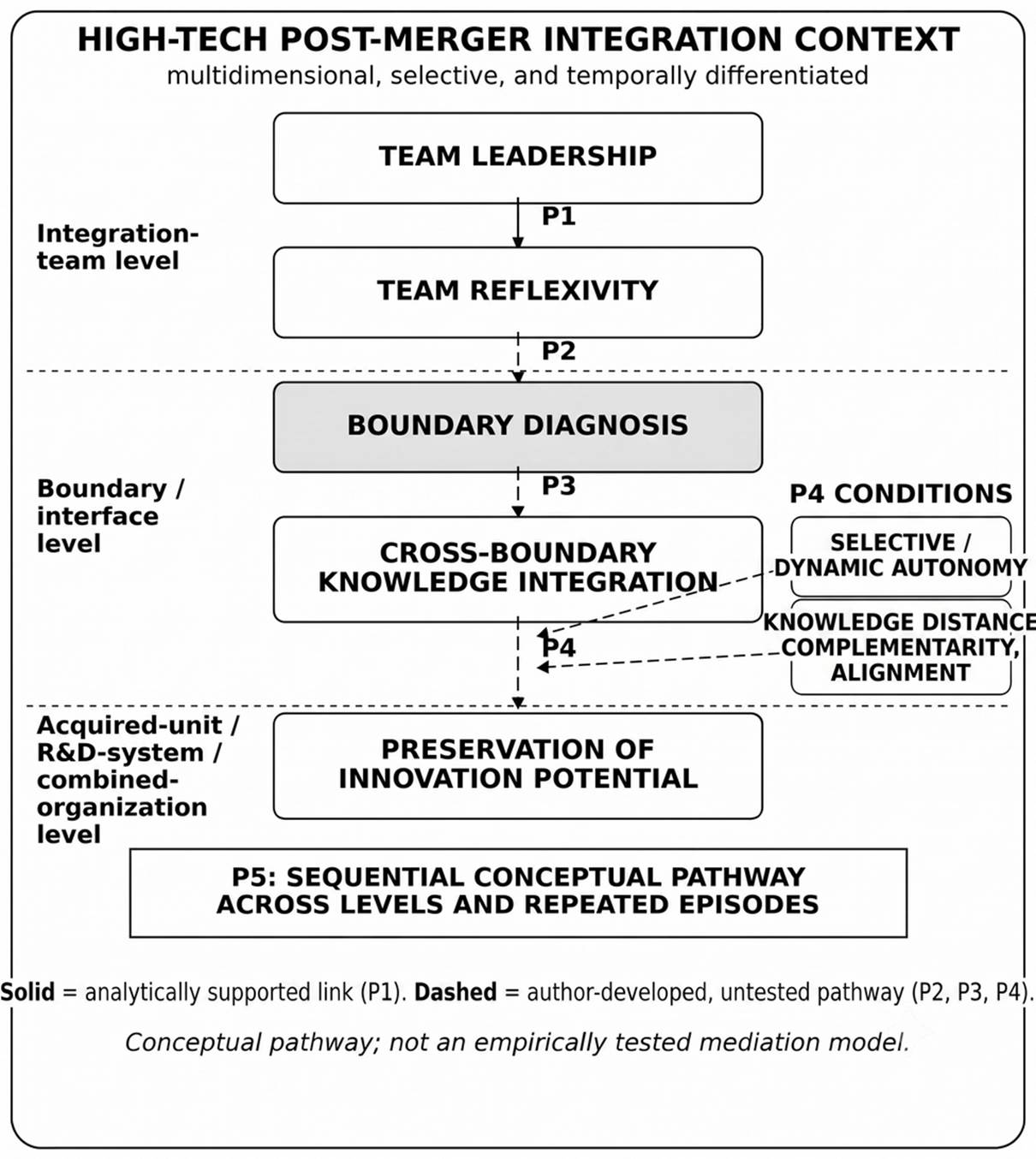
Figure 1. Multilevel Conceptual Pathway for Preserving Innovation Potential in High-Tech Post-Merger Integration
Source: compiled by the author.
Note: P1 denotes the participation-supportive expression of Team Leadership. The side boxes condition P4; pace and sequence qualify the pathway.
Proposition 5. Team leadership contributes to the preservation of innovation potential through a sequential conceptual pathway in which team reflexivity supports cross-boundary knowledge integration and that integration sustains the acquired firm's innovation-enabling resource base. This integrates Propositions 1–4 and specifies a conceptual sequence rather than empirical mediation.
Selective and dynamic acquired-firm autonomy conditions the knowledge-integration-to-preservation transition. Autonomy can protect routines, identities, and local decision practices, while permeability enables access and coordination. The configuration may change across time and functions [14; 17, pp. 148–160; 24, pp. 105–188; 36, pp. 420–441]; the model assumes neither complete absorption, complete independence, nor a universal optimum.
Knowledge distance, complementarity, and alignment form the second primary boundary family. Distance can increase novelty and translation costs; complementarity conditions whether difference offers joint value; alignment concerns fit between expertise and intended use [5, pp. 197–217; 12; 13, pp. 1–15; 16, pp. 642–651]. Pacing and sequence qualify both boundary families. Retention incentives, structural design, resources, identity, power, and executive decisions remain alternative explanations.
8. Theoretical, Managerial, and Research Implications
The contribution lies in the cross-level synthesis: it does not rest on any single component being new. The article links functional team leadership with reflexive boundary diagnosis, locates transfer, translation, and transformation within acquisition knowledge work, and separates future innovation capacity from current inputs and outputs [10, pp. 555–567; 30, pp. 707–727; 31, pp. 5–39; 40, pp. 731–757]. This adds an integration-team mechanism to post-merger accounts of capability preservation.
For managers, the implication is diagnostic. Integration leaders should involve relevant knowledge holders, examine assumptions, and use Table 2 to select coordination, translation, or negotiated transformation. A shared lexicon with known dependencies may require only coordination; different meanings attached to the same technical term require translation; conflict over product-roadmap priorities may require negotiated transformation. Structural, personnel, and interface decisions should then be assessed against coordination needs and risks to the innovation-enabling configuration [7, pp. 395–422; 17, pp. 148–160; 36, pp. 420–441].
Future research should identify the integration team or interface, distinguish leadership sources, and aggregate participation-supportive leadership and reflexivity at team level. Candidate preservation indicators include access to specialized expertise, continuity of knowledge holders and collaboration ties, viability of innovation-relevant routines, continuity of R&D projects, and usability of technological and IP assets. Multiwave designs should test adjacent links, cross-level accumulation, boundary configurations, and pacing.
9. Limitations and Directions for Future Research
The central limitation is the evidential distance between adjacent components and the full model. Participation-supportive leadership is associated with reflexivity, but the remaining transitions have not been tested as a sequence; they are proposed here. Proposition 5 therefore specifies a conceptual pathway; it does not claim empirical mediation.
The review is bounded by its purposively assembled closed corpus. Studies vary by sector, country, method, unit, and measure; practitioner materials were audited separately and did not support propositions. These controls strengthen traceability but preclude claims of completeness or saturation; the purposive logic may underrepresent literatures framing the same problems through other constructs, including team boundary-spanning research [41, pp. 333–339; 42, pp. 404–428].
No validated instrument captures the proposed configuration. High-tech acquisitions are heterogeneous; autonomy, relatedness, and speed are not uniformly beneficial. Research should establish discriminant measures, compare technological and national contexts, examine nonlinear and configurational effects, and test structural, incentive, identity, political, and resource-allocation alternatives [12; 30].
10. Conclusion
The model proposes that team leadership contributes to preserving innovation potential indirectly and conditionally by organizing technically relevant participation and enabling reflexive diagnosis of cross-boundary differences. When the diagnosed boundary is matched with coordination, translation, or negotiated transformation, complementary knowledge becomes jointly usable while the acquired firm's innovation-enabling configuration remains viable.
Overall, the article contributes a multilevel, temporal account linking integration-team regulation, interorganizational knowledge work, and an organizational innovation condition. Selective autonomy and knowledge configuration condition the Knowledge Integration–Preservation transition, while pace and sequence qualify the pathway. Empirical work should follow teams, interfaces, and innovation-enabling resources over time and test alternative mechanisms. Managers should organize participation, diagnose boundaries before choosing an integration mechanism, and assess whether the acquired knowledge system remains usable.
Источники:
2. Гудиев А.В., Долгов М.В., Минева О.К., Шебураков И.Б. Особенности командного управления в России: результаты масштабного исследования. Часть 1. Наполненность дефиниций «команда», «командное управление», сдерживающие и поддерживающие факторы // Лидерство и менеджмент. – 2025. – № 9. – c. 1861-1882. – doi: 10.18334/lim.12.9.123771.
3. Гудиев А.В., Долгов М.В., Минева О.К., Шебураков И.Б. Особенности командного управления в России: результаты масштабного исследования. Часть 2. Лидер команды // Лидерство и менеджмент. – 2025. – № 10. – c. 2033-2046. – doi: 10.18334/lim.12.10.123774.
4. Гудиев А.В., Долгов М.В., Минева О.К., Шебураков И.Б. Особенности командного управления в России: результаты масштабного исследования. Часть 3. Состав команды и взаимодействие // Лидерство и менеджмент. – 2025. – № 10. – c. 2047-2070. – doi: 10.18334/lim.12.10.123775.
5. Ahuja G., Katila R. Technological acquisitions and the innovation performance of acquiring firms: A longitudinal study // Strategic Management Journal. – 2001. – № 3. – p. 197. – doi: 10.1002/smj.157.
6. Angwin D.N. Speed in M&A integration: The first 100 days // European Management Journal. – 2004. – № 4. – p. 418-430. – doi: 10.1016/j.emj.2004.06.005.
7. Birkinshaw J., Bresman H., Håkanson L. Managing the post-acquisition integration process: How the human integration and task integration processes interact to foster value creation // Journal of Management Studies. – 2000. – № 3. – p. 395–425. – doi: 10.1111/1467-6486.00186.
8. Bresman H., Birkinshaw J., Nobel R. Knowledge transfer in international acquisitions // Journal of International Business Studies. – 1999. – № 3. – p. 439-462. – doi: 10.1057/palgrave.jibs.8490078.
9. Burke C.S., Stagl K.C., Klein C., Goodwin G.F., Salas E., Halpin S.M. What type of leadership behaviors are functional in teams? // A meta-analysis // The Leadership Quarterly. – 2006. – № 3. – p. 288-307. – doi: 10.1016/j.leaqua.2006.02.007.
10. Carlile P.R. Transferring, translating, and transforming: An integrative framework for managing knowledge across boundaries // Organization Science. – 2004. – № 5. – p. 555–568. – doi: 10.1287/orsc.1040.0094.
11. Carson J.B., Tesluk P.E., Marrone J.A. Shared leadership in teams: An investigation of antecedent conditions and performance // Academy of Management Journal. – 2007. – № 5. – p. 1217-1234. – doi: 10.5465/AMJ.2007.27468718.
12. Cefis E., Marsili O., Rigamonti D. In and out of balance: Industry relatedness, learning capabilities and post-acquisition innovative performance // Journal of Management Studies. – 2020. – № 2. – p. 210-245. – doi: 10.1111/joms.12441.
13. Chattopadhyay S., Karim S., Capron L. Acquiring firm inventors’ performance: Exploring the alignment of inventors’ knowledge base with firms’ innovation trajectories // Strategy Science. – 2026. – p. 1-18. – doi: 10.1287/stsc.2024.0241.
14. Chen Q., Hsu D.H., Zvilichovsky D. Inventor commingling and innovation in technology start-up acquisitions // Organization Science. – 2026. – № 1. – p. 302–322. – doi: 10.1287/orsc.2022.16189.
15. Christofi M., Vrontis D., Thrassou A., Shams S.M.R. Triggering technological innovation through cross-border mergers and acquisitions: A micro-foundational perspective // Technological Forecasting and Social Change. – 2019. – p. 148-166. – doi: 10.1016/j.techfore.2019.05.026.
16. Cloodt M., Hagedoorn J., Van Kranenburg H. Mergers and acquisitions: Their effect on the innovative performance of companies in high-tech industries // Research Policy. – 2006. – № 5. – p. 642-654. – doi: 10.1016/j.respol.2006.02.007.
17. Colman H.L. Facilitating integration and maintaining autonomy: The role of managerial action and interaction in post-acquisition capability transfer // Journal of Business Research. – 2020. – p. 148-160. – doi: 10.1016/j.jbusres.2019.09.063.
18. Daronco E.L., Silva D.S., Seibel M.K., Cortimiglia M.N. A new framework of firm-level innovation capability: A propensity–ability perspective // European Management Journal. – 2023. – № 2. – p. 236–250. – doi: 10.1016/j.emj.2022.02.002.
19. D’Innocenzo L., Mathieu J.E., Kukenberger M.R. A meta-analysis of different forms of shared leadership–team performance relations // Journal of Management. – 2016. – № 7. – p. 1964-1991. – doi: 10.1177/0149206314525205.
20. Edmondson A.C. Psychological safety and learning behavior in work teams // Administrative Science Quarterly. – 1999. – № 2. – p. 350-383. – doi: 10.2307/2666999.
21. Graebner M.E., Heimeriks K.H., Huy Q.N., Vaara E. The process of post-merger integration: A review and agenda for future research // Academy of Management Annals. – 2017. – № 1. – p. 1-55. – doi: 10.5465/annals.2014.0078.
22. Grant R.M. Toward a knowledge-based theory of the firm // Strategic Management Journal. – 1996. – p. 109-122. – doi: 10.1002/smj.4250171110.
23. Hackman J.R., Wageman R. A theory of team coaching // Academy of Management Review. – 2005. – № 2. – p. 269-287. – doi: 10.5465/AMR.2005.16387885.
24. Haspeslagh P.C., Jemison D.B. Managing Acquisitions: Creating Value Through Corporate Renewal. - New York: The Free Press, 1991.
25. Hitt M.A., King D., Krishnan H., Makri M., Schijven M., Shimizu K., Zhu H. Creating value through mergers and acquisitions: Challenges and opportunities. / The Handbook of Mergers and Acquisitions / Eds. D. Faulkner, S. Teerikangas, R.J. Joseph. - Oxford: Oxford University Press, 2012. – 71-113 p.
26. Jaakkola E. Designing conceptual articles: Four approaches // AMS Review. – 2020. – p. 18-26. – doi: 10.1007/s13162-020-00161-0.
27. Kapoor R., Lim K. The impact of acquisitions on the productivity of inventors at semiconductor firms: A synthesis of knowledge-based and incentive-based perspectives // Academy of Management Journal. – 2007. – № 5. – p. 1133-1155. – doi: 10.5465/amj.2007.27169706.
28. Konradt U., Otte K.-P., Schippers M.C., Steenfatt C. Reflexivity in teams: A review and new perspectives // The Journal of Psychology. – 2016. – p. 153-174. – doi: 10.1080/00223980.2015.1050977.
29. Leblanc P.-M., Harvey J.-F., Rousseau V. A meta-analysis of team reflexivity: Antecedents, outcomes, and boundary conditions // Human Resource Management Review. – 2024. – № 4. – p. 101042. – doi: 10.1016/j.hrmr.2024.101042.
30. Mendoza-Silva A. Innovation capability: A systematic literature review // European Journal of Innovation Management. – 2019. – № 3. – p. 707-734. – doi: 10.1108/EJIM-09-2019-0263.
31. Morgeson F.P., DeRue D.S., Karam E.P. Leadership in teams: A functional approach to understanding leadership structures and processes // Journal of Management. – 2010. – № 1. – p. 5-39. – doi: 10.1177/0149206309347376.
32. Okhuysen G.A., Eisenhardt K.M. Integrating knowledge in groups: How formal interventions enable flexibility // Organization Science. – 2002. – № 4. – p. 370-386. – doi: 10.1287/orsc.13.4.370.2947.
33. Ornaghi C., Cassi L. Acquisitions, inventors’ turnover, and innovation: Evidence from the pharmaceutical industry // European Economic Review. – 2026. – p. 105263. – doi: 10.1016/j.euroecorev.2026.105263.
34. Pablo A.L. Determinants of acquisition integration level: A decision-making perspective // Academy of Management Journal. – 1994. – № 4. – p. 803-836. – doi: 10.5465/256601.
35. Paruchuri S., Nerkar A., Hambrick D.C. Acquisition integration and productivity losses in the technical core: Disruption of inventors in acquired companies // Organization Science. – 2006. – № 5. – p. 545–562. – doi: 10.1287/orsc.1060.0207.
36. Ranft A.L., Lord M.D. Acquiring new technologies and capabilities: A grounded model of acquisition implementation // Organization Science. – 2002. – № 4. – p. 420–441. – doi: 10.1287/orsc.13.4.420.2952.
37. Rogova E., Kirichenko M., Lebedeva D. Do mergers and acquisitions promote R&D? The case of European innovation and technology sector // Journal of Corporate Finance. – 2023. – № 4. – p. 5–18. – doi: 10.17323/j.jcfr.2073-0438.17.4.2023.5-18.
38. Rogova E., Tkachenko E., Kopysov D. Factors signalling the value of European high tech startups at acquisition // Proceedings of the 16th European Conference on Innovation and Entrepreneurship, ECIE 2021: Reading: Academic Conferences International. 2021. – p. 821–829.– doi: 10.34190/EIE.21.030.
39. Schippers M.C., Den Hartog D.N., Koopman P.L. Reflexivity in teams: A measure and correlates // Applied Psychology. – 2007. – № 2. – p. 189–211. – doi: 10.1111/j.1464-0597.2006.00250.x.
40. Schippers M.C., Edmondson A.C., West M.A. eam reflexivity as an antidote to team information-processing failures // Small Group Research. – 2014. – № 6. – p. 731–769. – doi: 10.1177/1046496414553473.
41. Snyder H. Literature review as a research methodology: An overview and guidelines // Journal of Business Research. – 2019. – p. 333-339. – doi: 10.1016/j.jbusres.2019.07.039.
42. Torraco R. Writing integrative literature reviews: Using the past and present to explore the future // Human Resource Development Review. – 2016. – p. 404-428/. – doi: 10.1177/1534484316671606.
43. Vayner O.V., Rogova E.M. Target’s financial performance in corporate acquisitions: brics evidence // Russian Management Journal. – 2022. – № 1. – p. 28-51. – doi: 10.21638/spbu18.2022.102.
44. Verginer L., Riccaboni M. The impact of biotech acquisitions on inventor productivity // Journal of Business Research. – 2025. – p. 115573. – doi: 10.1016/j.jbusres.2025.115573.
45. Wang D., Waldman D.A., Zhang Z. A meta-analysis of shared leadership and team effectiveness // Journal of Applied Psychology. – 2014. – № 2. – p. 181–198. – doi: 10.1037/a0034531.
46. Webster J., Watson R.T. Analyzing the past to prepare for the future: Writing a literature review // MIS Quarterly. – 2002. – № 2. – p. 13-23. – doi: 10.2307/4132319.
47. Whetten D.A. What constitutes a theoretical contribution? // Academy of Management Review. – 1989. – № 4. – p. 490–495. – doi: 10.5465/amr.1989.4308371.
48. Zaccaro S.J., Rittman A.L., Marks M.A. Team leadership // The Leadership Quarterly. – 2001. – № 4. – p. 451–483. – doi: 10.1016/S1048-9843(01)00093-5.
Страница обновлена: 15.09.2026 в 10:07:58
Download PDF | Downloads: 4
Командное лидерство в интеграции высокотехнологичных компаний после слияния: концептуальная модель сохранения инновационного потенциала
Ostapenko I.A.Journal paper
Leadership and Management
Volume 13, Number 8 (August 2026)
Abstract:
High-tech acquisitions can weaken the organizational foundations on which future innovation depends. This article addresses how team leadership can help preserve that innovation potential during post-merger integration. It develops a conceptual model through an integrative review of management, team, knowledge, and acquisition research. The model proposes that participation-supportive leadership is positively related to team reflexivity and that reflexive evaluation helps integration teams identify consequential differences in expertise, interpretation, priorities, dependencies, and interests. Boundary diagnosis then guides knowledge integration through mechanisms suited to the problem encountered, moving beyond transfer alone. Preservation is treated as the continuing viability and usability of the organizational system that sustains future innovation, distinguished from current innovation output. The pathway is conditioned by selective autonomy and by the distance, complementarity, and alignment of the knowledge being combined, while dimension-specific pacing and sequence operate as cross-cutting temporal qualifiers. The article offers scholars a multilevel explanation of post-merger innovation preservation and gives managers a basis for integration decisions that do not destroy acquired capabilities
Keywords: team leadership, team reflexivity, knowledge integration, post-merger integration, innovation potential, high-tech firms, acquired-firm autonomy, knowledge complementarity
JEL-classification: D83, G34, M12, O31, O32
References:
Ahuja G., Katila R. (2001). Technological acquisitions and the innovation performance of acquiring firms: A longitudinal study Strategic Management Journal. 22 (3). 197. doi: 10.1002/smj.157.
Angwin D.N. (2004). Speed in M&A integration: The first 100 days European Management Journal. 22 (4). 418-430. doi: 10.1016/j.emj.2004.06.005.
Birkinshaw J., Bresman H., Håkanson L. (2000). Managing the post-acquisition integration process: How the human integration and task integration processes interact to foster value creation Journal of Management Studies. 37 (3). 395–425. doi: 10.1111/1467-6486.00186.
Bresman H., Birkinshaw J., Nobel R. (1999). Knowledge transfer in international acquisitions Journal of International Business Studies. 30 (3). 439-462. doi: 10.1057/palgrave.jibs.8490078.
Burke C.S., Stagl K.C., Klein C., Goodwin G.F., Salas E., Halpin S.M. (2006). What type of leadership behaviors are functional in teams? A meta-analysis // The Leadership Quarterly. 17 (3). 288-307. doi: 10.1016/j.leaqua.2006.02.007.
Carlile P.R. (2004). Transferring, translating, and transforming: An integrative framework for managing knowledge across boundaries Organization Science. 15 (5). 555–568. doi: 10.1287/orsc.1040.0094.
Carson J.B., Tesluk P.E., Marrone J.A. (2007). Shared leadership in teams: An investigation of antecedent conditions and performance Academy of Management Journal. 50 (5). 1217-1234. doi: 10.5465/AMJ.2007.27468718.
Cefis E., Marsili O., Rigamonti D. (2020). In and out of balance: Industry relatedness, learning capabilities and post-acquisition innovative performance Journal of Management Studies. 57 (2). 210-245. doi: 10.1111/joms.12441.
Chattopadhyay S., Karim S., Capron L. (2026). Acquiring firm inventors’ performance: Exploring the alignment of inventors’ knowledge base with firms’ innovation trajectories Strategy Science. 1-18. doi: 10.1287/stsc.2024.0241.
Chen Q., Hsu D.H., Zvilichovsky D. (2026). Inventor commingling and innovation in technology start-up acquisitions Organization Science. (1). 302–322. doi: 10.1287/orsc.2022.16189.
Christofi M., Vrontis D., Thrassou A., Shams S.M.R. (2019). Triggering technological innovation through cross-border mergers and acquisitions: A micro-foundational perspective Technological Forecasting and Social Change. 146 148-166. doi: 10.1016/j.techfore.2019.05.026.
Cloodt M., Hagedoorn J., Van Kranenburg H. (2006). Mergers and acquisitions: Their effect on the innovative performance of companies in high-tech industries Research Policy. 35 (5). 642-654. doi: 10.1016/j.respol.2006.02.007.
Colman H.L. (2020). Facilitating integration and maintaining autonomy: The role of managerial action and interaction in post-acquisition capability transfer Journal of Business Research. 109 148-160. doi: 10.1016/j.jbusres.2019.09.063.
Daronco E.L., Silva D.S., Seibel M.K., Cortimiglia M.N. (2023). A new framework of firm-level innovation capability: A propensity–ability perspective European Management Journal. 41 (2). 236–250. doi: 10.1016/j.emj.2022.02.002.
D’Innocenzo L., Mathieu J.E., Kukenberger M.R. (2016). A meta-analysis of different forms of shared leadership–team performance relations Journal of Management. 42 (7). 1964-1991. doi: 10.1177/0149206314525205.
Edmondson A.C. (1999). Psychological safety and learning behavior in work teams Administrative Science Quarterly. 44 (2). 350-383. doi: 10.2307/2666999.
Graebner M.E., Heimeriks K.H., Huy Q.N., Vaara E. (2017). The process of post-merger integration: A review and agenda for future research Academy of Management Annals. 11 (1). 1-55. doi: 10.5465/annals.2014.0078.
Grant R.M. (1996). Toward a knowledge-based theory of the firm Strategic Management Journal. 17 109-122. doi: 10.1002/smj.4250171110.
Gudiev A.V. (2022). Distributed Leadership. Vertical Power is Changed by Horizontal Influence. Human capital. (11). 93–103. doi: 10.25629/HC.2022.11.10.
Gudiev A.V., Dolgov M.V., Mineva O.K., Sheburakov I.B. (2025). Command management particularities in Russia: large-scale study results. Part 3. Team composition and interaction. Leadership and Management. 12 (10). 2047-2070. doi: 10.18334/lim.12.10.123775.
Gudiev A.V., Dolgov M.V., Mineva O.K., Sheburakov I.B. (2025). Command management particularities in Russia: large-scale study results. Part 1. Fullness of definitions of team, team management, and deterrent and supportive factors. Leadership and Management. 12 (9). 1861-1882. doi: 10.18334/lim.12.9.123771.
Gudiev A.V., Dolgov M.V., Mineva O.K., Sheburakov I.B. (2025). Particularities of command management in Russia: the results of a large-scale study. Part 2. The team leader. Leadership and Management. 12 (10). 2033-2046. doi: 10.18334/lim.12.10.123774.
Hackman J.R., Wageman R. (2005). A theory of team coaching Academy of Management Review. 30 (2). 269-287. doi: 10.5465/AMR.2005.16387885.
Haspeslagh P.C., Jemison D.B. (1991). Managing Acquisitions: Creating Value Through Corporate Renewal
Hitt M.A., King D., Krishnan H., Makri M., Schijven M., Shimizu K., Zhu H. (2012). Creating value through mergers and acquisitions: Challenges and opportunities
Jaakkola E. (2020). Designing conceptual articles: Four approaches AMS Review. 10 18-26. doi: 10.1007/s13162-020-00161-0.
Kapoor R., Lim K. (2007). The impact of acquisitions on the productivity of inventors at semiconductor firms: A synthesis of knowledge-based and incentive-based perspectives Academy of Management Journal. 50 (5). 1133-1155. doi: 10.5465/amj.2007.27169706.
Konradt U., Otte K.-P., Schippers M.C., Steenfatt C. (2016). Reflexivity in teams: A review and new perspectives The Journal of Psychology. 150 153-174. doi: 10.1080/00223980.2015.1050977.
Leblanc P.-M., Harvey J.-F., Rousseau V. (2024). A meta-analysis of team reflexivity: Antecedents, outcomes, and boundary conditions Human Resource Management Review. 34 (4). 101042. doi: 10.1016/j.hrmr.2024.101042.
Mendoza-Silva A. (2019). Innovation capability: A systematic literature review European Journal of Innovation Management. 24 (3). 707-734. doi: 10.1108/EJIM-09-2019-0263.
Morgeson F.P., DeRue D.S., Karam E.P. (2010). Leadership in teams: A functional approach to understanding leadership structures and processes Journal of Management. 36 (1). 5-39. doi: 10.1177/0149206309347376.
Okhuysen G.A., Eisenhardt K.M. (2002). Integrating knowledge in groups: How formal interventions enable flexibility Organization Science. 13 (4). 370-386. doi: 10.1287/orsc.13.4.370.2947.
Ornaghi C., Cassi L. (2026). Acquisitions, inventors’ turnover, and innovation: Evidence from the pharmaceutical industry European Economic Review. 184 105263. doi: 10.1016/j.euroecorev.2026.105263.
Pablo A.L. (1994). Determinants of acquisition integration level: A decision-making perspective Academy of Management Journal. 37 (4). 803-836. doi: 10.5465/256601.
Paruchuri S., Nerkar A., Hambrick D.C. (2006). Acquisition integration and productivity losses in the technical core: Disruption of inventors in acquired companies Organization Science. 17 (5). 545–562. doi: 10.1287/orsc.1060.0207.
Ranft A.L., Lord M.D. (2002). Acquiring new technologies and capabilities: A grounded model of acquisition implementation Organization Science. 13 (4). 420–441. doi: 10.1287/orsc.13.4.420.2952.
Rogova E., Kirichenko M., Lebedeva D. (2023). Do mergers and acquisitions promote R&D? The case of European innovation and technology sector Journal of Corporate Finance. 17 (4). 5–18. doi: 10.17323/j.jcfr.2073-0438.17.4.2023.5-18.
Rogova E., Tkachenko E., Kopysov D. (2021). Factors signalling the value of European high tech startups at acquisition Proceedings of the 16th European Conference on Innovation and Entrepreneurship, ECIE 2021. 821–829. doi: 10.34190/EIE.21.030.
Schippers M.C., Den Hartog D.N., Koopman P.L. (2007). Reflexivity in teams: A measure and correlates Applied Psychology. 56 (2). 189–211. doi: 10.1111/j.1464-0597.2006.00250.x.
Schippers M.C., Edmondson A.C., West M.A. (2014). eam reflexivity as an antidote to team information-processing failures Small Group Research. 45 (6). 731–769. doi: 10.1177/1046496414553473.
Snyder H. (2019). Literature review as a research methodology: An overview and guidelines Journal of Business Research. 104 333-339. doi: 10.1016/j.jbusres.2019.07.039.
Torraco R. (2016). Writing integrative literature reviews: Using the past and present to explore the future Human Resource Development Review. 15 404-428/. doi: 10.1177/1534484316671606.
Vayner O.V., Rogova E.M. (2022). Target’s financial performance in corporate acquisitions: brics evidence Russian Management Journal. 20 (1). 28-51. doi: 10.21638/spbu18.2022.102.
Verginer L., Riccaboni M. (2025). The impact of biotech acquisitions on inventor productivity Journal of Business Research. 200 115573. doi: 10.1016/j.jbusres.2025.115573.
Wang D., Waldman D.A., Zhang Z. (2014). A meta-analysis of shared leadership and team effectiveness Journal of Applied Psychology. 99 (2). 181–198. doi: 10.1037/a0034531.
Webster J., Watson R.T. (2002). Analyzing the past to prepare for the future: Writing a literature review MIS Quarterly. 26 (2). 13-23. doi: 10.2307/4132319.
Whetten D.A. (1989). What constitutes a theoretical contribution? Academy of Management Review. 14 (4). 490–495. doi: 10.5465/amr.1989.4308371.
Zaccaro S.J., Rittman A.L., Marks M.A. (2001). Team leadership The Leadership Quarterly. 12 (4). 451–483. doi: 10.1016/S1048-9843(01)00093-5.