
Trade-led growth: empirical evidence from North Macedonia
Воронова Т.А.1  , Трохова Е.В.1 , Масленникова Н.В.1 , Селамовски Ф.1
1 Российский экономический университет им. Г.В. Плеханова, Москва, Россия
Скачать PDF | Загрузок: 14
Статья в журнале
Экономические отношения (РИНЦ, ВАК)
опубликовать статью | оформить подписку
Том 16, Номер 2 (Апрель-июнь 2026)
Эта статья проиндексирована РИНЦ, см. https://elibrary.ru/item.asp?id=91732748 [91732748]
Аннотация:
В данной статье рассмотрена гипотеза роста, обусловленного внешней торговлей в Северной Македонии путем оценки расширенной производственной функции Кобба-Дугласа за период 2002-2022 гг. Результаты указывают на значительное влияние открытости торговли на экономический рост, что дает основания для подтверждения гипотезы. Показано, что затраты на трудовые ресурсы и капитальные вложения также оказывают значительное влияние на экономический рост. Коэффициенты эластичности ВВП по трудовым затратам и открытости торговли продемонстрировали повышение, а по капитальным затратам снижение. Несмотря на некоторые позитивные структурные сдвиги, эмпирические данные демонстрируют убывающую отдачу от масштаба, что указывает на определенные неэффективные аспекты экономической системы. Для максимизации отдачи в меняющихся условиях необходимы структурные корректировки, сочетающие оптимальное использование труда, капитала и открытости торговли.
Ключевые слова: экономический рост, открытость экономики, функция Кобба-Дугласа, развивающиеся страны, Северная Македония
JEL-классификация: O40, O41, O47
Introduction
Foreign trade has expanded dramatically during the period of globalization, becoming one of the most dynamic segments and the cornerstone of the global economy. As a result, it is nowadays widely accepted that trade openness plays a crucial role in economic growth by facilitating access to global markets, promoting specialization based on comparative advantage, encouraging innovation through competition, and ensuring efficient allocation of resources. Moreover, studies argue that trade facilitates technology adoption and transfer of knowledge and skills [2]. However, some research also argues that trade openness could potentially lead to higher inflation rates [3] and increase the output volatility in developing countries with lower level of development [1]. The lack of consensus on this matter combined with the fact that the global economy is currently experiencing a period of heightened volatility which significantly affects trade flows and output determines the relevance of this study.
In general, the growth-trade nexus in small developing countries such as North Macedonia has been relatively understudied. Although many studies analyze trade openness and economic growth, most of them omit the possibility of a time-varying relationship between them. The output responsiveness to changes in trade patterns and trade openness can change over time. Moreover, in the case of North Macedonia there is an evident lack of empirical research on the responsiveness of the aggregate output to trade openness vis-à-vis other important inputs required by the industrial sector.
Since the previous empirical research on developing countries provides unambiguous results and there is a significant gap in the literature on the growth-trade nexus in the case of North Macedonia, the objective of this study is to evaluate the validity of the trade-led growth hypothesis for North Macedonia – a small developing European economy.
Given the aforementioned literature gap, the scientific novelty of this study lies in the in-depth analysis of the long-term cointegration between trade openness and industrial output in the case of North Macedonia as well as the time-varying responsiveness of the aggregate output to trade openness vis-à-vis other variables (capital and labor inputs) using an augmented Cobb-Douglas function.
The study's hypothesis assumes that there is a significant positive effect of trade openness on economic growth in small resource-dependent developing countries, with its impact strengthening over time—potentially indicating increased vulnerability to external shocks.
Literature review
A significant amount of research addresses the trade-economic growth nexus especially in developing countries. Elezi at al. in their 2025 study analyze the effects of trade and trade openness on economic growth in Western Balkan economies and find evidence that higher trade openness is associated with higher GDP per capita in these countries hence supporting the hypothesis of trade-led growth [4]. A 2016 study by Pilinkienė also presents evidence that higher-degree trade openness provides the conditions for competitiveness increase and accelerated economic growth in Central and Eastern European countries [13]. Mahfoudh et al. in their 2018 study on trade openness and economic growth in MENA countries provide evidence that openness to foreign trade is mostly beneficial [9]. Additionally, their findings indicate that export diversification also has significant effect on economic growth. Islam in his 2022 provides similar conclusions. By using a pooled mean group estimation to a model based on the Cobb-Douglas production function, the author finds enough evidence to validate the trade-led growth hypothesis for selected South Asian countries [7]. By applying the Granger causality test, Kumar finds a bidirectional causality between India’s GDP and exports which supports both export-led growth and growth-led export hypotheses [8]. By comparing China and India, Goudar and Nagoor [5] provide similar conclusion of trade-led growth in India, as well as China. In the case of China, the authors argue that the trade-led growth has propelled it to become the world's manufacturing hub. Oppong-Baah et al. provide evidence that trade has had positive impact on economic growth in Ghana and Nigeria [12]. Nwakwo et al. also examine the impact of international trade on economic growth in Nigeria and find that trade openness is one of the key drivers of growth [11].
Despite the fact that most of the empirical studies find evidence on the positive impact of trade openness on economic growth, some studies find differing results. By using an augmented production function based on the Cobb-Douglas function, Mbingui and Etoka-Beka in their 2021 study find that in the short and long-term, trade openness negatively affects economic growth in Congo [10]. The authors argue that the negative relationship can be explained by the excess dependence of the Congolese economy on exports of natural resources.
Methodology
In line with previous research [7] [10] this study uses an empirical model based on the Cobb-Douglas production function:
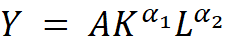 (1)
(1)
where Y is the nominal GDP (in
current prices), K is capital input, L denotes labor input and A
stands for technology index.  and are the output elasticities of capital and labor. Elasticity
values are assumed to be constants determined by available technology. Y, K and L
are expressed in billions of Macedonian denars (MKD). Since there are some data
availability challenges, for the aim of this study the capital input is
measured as the annual total gross investment. The labor input is measured as
follows:
and are the output elasticities of capital and labor. Elasticity
values are assumed to be constants determined by available technology. Y, K and L
are expressed in billions of Macedonian denars (MKD). Since there are some data
availability challenges, for the aim of this study the capital input is
measured as the annual total gross investment. The labor input is measured as
follows:
 (2)
(2)
where  is the average annual gross wage (AAGW) and E is the total
number of employed people within the economy.
is the average annual gross wage (AAGW) and E is the total
number of employed people within the economy.
The technology index is defined as:
 (3)
(3)
where TRO denotes trade openness and is calculated as the total foreign trade turnover (the sum of exports and imports) divided by GDP, expressed as percentage. For the purpose of this study, TRO is used simply as the integer value of the percentage. The theoretical justification behind this specification of the technology index is that trade openness promotes transfer of knowledge, skills and technology spillovers and hence fosters economic growth [2].
Based on Equations (1) and (3), the output function can be specified as follows:
 . (4)
. (4)
Given that Equation (4) is multiplicative, a logarithmic transformation is used. Hence, the linear expression of Equation (4) to be estimated can be written as follows:
 . (5)
. (5)
Empirical analysis
The model builds on data collected by the State Statistical Office of North Macedonia and it spans a period of 21 years (2002-2022). Table 1 presents the description of the variables used. As seen, GDP in current prices has increased from 258,6 in 2002 to 816,1 billion MKD in 2022 (a 3,2x increase). The compound average growth rate of GDP for the period between 2002 and 2022 was 5,9%. However, over the last decade growth rates have experienced a slowdown. This situation mostly reflects the overall global slowdown due to rising uncertainty, a result of the appearance of numerous global security and economic challenges [14].
Gross investment CAGR for the same period was 8,9% which is higher than GDP. This suggests that the investment dynamics within the Macedonian economy has generally improved. On the other hand, the labor costs grew on average by 5,8%, i.e. had a similar trend as GDP. The scenario where gross investment outpaces total labor costs points towards positive developments such as technology adoption, and economic expansion aiming to increase productivity and achieve economies of scale. Like GDP, both gross investment and labor costs have exhibited lower growth rates in the last decade.
Table 1
Description of data used in the estimation model, 2002-2022
|
Indicators
|
|
|
|
Compound
average growth rate
| ||
|
2002
|
2012
|
2022
|
2002-2012
|
2013-2022
|
2002-2022
| |
|
GDP,
in billion MKD
|
258,6
|
466,7
|
816,1
|
6,1%
|
5,6%
|
5,9%
|
|
Gross
investment, in billion MKD
|
53,9
|
135,0
|
293,9
|
9,6%
|
8,2%
|
8,9%
|
|
Labor
costs, in billion MKD
|
136,7
|
259,6
|
425,1
|
6,6%
|
4,9%
|
5,8%
|
|
Exports
|
|
|
|
|
|
|
|
In billion MKD
|
68,0
|
211,8
|
594,0
|
12,0%
|
11,8%
|
11,4%
|
|
Share of GDP, %
|
26,3%
|
45,4%
|
72,8%
|
|
|
|
|
Imports
|
|
|
|
|
|
|
|
In billion MKD
|
117,0
|
311,9
|
761,9
|
10,3%
|
10,6%
|
9,8%
|
|
Share of GDP, %
|
45,2%
|
66,8%
|
93,4%
|
|
|
|
|
Trade
deficit
|
|
|
|
|
|
|
|
In billion MKD
|
-49,0
|
-100,2
|
-167,9
|
7,4%
|
7,1%
|
6,4%
|
|
Share of GDP, %
|
-18,9%
|
-21,5%
|
-20,6%
|
|
|
|
|
Trade
turnover
|
|
|
|
|
|
|
|
In billion MKD
|
185,0
|
523,7
|
1335,9
|
11,0%
|
11,1%
|
10,5%
|
|
Share of GDP, %
|
71,5%
|
112,2%
|
166,1%
|
|
|
|
North Macedonia’s foreign trade has experienced a dynamic growth between 2000 and 2022. Both exports and imports have exhibited average growth rates significantly higher than GDP. Exports have grown on average by 11,4% while imports by 9,8%. Although the economy has experienced a slowdown over the last decade, imports CAGR demonstrated a minor increase. On the contrary, exports have experienced small stagnation, but to a lesser extent than other economic categories.
It is observable that North Macedonia has a significant negative trade balance, i.e. trade deficit which is somewhat expected given that the country is a small, resource-dependent economy. Depending on global patterns, as well as domestic economic trends, the deficit varied between 12 and 25 % GDP over the last 20 years. It can be concluded that in conditions of global economic downturns, the trade deficit of North Macedonia deepens which suggests that the country is substantially subjected to external trade shocks. It is noteworthy that due to the exports average growth rates outpacing imports growth rates, over the last decade the average growth rates of the trade deficit have slowed down.
Due to its dynamic activity vis-à-vis other economic segments, foreign trade has become one of the most important sectors of the Macedonian economy. The share of exports in GDP increased from 26,3% in 2002 to 72,8% in 2022. On the other side, the share of imports in GDP increased from 45,2% to 93,4%. It is obvious that the share of exports has been increasing faster than the share of imports. The overall trade openness index (TRO) illustrates North Macedonia’s growing dependency on trade. In 2022, the trade openness index stood at 166,1% which is significantly higher than the 71,5% in 2002. This trend is mostly the result of the Macedonian policy of economic openness through trade liberalization, as well as export-oriented inward FDI.
In order to establish whether there is a correlation between the variables in the long-term this study employs the Engle-Granger cointegration test. The test ensures robust analysis of long-term relationships between non-stationary variables, validating their co-movement trends [5]. Results are displayed in Table 2. The Engle-Granger cointegration test revealed that GDP is cointegrated with gross investment (5% level) and labor costs (10% level). This suggests that even though variables might vary independently over short periods, generally they tend to move together in the long run exhibiting a meaningful interdependence.
On the other side, cointegration between GDP and trade openness could not be confirmed indicating that both variables might follow their own independent stochastic trends in the long run, i.e. no stable, long-term equilibrium between GDP growth and trade openness can be found. This is somewhat expected since the total foreign trade turnover growth rates have been outpacing growth rates of other GDP components and in general the GDP itself.
Table 2
Engle-Granger cointegration test
|
|
Y-K
|
Y-L
|
Y-TRO
|
Y-EXP
|
Y-IMP
|
|
Alpha
|
5%
|
10%
|
10%
|
5%
|
10%
|
|
Type
|
drift only
|
drift & trend
|
all
|
drift only, no trend & drift
|
drift only, no trend & drift
|
|
Tau-statistic
|
-4,179
|
-14,232
|
-2,192
|
-3,734
|
-3,168
|
|
Tau-critical
|
-3,643
|
-3,848
|
-3,643
|
-3,547
|
-3,547
|
|
p-value
|
0,020
|
< 0,01
|
> 0,1
|
0,036
|
> 0,1
|
|
Cointegration
|
yes
|
yes
|
no
|
yes
|
no
|
|
Obs.
|
21
|
21
|
21
|
30
|
30
|
Although GDP and the trade openness index are not cointegrated in the long-term, the Engle-Granger test showed that individually, exports and GDP are cointegrated. In other words, changes in exports can explain some portion of the variation in GDP, and vice versa, indicating a strong interdependence between these two economic indicators. The lays the grounds to argue the validity not just of the trade-led growth but the export-led growth (ELG) hypothesis as well.
On the other hand, cointegration between imports and GDP is not found implying that while both imports and GDP might grow together over time due to overall economic growth, their paths do not necessarily converge in the long term. This would suggest that imports provide access to foreign inputs necessary for domestic consumption and production but do not directly influence long-term GDP trends unless they affect productivity or innovation.
In line with the specified model (Equation (5)), Table 3 displays the results of the OLS estimation. Two models with different time periods (2002-2017 and 2002-2022) were estimated in order to evaluate whether and how the responsiveness of output to changes in inputs has evolved over time. The Newey-West estimator was employed to derive heteroscedasticity-autocorrelation consistent (HAC) standard errors of the coefficients since the Breusch-Godfrey and Durbin-Watson tests for autocorrelation provided unclear results. The Breusch-Pagan and White tests did not detect strong heteroskedasticity.
Overall, the adjusted R2 are very high, which suggests that the models fit the data extremely well and can provide meaningful insight into the effects of changes in trade openness, gross investment and labor costs on North Macedonia’s GDP. Based on the F-test, both regressions are found to be statistically significant. The standard errors are also quite low implying that the estimations are very precise.
Table 3
Augmented Cobb-Douglas function: estimation summary
|
|
Model 1 [2002 - 2017]
|
Model 2 [2002-2022]
| ||||||
|
Regression summary
| ||||||||
|
R2
|
0,992
|
0,996
| ||||||
|
Adjusted R2
|
0,990
|
0,995
| ||||||
|
Standard error
|
2,74%
|
2,49%
| ||||||
|
F-test
|
455,19 (0,00)
|
1 276,39 (0,00)
| ||||||
|
Observations
|
15
|
21
| ||||||
|
Breusch-Pagan test
(LM / p-value) |
0,889 (0,828)
|
1,14 (0,767)
| ||||||
|
White test
(LM / p-value) |
0,257 (0,879)
|
2,876 (0,237)
| ||||||
|
Breusch-Godfrey test
(LM / p-value) |
0,533 (0,465)
|
4,222 (0,040)
| ||||||
|
DW test (D-lower / D-upper / D-stat)
|
0,81 / 1,75 (1,54)
|
1,03 / 1,67 (1,26)
| ||||||
|
Variables summary
| ||||||||
|
Variables
|
Coefficients
|
Std error
|
t stat
|
p-value
|
Coefficients
|
Std error
|
t stat
|
p-value
|
|
Constant
|
4,058
|
0,426
|
11,735
|
0,000
|
3,541
|
0,466
|
10,294
|
0,000
|
|
ln K
|
0,283
|
0,116
|
2,437
|
0,033
|
0,233
|
0,076
|
3,056
|
0,007
|
|
ln L
|
0,379
|
0,117
|
3,248
|
0,008
|
0,443
|
0,086
|
5,161
|
0,000
|
|
ln TRO
|
0,204
|
0,118
|
1,721
|
0,113
|
0,272
|
0,076
|
3,561
|
0,002
|
In terms of the variables, in the full-period model all of the coefficients are positive and statistically significant at 1% level. In the model for the period 2002-2017, they are also positive, but statistically significant at different levels. Labor costs coefficient is significant at 1%, gross investment at 5% and trade openness at 15%. Transforming Equation (5) back to its original specification, i.e. Equation (4), North Macedonia’s output function can be expressed as:
 .
.
Based on the estimations for the period 2002-2017 conclusion can be made that a 1% increase in labor costs would result in 0,379% increase in output ceteris paribus. The same 1% increase in capital and trade openness would result in 0,283% and 0,204% increase in output ceteris paribus respectively. This indicates that the output responsiveness to changes in labor costs was the highest, and in trade openness the lowest during this period. However, estimation of the production function for the full period 2002-2022 demonstrates that some changes have happened since 2017. A 1% increase in labor costs would result in 0,44% increase in output ceteris paribus. A 1% increase in trade openness and capital would result in 0,27% and 0,23% increase in output ceteris paribus respectively.
As observed the output responsiveness to labor costs has remained the highest among the variables, and moreover it has increased. An increase in the responsiveness of output with respect to labor input over time generally indicates improving labor productivity, reduced diminishing returns, and structural transformations favoring labor-intensive activities. This phenomenon points to broader socio-economic changes that positively influence the role of labor in driving economic growth. On the other hand, the output responsiveness to gross investments had decreased. A decrease in the responsiveness of output with respect to capital input indicates structural shifts to other inputs and some level of maturity of key industries. Industries experiencing saturation in capital expansion often reach maturity stages characterized by slower growth rates despite continued investment efforts. In this context, the need for complementary innovations arises to sustain competitiveness. Overall, observing an increase in labor responsiveness coupled with a decrease in capital responsiveness indicates structural transformations within the national economy favoring skill-based development over expansion strategies.
The output responsiveness to trade openness has likewise increased. This suggests that the Macedonian economy is becoming more dependent on international trade for its growth. Moreover, the rise in responsiveness reflects structural shifts within the economy where sectors heavily reliant on global markets have expanded relative to domestic-oriented industries. However, higher sensitivity also implies greater vulnerability to external shocks like tariffs, exchange rate fluctuations, or disruptions in supply chains. These findings align well with the previous research considered in the literature review.
It is noteworthy that the
output function exhibits decreasing returns to scale (DRS) which signifies that
an increase of capital, labor and trade openness by a factor λ produces
an increase in output smaller than a factor λ (  ). DRS suggest that the Macedonian economy is experiencing certain
production inefficiencies. Nevertheless, some positive trend is evident, i.e. the
returns to scale have been gradually increasing. The model for the period
2002-2017 suggests that simultaneous
1% increase of all of the inputs would result in a 0,866% increase in output,
while the model for the period 2002-2022 suggests that the same situation would
yield a 0,95% increase in output. An increase in returns to scale over time
implies better effectiveness in combining labor and capital inputs, i.e.
although individual components show mixed effects, the aggregate system still
benefits from synergies between them. This reflects not only improvement of
internal efficiencies but broader systemic improvements across industries. The
increasing returns to scale are mostly attributable to the implementation of
technological advancements, economies of scales in key industrial segments, as
well as improvements in human capital.
). DRS suggest that the Macedonian economy is experiencing certain
production inefficiencies. Nevertheless, some positive trend is evident, i.e. the
returns to scale have been gradually increasing. The model for the period
2002-2017 suggests that simultaneous
1% increase of all of the inputs would result in a 0,866% increase in output,
while the model for the period 2002-2022 suggests that the same situation would
yield a 0,95% increase in output. An increase in returns to scale over time
implies better effectiveness in combining labor and capital inputs, i.e.
although individual components show mixed effects, the aggregate system still
benefits from synergies between them. This reflects not only improvement of
internal efficiencies but broader systemic improvements across industries. The
increasing returns to scale are mostly attributable to the implementation of
technological advancements, economies of scales in key industrial segments, as
well as improvements in human capital.
Policy implications
In general, the output responsiveness to input changes suggests that under current conditions the Macedonian economic growth model in the short and mid-term should be predominantly based on the increase in labor costs. When considering the specification of the labor costs variable, Equation (2), it is obvious that the labor costs will increase if at least one of the variables: gross annual salary or people employed increases. In this context, it must be noted that since 2019, the growth of labor costs had mostly been attributable to the growth of the average annual gross wage (Figure 1). Data shows that although AAGW have grown on average by just 4,9% over the last decade which is relatively modest compared to other economic indicators, since 2018 certain acceleration in wages growth is noticeable. Between 2018 and 2022 AAGW increased by 33,7% while the number of people employed within the economy decreased by 10,5% reaching a ten-year minimum.
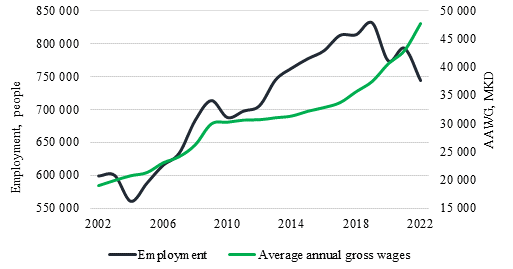
Figure 1. Employment and average annual gross wages in North Macedonia 2002-2022
Source: composed by authors based on [15]
North Macedonia has been experiencing labor force shrinkage due to significant emigration, mostly to more developed EU members, and decades of low birth rates against aging population. Between 2017 and 2024 the labor force decreased by approximately 8%. Moreover, the number of unemployed people decreased by almost 49% while the number of employed people increased by just 4%. This signifies that the labor input measured as employed people is somewhat limited. Hence, it can be argued that in the long-term labor costs are more likely to grow due to AAGW increase. However, AAGW growth, to a certain extent, is also constrained due to labor productivity limitations, i.e. slower labor productivity growth usually puts downward pressure on wages growth dynamics. Hence, increasing trade openness and gross investment in order to accelerate economic growth is probably the more suitable option in the long-term.
In terms of capital, it can be also argued that in the mid-term prospects are somewhat limited, especially when considering purely domestic sources and the aforementioned decrease of output responsiveness to changes in capital. Hence, higher gross investment growth rates and increased output elasticity are contingent upon the ability to attract greenfield foreign direct investment (FDI) in order to mitigate the deficit of domestic sources of capital combined with the relatively modest stimulus of the domestic private sector to invest into R&D, new technology and manufacturing of goods with higher value added. New FDI into manufacturing could potentially allow the country to capitalize on technology and knowledge spillover, as well as the creation of new jobs. Access to new modern technology could potentially increase productivity and thus create a suitable environment for sustainable wages growth. Moreover, in the mid and long-term the technology factor can alter the production function and allow North Macedonia to achieve increasing returns to scale instead of the current decreasing ones, i.e. to achieve higher (optimal) production efficiency.
Having in mind the long-run equilibrium relationship between GDP and exports, the output responsiveness to trade openness, as well as the fact that the exports-GDP ratio has been increasing faster than the imports-GDP ratio, it evident that the policy focus should be also placed on enhancing export-oriented sectors. Moreover, the policy of attracting new export-oriented FDI into manufacturing should be furtherly promoted. Export-oriented FDI aligns with both the need to enhance export-oriented sectors, as well as the aforementioned need to achieve higher output responsiveness to changes in capital. However, it must be highlighted that, as previously mentioned, increasing trade openness can also increase the level of vulnerability of the national economic system. Hence, although the long-term economic growth model should be predominantly based on openness, it should also include diversification of trade partners in order to minimize exposure to country-specific trade shocks.
Conclusion
Dynamics analysis of different economic segments, cointegration test, as well as the estimation of the augmented Cobb-Douglas production function provided empirical evidence to accept the trade-led-growth hypothesis for North Macedonia. Moreover, an increase in the output responsiveness to changes in trade openness is observed, which signifies enhanced responsiveness of national income to variations in international trade flows. This situation underscores both opportunities for accelerated economic growth through deeper engagement with global markets and focus on export-oriented sectors but also highlights risks related to dependency on external conditions.
In terms of the other production factors, this study highlights several key trends:
1) Growth rates of capital inputs outpaced growth rates of labor inputs,
2) Estimations showed declining responsiveness to capital and rising responsiveness to labor, coupled with growing returns to scale.
3) Despite the growing returns to scale, they still can be classified as diminishing, i.e. simultaneous increase in inputs leads to less than proportional increase in output.
The combination of these trends points towards a need for rebalancing resource allocation between capital and labor expenditures. Specifically, policies aimed at enhancing worker skills rather than simply pouring funds into physical infrastructure alone appear promising under current circumstances. Accelerated capital investment might become inefficient unless complemented by innovations enhancing capital's effectiveness
Altogether, the main policy implication is that the short-term economic growth model should be based on enhanced labor efficiency. However, since North Macedonia is experiencing demographic crisis, and more specifically significant labor force limitations, the long-term economic growth model should be based on a combination of TLG and investment in technological advances aiming to increase productivity across different economic sectors. It must be noted that constant structural adjustments combining optimal use of both capital and labor are needed to maximize returns given the evolving nature not only of the Macedonian economy, but the global economic system as well.
Источники:
2. Barro R.J., Sala-i-Martin X. Technological Diffusion, Convergence, and Growth // Journal of Economic Growth. – 1997. – № 1. – p. 1-26.
3. Cooke D. Openness and Inflation // Journal of Money, Credit and Banking. – 2010.
4. Elezi S., Midovska Petkoska M., Boshkoska Klisaroski M. Effects of Trade Openness on Economic Growth in the Western Balkans Countries in Time of Crises – Empirical Evidence. 10th International Scientific Conference ERAZ 2024 – Conference Proceedings. [Электронный ресурс]. URL: https://eraz-conference.com/effects-of-trade-openness-on-economic-growth-in-the-western-balkans-countries-in-time-of-crises-empirical-evidence/ (дата обращения: 06.04.2024).
5. Engle R.F., Granger C.W.J. Co-integration and Error Correction: Representation, Estimation and Testing // Econometrica. – 1987. – № 2. – p. 251-276.
6. Goudar A., Nagoor B.H. Trade-Led Growth in India and China: An Econometric Analysis. 8th International Conference on “Economic Growth and Sustainable Development: Emerging Trends”. [Электронный ресурс]. URL: https://sdmimd.ac.in/iec2023/papers/IEC2325.pdf (дата обращения: 05.04.2026).
7. Islam Md.S. Does the trade‐led growth hypothesis exist for South Asia? A pooled mean group estimation // Regional Science Policy and Practice. – 2022. – № 2. – p. 244-258. – doi: 10.1111/rsp3.12481.
8. Kumar G. Export-led-growth Hypothesis: Further Econometrics Evidence from India // Economic Affairs. – 2015. – № 2. – p. 197-205. – doi: 10.5958/0976-4666.2015.00029.7.
9. Mahfoudh N., Alhamshary F., Al Eisa B. Trade Openness and Economic Growth: A Vision Based on Export Growth for MENA Countries // International Journal of Econometrics and Financial Management. – 2018. – № 2. – p. 36-44. – doi: 10.12691/ijefm-6-2-2.
10. Mbingui C., Etoka-Beka A.S. Effects of Trade Openness on Economic Growth in the Republic of Congo // Theoretical Economics Letters. – 2021. – № 4. – p. 724-742. – doi: 10.4236/tel.2021.114048.
11. Nwankwo N.U., Amadi C.R., Nwikina C.G. International Trade and Economic Growth Nexus: Evidence from Nigeria // International Journal of Social Sciences and Management Studies. – 2024. – № 3. – p. 85-96.
12. Oppong-Baah T., Bo Yu., Twi-Brempong Ch., Amoah E.O., Prempeh N.A., Addai M. The Impact of Trade Openness on Economic Growth: The Case of Ghana and Nigeria // Journal of Human Resource and Sustainability Studies. – 2022. – № 1. – p. 142-160. – doi: 10.4236/jhrss.2022.101010.
13. Pilinkienė V. Trade openness, economic growth and competitiveness. The case of the Central and Eastern European Countries // Engineering Economics. – 2016. – № 2. – p. 185-194. – doi: 10.5755/j01.ee.27.2.14013.
14. Selamovski F., Selamovska K. Global Security Issues: Tackling Migration and Refugee Crises // Security Dialogues. – 2024. – № 2. – p. 33-41. – doi: 10.47054/SD2415233s.
15. State Statistical Office of North Macedonia. [Электронный ресурс]. URL: https://www.stat.gov.mk/ (дата обращения: 10.04.2026).
Страница обновлена: 18.10.2026 в 19:49:10
Download PDF | Downloads: 14
Trade-led growth: empirical evidence from North Macedonia
Voronova T.A., Trokhova E.V., Maslennikova N.V., Selamovski F.Journal paper
Journal of International Economic Affairs
Volume 16, Number 2 (April-June 2026)
Abstract:
This study aims to test the trade-led growth hypothesis in North Macedonia by estimating an augmented Cobb-Douglas production function for the period 2002-2022. Findings indicate a significant impact of trade openness on economic growth, thus providing grounds to validate the trade-led growth hypothesis. Labor and capital inputs are also found to have significant impact on economic growth. The output elasticities of labor and trade openness showed an increase, while those of capital showed a decrease. Albeit some positive structural shifts are evident, the empirical evidence demonstrates diminishing returns to scale indicating some inefficiencies within the economic system. Structural adjustments combining optimal use of labor, capital and trade openness are needed to maximize returns under evolving conditions.
Keywords: economic growth, economic openness, Cobb-Douglas function, developing countries, North Macedonia
JEL-classification: O40, O41, O47
References:
Abubaker R. (2015). The asymmetric impact of trade openness on output volatility Empirical Economics. 49 (3). 881-887. doi: 10.1007/s00181-014-0899-2.
Barro R.J., Sala-i-Martin X. (1997). Technological Diffusion, Convergence, and Growth Journal of Economic Growth. 2 (1). 1-26.
Cooke D. (2010). Openness and Inflation Journal of Money, Credit and Banking. 42
Elezi S., Midovska Petkoska M., Boshkoska Klisaroski M. Effects of Trade Openness on Economic Growth in the Western Balkans Countries in Time of Crises – Empirical Evidence10th International Scientific Conference ERAZ 2024 – Conference Proceedings. Retrieved April 06, 2024, from https://eraz-conference.com/effects-of-trade-openness-on-economic-growth-in-the-western-balkans-countries-in-time-of-crises-empirical-evidence/
Engle R.F., Granger C.W.J. (1987). Co-integration and Error Correction: Representation, Estimation and Testing Econometrica. 55 (2). 251-276.
Goudar A., Nagoor B.H. Trade-Led Growth in India and China: An Econometric Analysis8th International Conference on “Economic Growth and Sustainable Development: Emerging Trends”. Retrieved April 05, 2026, from https://sdmimd.ac.in/iec2023/papers/IEC2325.pdf
Islam Md.S. (2022). Does the trade‐led growth hypothesis exist for South Asia? A pooled mean group estimation Regional Science Policy and Practice. 14 (2). 244-258. doi: 10.1111/rsp3.12481.
Kumar G. (2015). Export-led-growth Hypothesis: Further Econometrics Evidence from India Economic Affairs. 60 (2). 197-205. doi: 10.5958/0976-4666.2015.00029.7.
Mahfoudh N., Alhamshary F., Al Eisa B. (2018). Trade Openness and Economic Growth: A Vision Based on Export Growth for MENA Countries International Journal of Econometrics and Financial Management. 6 (2). 36-44. doi: 10.12691/ijefm-6-2-2.
Mbingui C., Etoka-Beka A.S. (2021). Effects of Trade Openness on Economic Growth in the Republic of Congo Theoretical Economics Letters. 11 (4). 724-742. doi: 10.4236/tel.2021.114048.
Nwankwo N.U., Amadi C.R., Nwikina C.G. (2024). International Trade and Economic Growth Nexus: Evidence from Nigeria International Journal of Social Sciences and Management Studies. 3 (3). 85-96.
Oppong-Baah T., Bo Yu., Twi-Brempong Ch., Amoah E.O., Prempeh N.A., Addai M. (2022). The Impact of Trade Openness on Economic Growth: The Case of Ghana and Nigeria Journal of Human Resource and Sustainability Studies. 10 (1). 142-160. doi: 10.4236/jhrss.2022.101010.
Pilinkienė V. (2016). Trade openness, economic growth and competitiveness. The case of the Central and Eastern European Countries Engineering Economics. 27 (2). 185-194. doi: 10.5755/j01.ee.27.2.14013.
Selamovski F., Selamovska K. (2024). Global Security Issues: Tackling Migration and Refugee Crises Security Dialogues. 15 (2). 33-41. doi: 10.47054/SD2415233s.
State Statistical Office of North Macedonia. Retrieved April 10, 2026, from https://www.stat.gov.mk/