
IEM-системы в бизнес-логистике: реальность кибернетической интеграции и перспективы развития
Рожко О.Н.1 
1 Российский экономический университет им. Г.В. Плеханова, Москва, Россия
Скачать PDF | Загрузок: 20
Статья в журнале
Экономика, предпринимательство и право (РИНЦ, ВАК)
опубликовать статью | оформить подписку
Том 16, Номер 3 (Март 2026)
Эта статья проиндексирована РИНЦ, см. https://elibrary.ru/item.asp?id=89188432 [89188432]
Аннотация:
В статье рассматривается применение интегрированных систем управления предприятием (IEM-систем) в логистике закупок, управления запасами и распределения. Проведен сравнительный анализ функциональных возможностей IEM-подхода, направленного на оптимизацию логистических потоков от производства до конечного потребителя, и оценка его практической эффективности, по отношению к традиционным системам. Представлена концептуальная модель IEM-системы, и проведено сравнение ключевых показателей инновационной и традиционной систем управления. Выявлены основные устойчивые системные противоречия внедрения IEM-систем и ключевые направления трансформации: предиктивная и прескриптивная аналитика, реализация гибридных цифровых двойников, уникальная реализация принципа децентрализации концепции Логистика 4.0 через сочетание централизованного стратегического целеполагания с высокой автономией исполнительных элементов. Приведены практические примеры, подтверждающие основные выводы исследования. В заключении обоснован тезис о переходе от линейных моделей закупок и дистрибуции к адаптивным, основанным на данных, сетевой экосистемы. Сделан вывод о перспективах использования IEM-систем как эволюционного этапа развития корпоративных информационных систем в логистике.
Ключевые слова: интегрированные системы управления предприятием, закупки, запасы, логистика распределения, интеллектуальные сети поставок
JEL-классификация: L90, L20, L53, R15
ВВЕДЕНИЕ
Бизнес-логистика представляет собой системное управление сквозными потоками: материальными, информационными и финансовыми – в рамках предприятия любой сферы деятельности и за его пределами. Современная бизнес-логистика является областью непрерывной оптимизации, поддерживаемой цифровым инструментарием. Традиционно для решения этой задачи применяются ERP-системы (Enterprise Resource Planning system) планирования ресурсов предприятия, SCM-решения в управлении цепями поставок (Supply Chain Management) и специализированные программные продукты для управления запасами и закупками. Однако возникшие на рубеже 2020-х годов современные вызовы – волатильность спроса, кастомизация продукции, трансформация цепей поставок в сетевую структуру – требуют перехода к управлению логистикой как целостным, адаптивным организмом, глубоко встроенным в общую систему управления предприятием. Классические подходы, фокусирующиеся на локальной эффективности отдельных звеньев (складирование, транспортировка, управление запасами), исчерпали значительную часть своего потенциала и не способны эффективно функционировать в условиях глубокой интеграции [4] (Mustafin, 2024). Переход на более высокий уровень логистической интеграции сегодня концептуально может обеспечивается парадигмой интегрированной системы управления предприятием (Integrated Enterprise Management system) или, сокращенно, IEM-системы. IEM-система – это единая централизованная модель управления всеми бизнес-процессами предприятия в реальном времени, то есть она представляет собой не просто набор программных модулей, а «кибернетическую модель» предприятия, в которой все бизнес-процессы, данные и контуры управления синхронизированы для достижения глобальной цели (максимизация прибыли) в условиях ограничений и неопределенности внешней среды [27] (Olefirenko et al., 2018).
Цель исследования – провести критический анализ реализации принципов IEM в современной производственной логистике и выявить перспективные траектории ее развития. Для достижения цели были поставлены следующие задачи: провести комплексный анализ влияния IEM-систем на ключевые процессы логистики закупок, распределения и управления запасами, дать оценку достигаемым преимуществам внедрения системы и сделать выводы о перспективах развития IEM-систем. Объектом исследования выступают процессы бизнес-логистики, а предметом – функциональные возможности и эффекты от внедрения IEM-систем в данных процессах. Научная новизна заключается в рассмотрении IEM как целостной трансформирующей экосистемы, а не просто набора отдельных цифровых инструментов, с подкреплением выводов реальными примерами из бизнес-практики. Методологическую основу исследования составляют: системный и процессный подходы к управлению логистикой, а также сравнительный анализ информационных систем управления. Применение системного анализа и синтеза позволило изучить IEM-системы как сложные системно-информационные комплексы, их архитектуру и принципы взаимодействия с логистическими процессами. Сравнительный анализ дал возможность сопоставить функционал традиционных ERP-модулей и современных IEM-платформ на примере решений от SAP S/4HANA, Oracle Fusion Cloud, IFS, и других с ярко выраженными компонентами искусственного интеллекта (Artificial Intelligence, AI).
ТЕОРЕТИЯ И ПРАКТИКА IEM-СИСТЕМ В БИЗНЕС-ЛОГИСТИКЕ:
КИБЕРНЕТИЧЕСКИЙ ИМПЕРАТИВ
С позиций общей теории систем и кибернетики производственное предприятие – это сложная, открытая и целеустремленная система. Логистика в ней выполняет функцию регулятора, обеспечивающего согласование темпов и объемов материального потока с потребностями производства и сбыта. Согласно кибернетическому принципу необходимого разнообразия У. Эшби, только разнообразие управляющей системы может поглотить разнообразие управляемого объекта [2] (Klimenko, 2012). Для бизнес-логистики объектом является совокупность всех материальных потоков, колебания спроса, сбои в поставках, изменения в производственном расписании. Современный рынок генерирует колоссальное разнообразие возмущений, следовательно, система логистического управления как часть общей IEM-системы предприятия должна обладать сопоставимым внутренним разнообразием, которое достигается за счет [1, 4, 19] (Burya et al., 2024; Mustafin, 2024; Galuschenko, 2020): иерархии управления (стратегический, тактический, оперативный уровни), интеграции информационных систем и обратных связей управляющего воздействия в реальном времени (от сканеров штрихкодов, датчиков IoT, RFID-меток) [5, 26] (Olefirenko, 2017; Odrekhivskyi et al., 2023).
Все процессы бизнес-логистики (управление запасами, транспортировка, планирование потребностей и другие) должны быть подчинены не локальным ключевым показателям эффективности KPI (Key Performance Indicators), например, минимизация затрат на перевозку, а глобальным – оборачиваемости капитала, выполнению заказов в срок, общей рентабельности производства. IEM-система обеспечивает это через единую систему показателей, транслирующих финансовые цели в логистические [5] (Olefirenko, 2017). Таким образом, внедрение IEM в логистику – это не технологическая прихоть, а системная необходимость для выживания предприятия в современной конкурентной среде.
На практике внедрение IEM-принципов в логистике реализуется через корпоративные информационные ERP-системы [26] (Odrekhivskyi et al., 2023), которые уже сегодня позволили оптимизировать бизнес-процессы за счет:
- прослеживаемости (обеспечена интеграция данных от закупки сырья до отгрузки готовой продукции, когда менеджер видит статус заказа, уровень запасов в режиме, близком к реальному времени) [29] (Yaremko et al., 2021);
- автоматизации планирования (модули Advanced Planning and Scheduling (APS) и MRP II (Material Requirements Planning – планирование потребности в материалах) в рамках ERP позволяют синхронизировать производственное планирование с логистическими возможностями, например, наличием сырья, мощностями складов и т.д.) [19, 29] (Galuschenko, 2020; Yaremko et al., 2021);
- устранения «информационных силосов» (данные из WMS (Warehouse Management System – система управления складом) и MES (Manufacturing Execution System – производственная исполнительная система) поступают в единую базу, что снижает ошибки и дублирование) [3] (Kuchkovskaya, 2019);
- оптимизации запасов (интегрированный подход позволяет перейти от эмпирических нормативов к расчету страховых запасов на основе прогноза спроса и надежности поставщиков) [26] (Odrekhivskyi et al., 2023).
Таким образом, интеграция бизнес-процессов на основе ERP-систем предоставила значительные преимущества менеджменту в виде прослеживаемости и согласованности, однако в условиях современной раплексной среды ведения бизнеса, сталкивается с системными ограничениями, связанными с запаздыванием обратной связи, сложностью моделирования и организационной инерцией. Автор выделяет следующие основные устойчивые системные противоречия:
1. Конфликт динамики и статики. Логистика по своей природе динамична, однако ядро многих ERP-систем основано на относительно статичных мастер-данных и периодическом (пакетном) выполнении расчетов (например, запуск MRP раз в сутки). Это создает запаздывание в обратной связи, нарушая кибернетический принцип оперативности.
2. Проблема «последней мили» интеграции. Несмотря на интеграцию систем, сохраняется разрыв между планированием (в ERP/APS) и реальным исполнением (на складе, в цеху). Человеческий фактор, незапланированные простои, неточности данных от датчиков требуют постоянной «ручной» корректировки «на местах».
3. Сложность моделирования нелинейности. Традиционные ERP-системы плохо справляются с моделированием каскадных эффектов и нелинейных зависимостей в логистических сетях, например, «эффект хлыста».
4. Организационный барьер. Внедрение IEM на основе ERP-систем требует перехода от функционального к процессному управлению, что часто встречает сопротивление структурных подразделений, отстаивающих свою автономию.
Эволюция интегрированных систем управления предприятием будет определяться преодолением указанных противоречий через конвергенцию технологических трендов, позволяющих перейти от интеграции процессов и данных к интеграции решений и автономии.
В первую очередь это цифровые двойники (Digital Twins) логистических систем различных видов, в основном это не просто модели-прототипы (Digital Twin Prototype), а сложные гибриды (Hybrid Digital Twin), представляющие собой динамическую виртуальную копию всей материально-информационной логистической цепи за счет сочетания ML (Machine Learning – машинное обучение, с обновляемыми данными физического интернета IoT (Internet of Things – интернет вещей) в реальном времени [18, 23] (Canon et al., 2025; Michou et al., 2025). Наиболее совершенная версия гибрида – комплексный двойник, Digital Twin of Organization (цифровой двойник организации), сочетающий в себе весь комплекс технологий обработки данных, моделирования и визуализации, станет, по мнению экспертов [21, 24] (Li et al., 2025; Mohsen et al., 2025), ядром следующего поколения IEM-систем, позволяя проводить анализ последствий логистических решений в безопасной среде (по принципу, «что-если») [29], динамически оптимизировать отдельные звенья цепи даже на уровне субфункций (например, маршруты внутризаводского транспорта, расстановку запасов на складах), минимизировать разрыв между планированием и исполнением за счет непрерывного сопоставления плана с фактическим состоянием системы [25, 27] (Najmi et al., 2024; Olefirenko et al., 2018).
Аналитика на основе AI/ML является следующим, ее менее значимым, современным трендом, позволяющим перейти интегрированным системам управления предприятием от дескриптивной и диагностической аналитики к предиктивной и предписывающей [22, 28, 30] (Massari et al., 2025; Tubis et al., 2023; Zaman et al., 2025), например:
- прогноз сбоев на уровне элементарных операций (машинное обучение по данным с оборудования сможет предсказывать отказ погрузчика или конвейера, позволяя заранее перепланировать операции);
- адаптивное управление запасами (алгоритмы будут в режиме реального времени корректировать уровни страхового запаса, учитывая сотни факторов: тренды соцсетей, погоду, данные о движении транспорта поставщика и т.д.);
- автоматическая реоптимизация (в случае срыва поставки система не просто просигнализирует, а мгновенно предложит или даже автоматически самостоятельно применит новый оптимальный план, например, перенаправит заказ на другой склад, изменит производственную очередь).
Индустрия в рамках концепции Логистика 4.0 имеет ключевой тренд на децентрализацию и автономию, следовательно, парадигма IEM-систем стремится к сочетанию централизованного стратегического целеполагания с высокой автономией исполнительных элементов, что, кстати, является прямым следствием принципа У. Эшби: чтобы справиться с разнообразием операционной среды, нужно увеличить разнообразие на периферии системы [2] (Klimenko, 2012). Согласно обзору трудов [20–25, 30] (Herbke et al., 2024; Li et al., 2025; Massari et al., 2025; Michou et al., 2025; Mohsen et al., 2025; Najmi et al., 2024; Zaman et al., 2025), на практике это могут быть, например:
- автономные транспортные средства, получающие задания из общей системы, но самостоятельно выбирающие оптимальный маршрут в динамически меняющейся обстановке производственных цехов [21, 23, 30] (Li et al., 2025; Michou et al., 2025; Zaman et al., 2025);
- умные склады, где система управления (WMS) на основе цифрового двойника и AI самостоятельно управляет роботизированными ячейками, дронами-инвентаризаторами и системой сортировки [24, 25] (Mohsen et al., 2025; Najmi et al., 2024);
- программы смарт-контрактов в реестре блокчейн для автоматизации расчетов с логистическими провайдерами при наступлении определенных событий (например, подтверждение доставки) [20, 22, 24] (Herbke et al., 2024; Massari et al., 2025; Mohsen et al., 2025).
Важно отметить, что IEM-системы не заменяют отдельные функции ERP-систем или SCM-решений, а переосмысливают саму модель управления, устраняя модульную фрагментацию. Иначе говоря, IEM-системы – это не просто интегрированные информационные решения, объединяющие данные и бизнес-процессы всей цепи поставок: от планирования потребностей и закупок до складирования, распределения и доставки конечному потребителю, а это наиболее эффективный и доступный на настоящий момент цифровой инструментарий сквозного управления логистическими потоками.
ЭВОЛЮЦИЯ ERP-СИСТЕМ В IEM-СИСТЕМЫ
Традиционные ERP-системы изначально
создавались как модульные пакеты для планирования ресурсов предприятия,
управления материалами, финансами и т.д., IEM-система стремится к максимальной
целостности, симметрии и отсутствию модульных барьеров, создавая единую
архитектуру, где все данные и процессы стандартизированы, согласованы и
доступны в реальном времени. Концептуальная модель ее перехода от традиционных ERP-системы
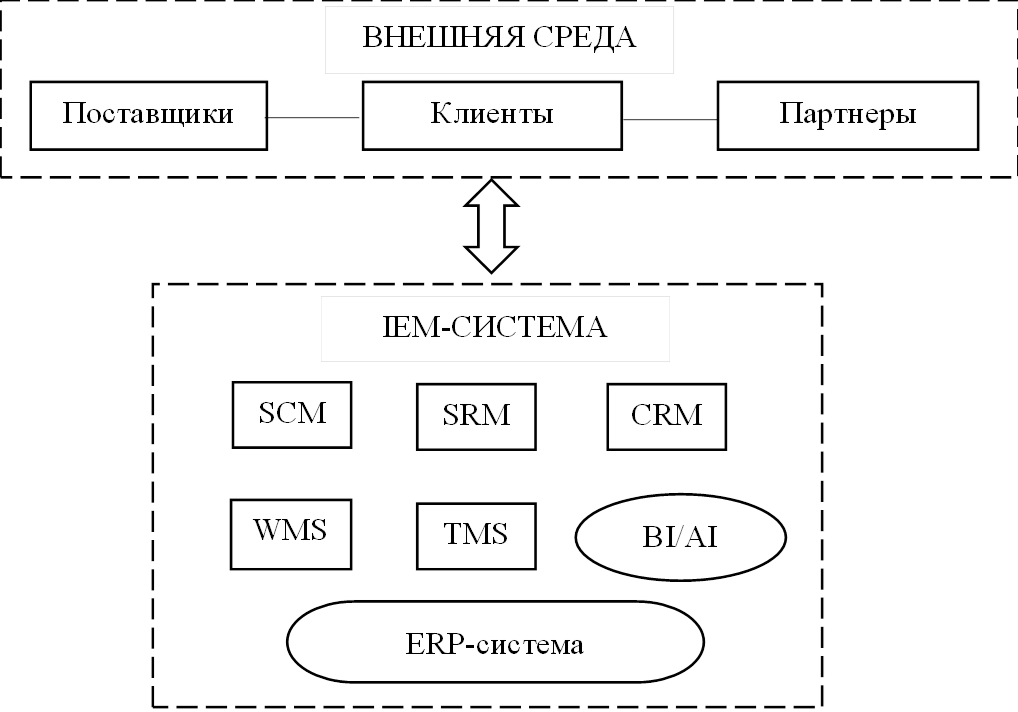 представлена на рисунке 1.
Рисунок 1. Концептуальная модель IEM-системы
Источник: составлено автором.
Концептуальная модель интерпретируется следующим образом: ERP-система выполняет роль транзакционного и учетного ядра, тогда как IEM-система формирует надстройку стратегического и процессного управления, объединяющую внутренние и внешние логистические контуры, включающую: решения SCM, SRM (Supplier Relationship Management – система управления закупками), складские WMS, TMS (Transportation Management System – система управления транспортом), CRM (Customer Relationship Management – система взаимодействия с клиентами), а также инструментарий искусственного интеллекта (AI) и бизнес-аналитики (Business Intelligence), BI). Таким образом, IEM-система «строится поверх» ERP-системы, расширяя ее функционал за счет интеллектуального планирования, более глубокой аналитики и высокой степени интеграции с партнерами.
Преимущества IEM-систем в отношении традиционных ERP наглядно представляет сравнительный анализ по ключевым критериям логистической системы предприятия (табл. 1), а также сравнительный анализ по ключевым функциям бизнес-логистики производства: закупки, управление запасами, распределение и сбыт (табл. 2).
Таблица 1
Сравнительный анализ ERP и IEM-систем по ключевым критериям логистической системы
|
Критерий сравнения
|
ERP-система
|
IEM-система
|
|
Концептуальная
основа
|
Планирование и учет
ресурсов предприятия |
Сквозное управление
бизнес-процессами и цепями поставок |
|
Уровень
интеграции
|
Внутри предприятия
|
Внутри предприятия и за его пределами (поставщики,
дистрибьюторы, клиенты)
|
|
Объект
управления
|
Материальные, финансовые и трудовые ресурсы
|
Потоки: материальные,
информационные, финансовые, сервисные |
|
Тип
аналитики
|
Описательная (отчетность)
|
Предиктивная и
прескриптивная аналитика |
|
Гибкость
и адаптивность
|
Ограниченная
|
Высокая, процессно-
ориентированная |
|
Реакция
на изменения спроса
|
Запаздывающая
|
Реакция в реальном времени
|
|
Технологическая
архитектура |
Монолитная
|
Модульная,
сервис-ориентированная |
|
Роль
в цифровой
трансформации |
Базовый уровень
автоматизации |
Инструмент
стратегического управления |
Таблица 2
Сравнительный анализ ERP и IEM-систем по ключевым функциям бизнес- логистики
|
Функции
|
ERP-система
|
IEM-система
|
|
Логистика закупок
|
Формирование заказов,
контроль бюджета |
Стратегическое управление поставщиками (SRM), оценка рисков
|
|
Управление запасами
|
Нормативные уровни,
MRP-расчеты |
Динамическая оптимизация запасов, прогнозирование спроса
|
|
Распределение и сбыт
|
Планирование отгрузок
|
Интеграция WMS, TMS, оптимизация
маршрутов
|
Сравнительный анализ показал, что реализация модели IEM-системы на практике позволяет предприятиям получать и обрабатывать данные в режиме реального времени, обеспечивая при этом единый источник оперативных данных для всех подразделений, оптимизировать запасы через аналитику спроса и прогнозирование, сокращать время на операционные процессы и улучшает качество принятия решений, снижать издержки и повышать уровень сервиса.
ОПЫТ ВНЕДРЕНИЯ IEM-ПОДХОДА В ОТЕЧЕСТВЕННЫХ И
ЗАРУБЕЖНЫХ КОМПАНИЯХ
Наибольшие преференции от внедрения IEM-систем в процессы бизнес-логистики получают, естественно, крупные компании и корпорации, однако это не означает, что средний и малый бизнес остается вне контура внедрения. Рассмотрим наиболее наглядные примеры, отражающие опыт внедрения элементов IEM-систем в различной их комбинации в отечественных и зарубежных компаниях.
Мировой розничный гигант Walmart служит классическим примером использования IEM-и SCM-инструментов. Компания разработала собственную ERP-систему для управления цепью поставок, включающую автоматизированные распределительные центры, системы отслеживания запасов и совместных прогнозов с поставщиками. Это позволило минимизировать время цикла пополнения запасов и снизить операционные издержки [10]. Следующим ходом компании стала основанная на искусственном интеллекте интеграция торговли Walmart и Google, котрые в начале 2026 года объявили о планах интегрировать запросы-поиски непосредственно в помощника Google Gemini, что свидетельствует о более глубоком переходе к будущему, ориентированному на автономные «агентские» системы, а не на традиционный поиск [7]. Расширение интеграции Walmart с компанией Wing, дочернее предприятие Alphabet, на основе IEM-и SCM-решений, предполагает внедрение беспилотной доставки в 150 магазинов ритейлера. Пилотная программа уже действует в Далласе и Атланте (США), а к 2027 году планируется, что сервис охватит более 270 магазинов [6].
Другим примером внедрения IEM-систем, использующим комбинацию WMS и SRM-инструментов, являются интеграционные процессы в Deere & Company, где реорганизация сети поставок и оптимизация распределения через SCM-системы привели к снижению запасов на миллиард долларов и сокращению времени поставки. Аналогично, Intel реализовала SCM-стратегии на основе принципов IEM, направленные на снижение затрат за счет управления инвентарем и прогнозирования [12].
Опыт внедрения бразильской компанией Alagoas IEM-решений как расширенного функционала на базе имеющейся ERP-системы отражает существенное улучшение межфункционального взаимодействия как для производителя, так и для дистрибьютора, что повысило операционную производительность и рост компании за счет более эффективного управления запасами и логистикой [18] (Canon et al., 2025).
Транснациональная корпорация Nestlе внедрила платформу на основе IEM-систем для создания Digital Twins, в данный момент их уже более 4 тыс. производств товарных продуктов, в течение двух лет планируется увеличить до 10 тыс. [13]. Система цифрового двойника глобальной цепи поставок корпорации в режиме реального времени агрегирует данные от тысяч поставщиков, производственных площадок и дистрибьюторских центров. Во время кризиса в Суэцком канале в 2021 г. система оперативно смоделировала альтернативные маршруты поставок сырья и готовой продукции, рассчитала новые сроки и влияние на производственные графики, что позволило минимизировать убытки и оперативно информировать клиентов.
На выставке CES 2026 конгломерат Siemens предоставил доклад о внедрении IEM-систем, чтобы подчеркнуть, как искусственный интеллект переходит из стадии эксперимента в основу промышленных операций. Например, Siemens AG внедрила AI-решение для косвенных закупок (MRO – Maintenance, Repair, Operations). Система анализирует исторические данные о закупках, описания товаров и поведения покупателей внутри компании. Алгоритмы ML автоматически категорируют неструктурированные запросы, сопоставляют их с оптимальными поставщиками и каталогами, а также выявляют массивные возможности для консолидации закупок и переговоров о скидках. Это привело к автоматизации до 70% рутинных транзакций и снижению затрат на 10–15% за счет выявления лучших условий [16].
Ключевым элементом цифровой трансформации Unilever стала IEM-экосистема на базе искусственного интеллекта, объединяющая все звенья цепочки поставок. Обрабатывая десятки миллиардов данных ежедневно, она обеспечивает сквозную аналитику – от прогноза до доставки. Успех был доказан в коллаборации с Walmart Mexico: реализованная система синхронизации увеличила доступность продукции до рекордных 98%, стимулировав рост продаж на 12% в годовом выражении, и одновременно оптимизировала уровень запасов. Это стало возможным благодаря разрушению традиционных барьеров между отделами и созданию целостной среды для обмена данными в режиме реального времени, что является прорывом для всей индустрии [15].
На основе IEM ПАО «Газпром нефть» создало экосистему цифровых продуктов и сервисов для управления цепочкой поставок Isource [17]. Ее инструменты позволяют оптимизировать закупочные процессы, снижать расходы и автоматизировать производственный контроль. IEM-система также обеспечивает доставку, управление складскими запасами и создает эффективные связи между производителями и поставщиками как в России, так и на международном рынке. Экосистема включает в себя специализированную SRM-платформу Processor для управления закупками и взаимоотношениями с поставщиками [17]. Решение обеспечивает полный цикл работы: от планирования потребностей и формирования годового плана с бюджетом до проведения конкурентных процедур, выбора контрагентов и юридического оформления договоров с применением электронной подписи. Объединяя все этапы в единое цифровое пространство, Processor сокращает сроки и издержки закупочной деятельности. Платформа предлагает глубокую автоматизацию, возможность интеграции с ERP и SCM-системами заказчика, гибкую доработку под специфические задачи, а также адаптивную аналитику. Доступ к системе возможен с любого устройства. Сервис Element, входящий с экосистему выступает как единый агрегатор данных, обеспечивая интеграцию с ИТ-системами компании и каталогами поставщиков и обеспечивает эффективное управление складскими комплексами. Цифровой продукт экосистемы Inspector решает задачу проактивного управления производством, обеспечивая контроль качества и сроков. Цифровой сервис Express предлагает комплексное решение для оптимизации грузоперевозок, он подбирает наиболее эффективные варианты под конкретные заявки, автоматизирует транспортный процесс и помогает сократить расходы. Внедрение цифровой экосистемы позволило компании сократить время проведения закупок по отдельным позициям до 50%. При этом система обеспечивает снижение операционных затрат на закупочную деятельность – до 15% по конкретным категориям и до 10% в целом [17]. Экономия достигается за счет автоматизированного выбора оптимальных коммерческих предложений от поставщиков на рынке. Экосистема Isource также дополнена пакетом финансовых и образовательных сервисов.
Российская ритейл-сеть «Магнит» при внедрении собственного сервиса доставки использовала компоненты IEM-системы для оптимизации «последней мили». Система динамически консолидирует заказы из разных гипермаркетов в один маршрут курьера, рассчитывает оптимальное время сборки заказа на складе с учетом готовности всех позиций и выстраивает маршруты, минимизирующие простой. Это позволило достичь высокого процента доставки в обещанное окно (более 95%) при контролируемых затратах [14]. Другим успешным примером компании по внедрению элементов IEM-систем является интегрированная система управления двором YMS (Yard Management System), которая позволяет автоматизировать ключевые операции, интегрироваться с TMS и WMS, а также обеспечивать высокую прозрачность, оперативность и эффективность взаимодействия всех участников процесса – от водителя и диспетчера, до логистического оператора и руководителя склада, все это обеспечивает прозрачную аналитику по ключевым показателям эффективности, и возможность динамично перестраивать процессы при изменении графиков и условий поставок [9].
Лидером среди российских компаний по внедрению в бизнес-процессы элементов IEM-систем остается ОАО «РЖД», для которой управление транспортно-логистическими потоками и интеграция с внешними клиентами с целью повышение эффективности грузовых перевозок является рутинным операционным процессом [1] (Burya et al., 2024). По материалам [8] уже внедрены на основе технологии блокчейн смарт-контракты, служащие гарантом устойчивых бизнес-ношений в сервисной среде за счет автоматической фиксации доставки на всех этапах транспортного процесса, подтверждающие выполнение условий договора. Реализуется платформа «Мультилог» предназначенная для построения сквозных логистических маршрутов, которая интегрирует различных перевозчиков и виды транспорта в единую экосистему. Она обеспечивает непрерывность доставки, организуя прямое взаимодействие клиента со всеми участниками цепи: оператором подвижного состава, смежными транспортными компаниями и государственными органами. Сервисы электронной площадки «Грузовые перевозки» постоянно развиваются, делая работу клиентов удобнее. Цифровые решения упрощают коммуникацию, позволяют вести весь документооборот онлайн, быстро выстраивать оптимальную цепочку поставки и, как результат, получать ускоренную доставку груза. ОАО «РЖД» первой осуществила комплексную интеграцию своих информационных систем с цифровыми платформами ключевых государственных органов, включая Минтранс России и Росреестр. Компания стала одним из пионеров в создании корпоративной витрины данных в рамках Национальной системы управления данными (НСУД) [8].
Следует отметить, что крупные как отечественные, так и зарубежные компании и концерны предпочитают инсорсинг в процессах разработки цифрового инструментария IEM-систем, организуя дочерние IT-структуры. В то же время, сегодня аутсорсинг IT-услуг и офшорная разработка программного обеспечения считаются действенными механизмами для внедрения инноваций и развития национальных экономик. Российские IT-компании сегодня также предлагают различные подходы реализации систем IEM. Одной из ведущих является компания Ultimate Humanless Enterprises CIS, объединяющая международную команду разработчиков, создавших универсальную организационно-независимую, многоагентную операционную систему IEM – dia$par [30] (Zaman et al., 2025). Система, выпущенная впервые на рынок в 2018 г., непрерывно совершенствуется, она контролирует исполнение всех бизнес-процессов предприятия в режиме реального времени, предоставляя всем бизнес-акторам, включая внешних, единое информационное поле, с равно актуальными и математически достоверными данными, заменяет ERP, CRM, WMS, MES, и т.д., а также обеспечивает защиту данных (100% соответствие требованиям GDPR, General Data Protection Regulation – общий регламент по защите данных). Компания имеет более трехсот примеров удачно реализованных практических кейсов с разнообразным функционалом, в различных отраслях и на разных уровнях и видах внутренней и внешней интеграции (познакомится с некоторыми их них ними можно на официальном сайте разработчиков [11]).
Представленные кейсы успешного практического внедрения позволяют сделать вывод, что IEM трансформирует линейный процесс «производство – склад – магазин – клиент» в адаптивную, замкнутую и самооптимизирующуюся сеть, где физические и информационные потоки синхронизированы в реальном времени. Перспективная задача научных исследований заключается в разработке эффективных экономических механизмов адаптации быстро прогрессирующего цифрового инструментария в практическую среду, что позволит полноценно реализовать все возможности IEM-систем в процессах бизнес-логистики, а не только комбинаторику ее отдельных элементов.
ЗАКЛЮЧЕНИЕ
Проведенный анализ выявил, что тенденции развития интегрированных систем управления предприятием в сфере логистического функционала направлены на трансформацию интегрированных систем управления предприятием из систем регистрации и регламентации в системы непрерывного моделирования, прогнозирования и автономного принятия решений. Рассмотренные практические кейсы, отражающие опыт внедрения IEM, позволяют утверждать, что именно IEM-системы сегодня выступают в роли катализатора фундаментальной трансформации бизнес-логистики производства, обеспечивая переход от реактивной и фрагментированной модели управления к предиктивной и управляемой данными (data-driven). Уже сегодня конвергенция цифровых двойников, предиктивной аналитики и децентрализованных автономных систем создает кибернетическую бизнес-логистику, способную к непрерывной самооптимизации в реальном времени. Ключевым вызовом станет не технология, а адаптация человеческого капитала и организационных структур к работе в симбиозе с такими высокоавтоматизированными, интеллектуальными IEM-системами. Фундаментальные кибернетические законы, сформулированные десятилетия назад, получают свое полное технологическое воплощение, определяя облик бизнес-логистики будущего.
Источники:
2. Клименко И.С. Интерпретация принципа необходимого разнообразия Эшби применительно к управлению в социально-экономических системах // Вестник Российского нового университета. Серия: Сложные системы: модели, анализ и управление. – 2012. – № 4. – c. 45-47.
3. Кучковская Н.В. Экономическое значение систем интеллектуального управления предприятием // Инновационное развитие экономики. – 2019. – № 1(49). – c. 44-50.
4. Мустафин Т.А. Логистика 4.0 как инструмент минимизации рисков // Экономика и предпринимательство. – 2024. – № 11(172). – c. 1041-1045. – doi: 10.34925/EIP.2024.172.11.183.
5. Олефиренко А.И. Интеллектуализация систем автоматизации предприятий в парадигме Intelligent Enterprise Management // Современная наука: актуальные проблемы теории и практики. Серия: Экономика и право. – 2017. – № 8. – c. 36-40.
6. Официальный сайт аналитического агентства ASECTOR.RU. [Электронный ресурс]. URL: https://asector.ru/news/2026_01_walmart_i_wing (дата обращения: 08.01.2026).
7. Официальный сайт аналитической компании в области глобальной криптоэкономики CoinDesk. [Электронный ресурс]. URL: https://www.coindesk.com/ru/tech/2026/01/11/walmart-and-google-bet-on-ai-agents-to-reshape-how-people-shop-online (дата обращения: 08.01.2026).
8. Официальный сайт Ассоциации «Цифровой транспорт и логистика». [Электронный ресурс]. URL: https://dtla.ru/ (дата обращения: 08.01.2026).
9. Официальный сайт компании IT-разработчика КОРУС-логистика. [Электронный ресурс]. URL: https://wms.korusconsulting.ru/expertise/tsifrovizatsiya-logisticheskikh-protsessov-dlya-pao-magnit-keys-vnedreniya-yms/ (дата обращения: 08.01.2026).
10. Официальный сайт компании Napoleon IT разработчика AI-решений для бизнеса. [Электронный ресурс]. URL: https://napoleonit.ru/blog/ii-v-riteyle-opyt-mirovogo-giganta-walmart (дата обращения: 08.01.2026).
11. Официальный сайт компании-разработчика Diaspar Business. [Электронный ресурс]. URL: https://diasparbusiness.com/cis-ru/ (дата обращения: 08.01.2026).
12. Официальный сайт международной группы консалтинговых компаний Logistics Bureau. [Электронный ресурс]. URL: https://www.logisticsbureau.com/ (дата обращения: 08.01.2026).
13. Официальный сайт сетевого информационно-аналитического издания Сетевое издание AdIndex. [Электронный ресурс]. URL: https://adindex.ru/news/digital/2025/06/17/334313.phtmlhttps://adindex.ru/news/digital/2025/06/17/334313.phtml (дата обращения: 08.01.2026).
14. Электронная медиа платформа Retail.ru. [Электронный ресурс]. URL: https://www.retail.ru/interviews/ (дата обращения: 08.01.2026).
15. Электронная медиа платформа Technology Magazine журналов по технологии и искусственному интеллекту. [Электронный ресурс]. URL: https://technologymagazine.com/articles/ai-the-new-secret-ingredient-in-unilevers-customer-recipe (дата обращения: 08.01.2026).
16. Электронное издание eeNews Europe [Электронный ресурс]. URL: https://www.eenewseurope.com/en/siemens-unveils-industrial-ai-technologies-at-ces-2026/#:~:text=At%20CES%202026%2C%20Siemens%20used,are%20designed%2C%20simulated%20and%20operated (дата обращения 08.01.2026).
17. Электронное новостное и аналитическое агенство ComNews в сфере цифровой трансформации и IТ. [Электронный ресурс]. URL: https://www.comnews.ru/content/231369/2024-02-15/2024-w07/1180/programmnye-razrabotki-rossiyskikh-korporaciy (дата обращения: 08.01.2026).
18. Canon Ju.G.F., dos Santos R.J.R., de Carvalho V.D.H., Monte M.B.Da.S., de Barros T.L. Integrated Logistics Management Through ERP System: A Case Study in an Emerging Regional Market // Logistics. – 2025. – № 2. – p. 59. – doi: 10.3390/logistics9020059.
19. Galuschenko A. Paradigm of Integrated Enterprise Managing (IEM) System as Universal (Organization-Independent) Enterprise Operating System. From Real Digital Transformation of Real Economy to Economic Singularity // Asian Business Research Journal. – 2020. – p. 28-42. – doi: 10.20448/JOURNAL.518.2020.5.28.42.
20. Herbke P. et al. DIDChain: Advancing Supply Chain Data Management with Decentralized Identifiers and Blockchain // /In 2024 IEEE International Conference on Service-Oriented System Engineering (SOSE). Shanghai, 2024. – p. 54-63.– doi: 10.1109/SOSE62363.2024.00013.
21. Li P., Chen Y., Guo X. Digital transformation and supply chain resilience // International Review of Economics & Finance. – 2025. – p. 104033. – doi: 10.1016/j.iref.2025.104033.
22. Massari G.F., Nacchiero R., Giannoccaro I. Transformative supply chains: the enabling role of digital technologies // International Journal of Production Economics. – 2025. – p. 109562. – doi: 10.1016/j.ijpe.2025.109562.
23. Michou H., Richet J.L. Digital transformation, emergence and complexity in supply networks // International Journal of Information Management. – 2025. – p. 102917. – doi: 10.1016/j.ijinfomgt.2025.102917.
24. Mohsen B.M., Mohsen M. Intelligent Supply Chain Networks: Integrating AI, Big Data, and Future Communication Technologies for Enhanced Decision-Making // Procedia Computer Science. – 2025. – p. 8-16. – doi: 10.1016/j.procs.2025.07.150.
25. Najmi M.H., Iqbal S.M.A., Khan S. Aligning Supply Chain Functions with Emerging Technologies: A Strategic Approach // Engineering Proceedings. – 2024. – № 1. – doi: 10.3390/engproc2024076034.
26. Odrekhivskyi M., Pshyk-Kovalska O., Zhezhukha V., Ivanochko I. Intelligent Management of Enterprise Business Processes // Mathematics. – 2023. – № 1. – p. 78. – doi: 10.3390/math11010078.
27. Olefirenko A. I., Galuschenko A. Major Features, Benefits, and Prerequisites for Intelligent Enterprise Managing System // Research in Social Sciences and Technology. – 2018. – № 3. – doi: 10.46303/ressat.03.03.5.
28. Tubis A.A., Grzybowska K., Król B. Supply Chain in the Digital Age: A Scientometric–Thematic Literature Review // Sustainability. – 2023. – № 14. – p. 11391. – doi: 10.3390/su151411391.
29. Yaremko S.A., Kuzmina E.M., Savina N.B., Gromaszek K., Yeraliyeva B., Borankulova G. Intelligent System in the Context of Business Process Modelling // International Journal of Electronics and Telecommunications. – 2021. – № 2. – p. 163-168. – doi: 10.24425/ijet.2021.135959.
30. Zaman S.A.A., Qazi H., Zafar A., Jiang Y. Emerging Technologies and Smart Supply Chain Management: A Roadmap for Future Success. / In book: Smart Supply Chain Management. - Singapore: Springer, 2025. – 135-156 p.
Страница обновлена: 03.10.2026 в 03:09:36
Download PDF | Downloads: 20
IEM systems in business logistics: the reality of cybernetic integration and development prospects
Rozhko O.N.Journal paper
Journal of Economics, Entrepreneurship and Law
Volume 16, Number 3 (March 2026)
Abstract:
The article discusses the application of integrated enterprise management systems (IEM systems) in procurement logistics, inventory management and distribution. A comparative analysis of the functionality of the IEM approach, aimed at optimizing logistics flows from production to the end user, and an assessment of its practical effectiveness in relation to traditional systems is carried out. A conceptual model of the IEM system is presented; and a comparison of key indicators of innovative and traditional management systems is carried out. The main persistent systemic contradictions of the introduction of IEM systems and key areas of transformation have been identified.
They are: predictive and prescriptive analytics, the implementation of hybrid digital twins, the unique implementation of the Logistics 4.0 decentralization principle through a combination of centralized strategic goal setting with high autonomy of executive elements. Practical examples confirms the main conclusions of the study. The thesis on the transition from linear purchasing and distribution models to adaptive, data-based network ecosystems is substantiated. The conclusion about the prospects of applying IEM systems as an evolutionary stage in the development of corporate information systems in logistics is made.
Keywords: integrated enterprise management systems, procurement, inventory, distribution logistics, intelligent supply networks
JEL-classification: L90, L20, L53, R15
References:
Burya L.V., Kotelnikov D.N., Merkulov S.D. (2024). Intelligent Management Systems on the Russian Railway: The Evolution of Logistics and Supply Chains in the Era of Digitalization. Aktualnye issledovaniya. (50-1(232)). 6-10.
Canon Ju.G.F., dos Santos R.J.R., de Carvalho V.D.H., Monte M.B.Da.S., de Barros T.L. (2025). Integrated Logistics Management Through ERP System: A Case Study in an Emerging Regional Market Logistics. 9 (2). 59. doi: 10.3390/logistics9020059.
Galuschenko A. (2020). Paradigm of Integrated Enterprise Managing (IEM) System as Universal (Organization-Independent) Enterprise Operating System. From Real Digital Transformation of Real Economy to Economic Singularity Asian Business Research Journal. 5 28-42. doi: 10.20448/JOURNAL.518.2020.5.28.42.
Herbke P. et al. (2024). DIDChain: Advancing Supply Chain Data Management with Decentralized Identifiers and Blockchain /In 2024 IEEE International Conference on Service-Oriented System Engineering (SOSE). 54-63. doi: 10.1109/SOSE62363.2024.00013.
Klimenko I.S. (2012). The Ashby Principle Interpretation According to Management in Social-Economic Systems. Vestnik Rossiyskogo novogo universiteta. Seriya: Slozhnye sistemy: modeli, analiz i upravlenie. (4). 45-47.
Kuchkovskaya N.V. (2019). The economic importance of intelligent enterprise management systems. Innovative development of economy. (1(49)). 44-50.
Li P., Chen Y., Guo X. (2025). Digital transformation and supply chain resilience International Review of Economics & Finance. 99 104033. doi: 10.1016/j.iref.2025.104033.
Massari G.F., Nacchiero R., Giannoccaro I. (2025). Transformative supply chains: the enabling role of digital technologies International Journal of Production Economics. 283 109562. doi: 10.1016/j.ijpe.2025.109562.
Michou H., Richet J.L. (2025). Digital transformation, emergence and complexity in supply networks International Journal of Information Management. 84 102917. doi: 10.1016/j.ijinfomgt.2025.102917.
Mohsen B.M., Mohsen M. (2025). Intelligent Supply Chain Networks: Integrating AI, Big Data, and Future Communication Technologies for Enhanced Decision-Making Procedia Computer Science. 265 8-16. doi: 10.1016/j.procs.2025.07.150.
Mustafin T.A. (2024). Logistics 4.0 as a tool for minimizing risks. Journal of Economy and Entrepreneurship. (11(172)). 1041-1045. doi: 10.34925/EIP.2024.172.11.183.
Najmi M.H., Iqbal S.M.A., Khan S. (2024). Aligning Supply Chain Functions with Emerging Technologies: A Strategic Approach Engineering Proceedings. 76 (1). doi: 10.3390/engproc2024076034.
Odrekhivskyi M., Pshyk-Kovalska O., Zhezhukha V., Ivanochko I. (2023). Intelligent Management of Enterprise Business Processes Mathematics. 11 (1). 78. doi: 10.3390/math11010078.
Olefirenko A. I., Galuschenko A. (2018). Major Features, Benefits, and Prerequisites for Intelligent Enterprise Managing System Research in Social Sciences and Technology. 3 (3). doi: 10.46303/ressat.03.03.5.
Olefirenko A.I. (2017). Intellectualization of Enterprise Automation Systems in the Intelligent Enterprise Management Paradigm. Sovremennaya nauka: aktualnye problemy teorii i praktiki. Seriya: Ekonomika i pravo. (8). 36-40.
Tubis A.A., Grzybowska K., Król B. (2023). Supply Chain in the Digital Age: A Scientometric–Thematic Literature Review Sustainability. 15 (14). 11391. doi: 10.3390/su151411391.
Yaremko S.A., Kuzmina E.M., Savina N.B., Gromaszek K., Yeraliyeva B., Borankulova G. (2021). Intelligent System in the Context of Business Process Modelling International Journal of Electronics and Telecommunications. 67 (2). 163-168. doi: 10.24425/ijet.2021.135959.
Zaman S.A.A., Qazi H., Zafar A., Jiang Y. (2025). Emerging Technologies and Smart Supply Chain Management: A Roadmap for Future Success Singapore: Springer.