Development trends of North Macedonia’s labor market
Воронова Т.А.1  , Селамовски Ф.1
1 Российский экономический университет им. Г.В. Плеханова, Москва, Россия
Скачать PDF | Загрузок: 7
Статья в журнале
Лидерство и менеджмент (РИНЦ, ВАК)
опубликовать статью | оформить подписку
Том 13, Номер 3 (Март 2026)
Эта статья проиндексирована РИНЦ, см. https://elibrary.ru/item.asp?id=89141017 [89141017]
Аннотация:
В данной статье оценивается текущее состояние македонского рынка труда на основе анализа трендов занятости, номинальной производительности труда, динамики заработной платы и миграционных потоков. Результаты показывают, что что развитие рынка труда уступает показателям других балканских и западноевропейских стран. Северная Македония характеризуется одним из наиболее высоких уровней безработицы среди европейских государств и испытывает серьезные трудности, включая низкий уровень занятости населения, сокращение числа трудоспособных граждан вследствие эмиграции и низкого уровня рождаемости за последние три десятилетия. В текущих условиях повышение производительности труда имеет решающее значение для компенсации негативных последствий демографических проблем, поддержания стабильности рынка труда и повышения общего объема производства
Ключевые слова: рынок труда, отток трудовых ресурсов, производительность, депопуляция, Северная Македония
JEL-классификация: J21, F22, D24, J11, R23
Introduction
The labor market plays a crucial role in shaping an economy by determining employment levels, wage rates and productivity. A healthy labor market contributes to economic growth through increased production capacity and innovation [13] (Radło et al., 2022). Conversely, issues like high unemployment or skill mismatches can lead to inefficiencies and reduced potential output. Additionally, government policies aimed at improving education, training programs, and labor regulations directly impact both individual opportunities and broader macroeconomic outcomes. Thus, understanding its dynamics helps policymakers design effective strategies for sustainable development.
Positive labor market development is also a necessity for North Macedonia given the current presence of serious issues such as emigration of working-age population to developed Western European countries, lack of skilled workforce and high unemployment rates. Hence, the aim of the study is to analyze the current state of the Macedonian labor market and draw meaningful conclusions about the prospects of future development.
The paper is structured as follows: the first part presents the analysis of the employment trends, wages’ dynamics, labor force participation rate and labor productivity. The second part discusses the developmental prospects of the Macedonian labor market. The last part provides the key conclusions.
Analysis of the current state of the Macedonian labor market
As a former socialist republic of Yugoslavia, North Macedonia inherited a system of central economic planning and levels of employment geared toward full employment. In the 1990s North Macedonia faced severe economic issues related to its secession from Yugoslavia and subsequent transition towards a market economy. This period was characterized by a significant loss in GDP, rampant inflation and high unemployment of over 30% [14] (Raveni, 2021). The high unemployment was a direct consequence of the collapse of state-owned companies in conditions when the private sector lacked sufficient capacity to absorb all those who had lost their jobs. High unemployment rates were also partly fueled by the economic reforms. Trade liberalization policies, the introduction of property rights, and implementation of regulations supportive of a market-oriented framework facilitated the emergence of a dynamic and adaptable labor market. However, while these reforms contributed significantly to economic restructuring, they simultaneously led to adverse social consequences including proliferation of informal employment arrangements [20].
Since the early 2000s, the country has undertaken significant efforts to create new jobs i.e. boost the labor supply aiming to accelerate economic growth. These efforts were mostly based on two main factors: firstly, the successful implementation of the 2006 Foreign Direct Investment attraction policy that offered substantial incentives for foreign companies to establish manufacturing facilities in North Macedonia; secondly, complementary measures including active labor market initiatives and temporary governmental subsidies aimed at creating additional job opportunities. As a result of the positive economic and political trends in the country, the number of people employed within the economy experienced a significant growth between 2006 and 2019 (Figure 1). This figure increased by almost 217 thousand.
The trend of continuous growth was interrupted in 2020 by the COVID-19 pandemic which led to a considerable decrease in the number of people employed. Although the pandemic is already pretty far behind and economic growth rates have since recovered, the number of people employed did not fully rebound. In 2024, it was still 6,7% lower than the 2019 level.
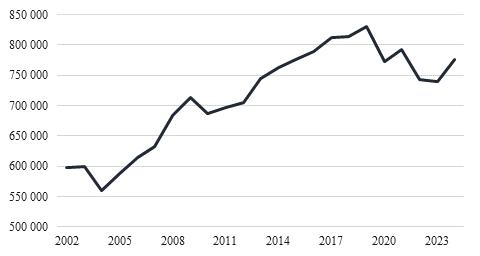
Figure 1. Total number of people employed, 2002–2024, ppl.
Source: Statistical Office of North Macedonia [17].
That said, the unemployment rates remain significantly higher in comparison with the European Union. In 2024 the overall unemployment rate in North Macedonia and the EU stood at 13,4% and 5,9% respectively [7]. However, it is notable that since 2015 the country has witnessed considerable progress in decreasing unemployment rates. In 2015 the unemployment rate was significantly higher – 26,1% [17]. Nevertheless, the country still has one of the highest unemployment rates in Europe, just behind Montenegro which had an unemployment rate of 14,1% in 2024.
The aforementioned decrease in the number of people employed might indicate that to some extent the unemployment rates are decreasing not simply as a result of the creation of new jobs and reduction in informal employment but also due to such factors as shrinkage of labor force and the overall population of the country. In turn, the labor force shrinkage is a direct consequence of ageing population amid low birth rates coupled with significant emigration of working-age population to other Western economies.
In this context it should be noted that North Macedonia has been an emigration country since the post–World War II period. Moreover, emigration has accelerated over the last decade. Although accurate data is not available, the United Nations estimated a migration stock of roughly 650 thousand, or almost one-third of the population, at the end of 2019. Between 1990 and 2019, it is estimated that more than 200 thousand Macedonians departed abroad [6]. The accelerated emigration is contributable to a mix of factors such as the visa facilitation agreement between North Macedonia and the European Union in 2007 combined with the inability of the country to accelerate income convergence with developed Western economies and to swiftly address domestic economic issues.
Emigrants from North Macedonia tend to be younger individuals with a diverse range of skill levels. Those who have higher education primarily settle in distant nations like the United States, Canada, and Australia. In contrast, lower or moderately skilled migrants usually stay within Western Europe, where most Macedonian expatriates can be found [6]. The inclination for Macedonian expatriates to repatriate is minimal. Consequently, knowledge acquired overseas is unlikely to benefit local developmental objectives.
Despite considerable governmental efforts over the past few decades aimed at attracting skilled returnees, the broader economic climate has also discouraged their return. Furthermore, the country struggles to match the sophisticated skill-retention initiatives implemented by wealthier nations facing demographic challenges and increasing demand for talent replenishment such as Germany. The number of Macedonian emigrants to Germany almost quadrupled between 2005 and 2019. While the pace was initially driven by the proliferation of Macedonians acquiring Bulgarian passports, the 2016 changes in Germany’s migration regime have also contributed significantly. Specifically, Germany proposed a labor migration scheme for citizens from Albania, Bosnia and Herzegovina, Kosovo, Montenegro, North Macedonia and Serbia, which was approved in October 2015 and went into effect from January 2016. In the years 2016 and 2017 alone, Macedonian nationals received nearly 21 000 approvals from Germany’s Federal Employment Agency and almost 8 000 newly issued visas. Nearly half of all approvals were issued in the category of skilled worker, while the industries for which approvals were most frequently granted in 2017 were construction and hospitality [10].
Despite the aforementioned positive developments over the last two decades, as observed, labor market outcomes in North Macedonia still lag. Although a general trend of declining labor force participation rate (LFPR) was witnessed in most European countries between 1990 and 2014, some regional and European peers have managed to reverse it over the last decade. For instance, after almost two decades of declining, the LFPR in Albania increased from 53,4% in 2014 to 60,7% in 2024. Similarly, in Serbia the LFPR increased from 51,6% to 57,2%. Albeit to a lesser extent, the same situation can be observed in Bulgaria and Slovenia. On the other side, LFPR in North Macedonia continued to decrease and in 2024 stood at 52,3%, almost 4 p.p. down compared to 1990 [21].
In general, a significant gap with the European Union whose LFPR stood at 57,5% is evident. Compared to some of the largest and leading European economies this gap is even more considerable. For instance, the LFPR in the UK and Germany in 2024 was around 61–62%. Germany even managed to increase the LFPR rate by 2,7 p.p. over the last three decades.
Table 1
Labor force participation rate, % of total population aged 15+
|
Countries
|
1990
|
1994
|
2004
|
2014
|
2024
|
|
Macedonia
|
56,2
|
54,8
|
53,4
|
54,6
|
52,3
|
|
Bosnia
|
54,7
|
52,3
|
51,6
|
50,5
|
49,3
|
|
Croatia
|
57,6
|
55,6
|
52,9
|
52,2
|
52,1
|
|
Montenegro
|
50,7
|
50,0
|
48,3
|
51,6
|
48,0
|
|
Serbia
|
58,1
|
56,9
|
54,0
|
51,6
|
57,2
|
|
Slovenia
|
58,6
|
58,1
|
59,1
|
57,9
|
58,4
|
|
Albania
|
61,8
|
63,4
|
57,5
|
53,4
|
60,7
|
|
Bulgaria
|
53,5
|
52,3
|
50,9
|
54,0
|
56,7
|
|
Greece
|
50,3
|
50,3
|
52,0
|
51,2
|
51,6
|
|
Germany
|
58,2
|
58,7
|
57,5
|
60,4
|
60,9
|
|
United Kingdom
|
62,4
|
60,8
|
61,4
|
62,1
|
61,7
|
|
European Union
|
56,0
|
55,3
|
55,7
|
56,7
|
57,5
|
Another indicator that is lagging behind are wages. Over the last decade average monthly gross wages (AMGW) exhibited higher growth rates. In 2024 the AMGW surpassed 60.000 Macedonian denars (approximately 1000 euros) [17], which is almost a two-fold increase compared to 2015. For comparison, between 2005 and 2014 the AMGV increased by only 46%.
This situation is mostly contributable to a combination of various factors such as productivity adjustments, changes in government policies and labor market conditions. In terms of productivity adjustments, it is notable that North Macedonia quite successfully managed to attract foreign direct investments into ICT and financial services which have relatively higher productivity and, in most cases, higher average salaries vis-à-vis the traditional domestic sectors. With regard to the labor market conditions, wages growth also coincides with the lack of skilled workers in many sectors due to significant emigration to Western countries and the presence of significant skills mismatch.
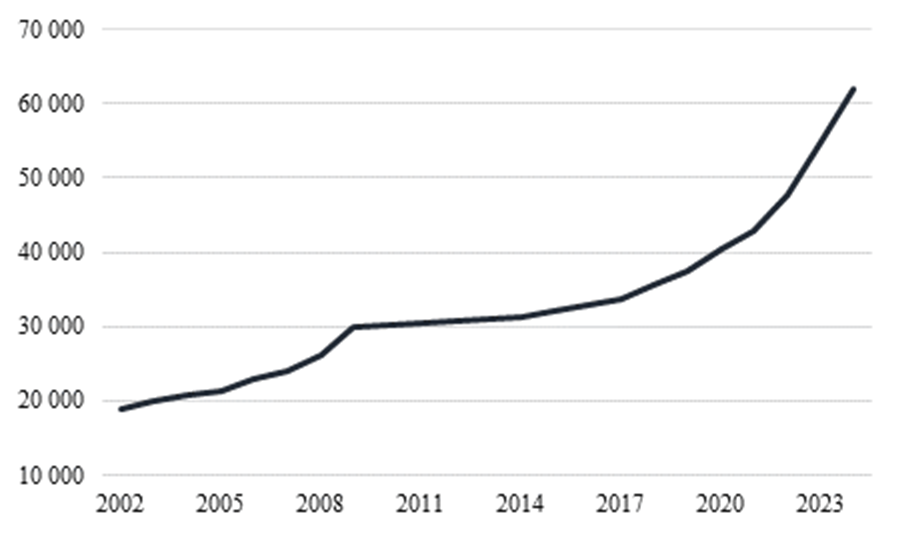
Figure 2. Average monthly gross wage, 2002–2024, Macedonian denars
Source: Statistical Office of North Macedonia [17].
Despite the fact that AMGW have been increasing faster than in most Western European countries, a significant gap still remains in place. The average monthly net salary in 2024 reached 740 euros – 7,9x lower than Switzerland which has the highest net salaries among European economies. North Macedonia is also lagging behind its regional peers. For instance, the average net salary in Slovenia and Croatia was 2,17 and 1,96 times higher. Although, the gap is smaller, wages in North Macedonia are also lower compared to Bulgaria, Serbia and Montenegro. The only regional peers which Macedonia is ahead of are Albania and Kosovo.
As with salaries, labor productivity in North Macedonia has been increasing faster than in most EU countries. The nominal labor productivity (NLP) in 2023 reached 19,6 thousand euros [7], a 75% increase compared to 2014. For comparison, the NLP in the largest European economies, Germany and France, increased by 33% and 18% respectively. Moreover, in terms of the growth rates, the country outpaced some regional peers such as Greece, Slovenia and Croatia, whose NLP increased by 13%, 45% and 60% respectively. However, vis-à-vis Bulgaria and Serbia, North Macedonia falls behind. The NLP in Bulgaria increased by 118% and in Serbia by 95%. In this context, it should be noted that to a large extent the limited growth of NLP compared to other countries explains the wages gap. As aforementioned, the NLP in North Macedonia between 2014 and 2023 increased by 75% which is equivalent to the AMGW growth for the same period. However, long-term growth requires outpacing growth rates of labor productivity over wages.
Although there are some grounds to claim that NLP growth has accelerated, yet again, a considerable gap with the current EU levels remains. Moreover, the gap with other Central and Eastern European countries is widening. For instance, among the EU members, Bulgaria has the lowest NLP and yet is 39% higher than North Macedonia’s. It also notable that in the early 2000s North Macedonia had higher NLP than Romania. However, since its accession to the EU, Romania has experienced rapid NLP growth and currently its NLP is twice the Macedonian level. Similarly, widening gap is observed when comparing the NLP levels to the ones in the Baltic countries. The gap between North Macedonia and Latvia and Lithuania was 30% in 2000, but in 2023 their NLP was two times higher.
Discussion of prospects
The forecast for the Macedonian labor market is not a positive one mostly due to the issue of declining population. According to Eurostat and UNCTAD, it is expected that the population of North Macedonia will continue to decline and by 2045 will fall below 1,6 million [7, 18]. By 2025 this figure is expected to fall to 1,5 million (Figure 3) which indicates that the population will decrease by 17% compared to current figures.
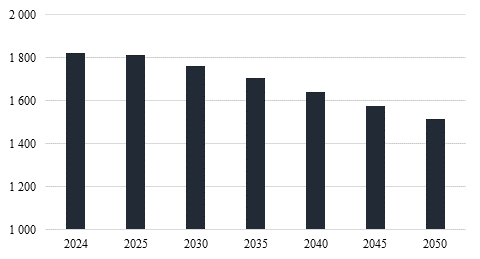
Figure 3. Population forecast, 2024–2050, ppl.
Source: Eurostat and UNCTAD [7, 8] (Fasani et al., 2020).
The expected declining population is mostly related to the deepening integration and potential full EU membership of North Macedonia. The country signed the Stabilization and Association Agreement in 2001 and became an EU candidate in 2005 [4, 15] (Selamovski , Voronova, 2025). The potential risks of full EU members for the general population and labor market are evident when analyzing the case of Croatia (Figure 4).
The number of Croatian emigrants in the first three years after its EU accession which enabled free movement of labor grew exponentially and as of 2017 remains extremely high compared to the pre-accession period. Most of the emigration flows are directed to other EU countries with higher net wages, most notably Germany, Austria and Italy. Given that most of the emigrants are aged 20–49, these migration patterns placed considerable pressure on the Croatian labor market [19] (Valenta et al., 2024). As a result, the Croatian labor policy partly aimed to furtherly liberalize labor movement and attract immigrants from non-EU countries, including Serbia and North Macedonia, in order to cover arising labor shortages. It is notable that the emigration intensity from Croatia is comparable to the level witnessed in Romania and Bulgaria since its EU accession in 2007 [5] (Drazenovic et al., 2018). Similar patterns were also witnessed in Latvia and Lithuania after their EU accession in 2004 [12] (Krisjane et al., 2013).
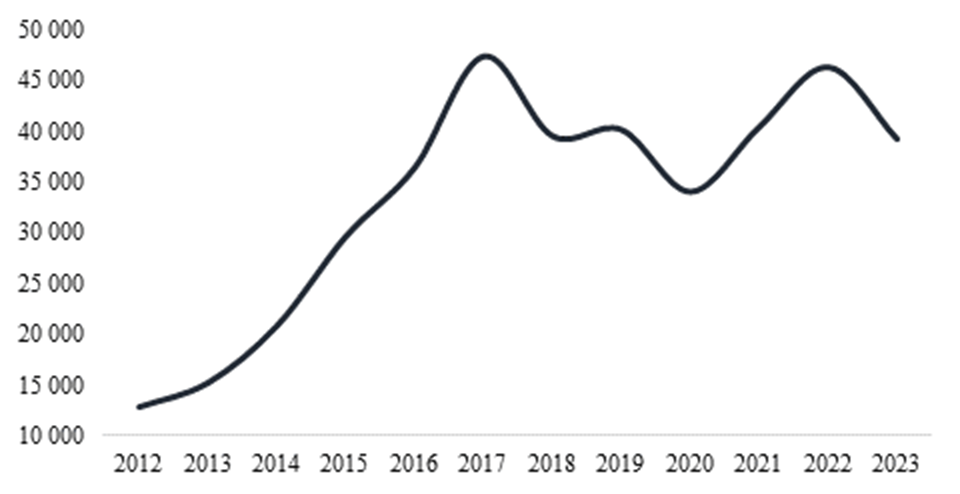
Figure 4. Number of emigrants from Croatia, 2012–2023, ppl.
Source: Eurostat. URL: https://ec.europa.eu/eurostat/data/database.
Decreasing population can have numerous negative, perhaps even devastating, effects on the Macedonian labor market given that unlike Croatia, Bulgaria and Romania, as aforementioned, North Macedonia struggles to attract skilled labor from other countries. The only viable option would be to import labor from third countries with even lower net wages. Macedonian authorities have already implemented some liberalization measures such as increasing quotas on migrants from Asia. However, the country has struggled to retain the immigrants. Many of them have used North Macedonia simply as a transit point for further migration to Western European countries.
Having this in mind, probably one of the main negative effects would be a further exacerbation of the labor shortage. A smaller working-age population means less available workers to fill job vacancies across industries. This can lead to a tighter labor market where companies have difficulties finding qualified employees, potentially resulting in increased wages but also higher unemployment rates among those who are less skilled or experienced [8] (Fasani et al., 2020). Another negative effect is the widening skills gap arising out of the labor shortage issues. As older generations retire, there may be a lack of transferable skills from one generation to another. Industries that rely heavily on specialized knowledge might face difficulties maintaining productivity levels without adequate replacements for retiring professionals.
Moreover, significant decrease in population can yield economic slowdown given its direct impact on demand. Fewer consumers mean lower demand for goods and services, which affects businesses' profitability and growth potential. Companies may scale back operations due to reduced consumer spending power, leading to layoffs and further weakening the economy [13] (Radło et al., 2022).
In the context of potential economic slowdown, narrowing labor market disparities is needed to mitigate the adverse effects of the forecasted population decline due to emigration. IMF estimates suggest that bridging the gap with the European Union through raising the labor force participation rate by roughly 10 percentage points and reducing unemployment by about 7 percentage points could boost potential output by nearly 25% [3] (Ayerst et al., 2025). This implies that addressing just one-third of this discrepancy would suffice to counterbalance anticipated demographic losses by 2030. Furthermore, initiatives aimed at diminishing these inequalities are expected to enhance motivations for people to stay engaged in the domestic economy.
Labor productivity plays a critical role under conditions of declining population, youth emigration, and low labor force participation rates because it directly affects economic growth and living standards despite the shrinking workforce. When there’s a decline in working-age individuals due to demographic shifts or emigration, higher labor productivity can help maintain output levels even with fewer workers [9, 11] (Gomado, 2025; Korkmaz et al., 2017). This ensures that production doesn’t suffer significantly from reduced manpower. Higher productivity allows each worker to produce more goods and services per hour worked [1] (Alani, 2012). As such, GDP can grow at a faster pace than would otherwise be possible given the smaller number of active workers. Moreover, this situation creates room for innovation, technological advancements, and overall efficiency improvements within firms and industries [2] (Al-Dalameh et al., 2021).
Conclusion
Some progress has been noted in the development of the labor market in North Macedonia. Unemployment rates are at their lowest level since the secession of the country from Yugoslavia. Wages and labor productivity have been growing at rates higher that the average growth rates of the European Union. Nevertheless, a series of issues remains a place. The current state of the Macedonian labor market can be characterized as a one of low labor force participation rates, significant youth emigration, ageing population and skill shortages. Moreover, unemployment rates still remain among the highest in Europe. These negative occurrences combined with the expected decrease in population, low inclination of emigrants to repatriate and the inability to attract skilled labor from third countries highlight the need for addressing disparities by raising the labor force participation rate, decreasing unemployment rates and increasing labor productivity in order to maintain stable economic growth rates in the long-run.
Источники:
2. Al-Dalameh M., Dajnoki K. The effect of migration on the labor market in the developed countries: A Systematic Review // International Business Management. – 2021. – № 2. – p. 72-78. – doi: 10.36478/ibm.2021.72.78.
3. Ayerst S., Kovachevska Stefanova S. Population dynamics, labor market ntegration, and migration, Republic of North Macedonia. / IMF Selected Issues Paper (SIP/2025/064). - Washington, D.C.: International Monetary Fund, 2025.
4. Besimi, F. 2025. The path of North Macedonia to the European Union is the only way forward. In: Stojkov, A., Warin, T. (eds) Western Balkans and the Future of Europe. The Future of Europe. Springer, Cham. https://doi.org/10.1007/978-3-031-86465-0_8 URL: https://doi.org/.
5. Drazenovic I., Kunovac M., Pripuzic D. Dynamics and determinants of emigration: the case of Croatia and the experience of new EU members // Public Sector Economics. – 2018. – № 4. – p. 415-447. – doi: 10.1016/10.3326/pse.42.4.3.
6. European Training Foundation. 2021. How migration, muman capital and the labor market interact in North Macedonia. [Электронный ресурс]. URL: https://openspace.etf.europa.eu/system/files/2021-07/migration_north_ (дата обращения: 17.12.2025).
7. Population and social conditions. Eurostat. 2025. [Электронный ресурс]. URL: https://ec.europa.eu/eurostat/data/database (дата обращения: 14.12.2025).
8. Fasani F., Llull J., Tealdi C. The economics of migration: labor market impacts and migration policies // Labour Economics. – 2020. – doi: 10.1016/j.labeco.2020.101929.
9. Gomado K.M. Labor productivity growth effects of structural reforms: evidence from developing countries // Journal of Productivity Analysis. – 2025. – p. 151-182. – doi: 10.1007/s11123-024-00743-1.
10. Hoffmeyer-Zlotnik, P. (2019). Developments in Germany in the context of visa liberalisation. Working Paper 83. European Migration Network.
11. Korkmaz S., Korkmaz O. The relationship between labor productivity and economic growth in OECD Countries // International Journal of Economics and Finance. – 2017. – № 5. – p. 71. – doi: 10.5539/ijef.v9n5p71.
12. Krisjane, Z., Berzins, M., Apsite, E. 2013. Post-accession migration from the Baltic States: the case of Latvia. In B. Glorius, I. Grabowska-Lusinska, & A. Kuvik (Eds.), Mobility in Transition: Migration Patterns after EU Enlargement (pp. 85–110). Amsterdam University Press. http://www.jstor.org/stable/j.ctt46mwhx.7
13. Radło M.J., Tomeczek A.F. Factors influencing labor productivity in modern economies: a review and qualitative text analysis // WSEAS Transactions on Environment and Development. – 2022. – № 18. – p. 291-314. – doi: 10.37394/232015.2022.18.30.
14. Raveni A. Labour market flexibility in transition countries: a case study of North Macedonia // ILIRIA International Review. – 2021. – № 1.
15. Selamovski F., Voronova T. A. Trade relations of North Macedonia with EU countries // Ekonomika i upravlenie: problemy resheniya. – 2025. – № 8. – p. 103-109. – doi: 10.36871/ek.up.p.r.2025.09.08.010.
16. Serafimova M., Bardarova Minov S., Atanasovski D. The labor market in Macedonia and the region – situations and analysis // International Journal of Economics, Management and Tourism. – 2023. – № 3. – p. 66-78. – doi: 10.46763/IJEMT2331057s.
17. Labor market. Statistical Office of North Macedonia. 2025. [Электронный ресурс]. URL: https://www.stat.gov.mk/ (дата обращения: 14.12.2025).
18. Population: total and urban population, annual. UNCTAD. 2025. [Электронный ресурс]. URL: https://unctadstat.unctad.org/datacentre/ (дата обращения: 14.12.2025).
19. Valenta M., Jakobsen J., Gregurović M., Župarić Iljić D. Changes in the Croatian migration system: conceptualizing the complexities of migrations, 1990-2023 // Labor History. – 2024. – № 4. – p. 510-527. – doi: 10.1080/0023656X.2023.2280052.
20. Velichkovska, K. 2025. Labor market dynamics and productivity trends in North Macedonia. In A. Lokce and A. B. Danevska (Eds.), From Transition to Transformation: An Economic Analysis of North Macedonia (1991-2023) (Vol. 1, pp. 269–306). Balkan University Press. http://www.jstor.org/stable/jj.34829328.12
21. Labor force participation rate. World Bank. 2025. [Электронный ресурс]. URL: https://databank.worldbank.org/source/world-development-indicators/Series/SL.TLF.CACT.ZS (дата обращения: 15.12.2025).
Страница обновлена: 17.10.2026 в 12:03:22
Download PDF | Downloads: 7
Тренды развития рынка труда в Северной Македонии
Voronova T.A., Selamovski F.Journal paper
Leadership and Management
Volume 13, Number 3 (March 2026)
Abstract:
This article evaluates the current state of the Macedonian labor market by analyzing employment trends, nominal labor productivity, wages dynamics and migration flows. Findings indicate that compared to other Balkan and Western European countries labor market development outcomes lag behind. North Macedonia has one of the highest unemployment rates in Europe and faces considerable challenges such as low labor force participation rate, decrease in working-age population as a result of emigration and low birth rates over the last three decades. In the current conditions improvements in productivity are pivotal for offsetting the negative effects of demographic challenges, supporting the stability of the labor market and boosting the overall output
Keywords: labor market, outflow of labor resources, productivity, depopulation, North Macedonia
JEL-classification: J21, F22, D24, J11, R23
References:
Al-Dalameh M., Dajnoki K. (2021). The effect of migration on the labor market in the developed countries: A Systematic Review International Business Management. 15 (2). 72-78. doi: 10.36478/ibm.2021.72.78.
Alani J. (2012). Effects of productivity growth on employment generation, Capital accumulation and economic growth in Uganda International Journal of Trade, Economics and Finance. (3). 170-175. doi: 10.7763/IJTEF.2012.V3.194.
Ayerst S., Kovachevska Stefanova S. (2025). Population dynamics, labor market ntegration, and migration, Republic of North Macedonia
Besimi, F. 2025. The path of North Macedonia to the European Union is the only way forward. In: Stojkov, A., Warin, T. (eds) Western Balkans and the Future of Europe. The Future of Europe. Springer, Cham. https://doi.org/10.1007/978-3-031-86465-0_8
Drazenovic I., Kunovac M., Pripuzic D. (2018). Dynamics and determinants of emigration: the case of Croatia and the experience of new EU members Public Sector Economics. 42 (4). 415-447. doi: 10.1016/10.3326/pse.42.4.3.
European Training Foundation. 2021. How migration, muman capital and the labor market interact in North Macedonia. Retrieved December 17, 2025, from https://openspace.etf.europa.eu/system/files/2021-07/migration_north_
Fasani F., Llull J., Tealdi C. (2020). The economics of migration: labor market impacts and migration policies Labour Economics. 67 doi: 10.1016/j.labeco.2020.101929.
Gomado K.M. (2025). Labor productivity growth effects of structural reforms: evidence from developing countries Journal of Productivity Analysis. 63 151-182. doi: 10.1007/s11123-024-00743-1.
Hoffmeyer-Zlotnik, P. (2019). Developments in Germany in the context of visa liberalisation. Working Paper 83. European Migration Network.
Korkmaz S., Korkmaz O. (2017). The relationship between labor productivity and economic growth in OECD Countries International Journal of Economics and Finance. 9 (5). 71. doi: 10.5539/ijef.v9n5p71.
Krisjane, Z., Berzins, M., Apsite, E. 2013. Post-accession migration from the Baltic States: the case of Latvia. In B. Glorius, I. Grabowska-Lusinska, & A. Kuvik (Eds.), Mobility in Transition: Migration Patterns after EU Enlargement (pp. 85–110). Amsterdam University Press. http://www.jstor.org/stable/j.ctt46mwhx.7
Labor force participation rateWorld Bank. 2025. Retrieved December 15, 2025, from https://databank.worldbank.org/source/world-development-indicators/Series/SL.TLF.CACT.ZS
Labor marketStatistical Office of North Macedonia. 2025. Retrieved December 14, 2025, from https://www.stat.gov.mk/
Population and social conditionsEurostat. 2025. Retrieved December 14, 2025, from https://ec.europa.eu/eurostat/data/database
Population: total and urban population, annualUNCTAD. 2025. Retrieved December 14, 2025, from https://unctadstat.unctad.org/datacentre/
Radło M.J., Tomeczek A.F. (2022). Factors influencing labor productivity in modern economies: a review and qualitative text analysis WSEAS Transactions on Environment and Development. (18). 291-314. doi: 10.37394/232015.2022.18.30.
Raveni A. (2021). Labour market flexibility in transition countries: a case study of North Macedonia ILIRIA International Review. 11 (1).
Selamovski F., Voronova T. A. (2025). Trade relations of North Macedonia with EU countries Ekonomika i upravlenie: problemy resheniya. (8). 103-109. doi: 10.36871/ek.up.p.r.2025.09.08.010.
Serafimova M., Bardarova Minov S., Atanasovski D. (2023). The labor market in Macedonia and the region – situations and analysis International Journal of Economics, Management and Tourism. (3). 66-78. doi: 10.46763/IJEMT2331057s.
Valenta M., Jakobsen J., Gregurović M., Župarić Iljić D. (2024). Changes in the Croatian migration system: conceptualizing the complexities of migrations, 1990-2023 Labor History. 65 (4). 510-527. doi: 10.1080/0023656X.2023.2280052.
Velichkovska, K. 2025. Labor market dynamics and productivity trends in North Macedonia. In A. Lokce and A. B. Danevska (Eds.), From Transition to Transformation: An Economic Analysis of North Macedonia (1991-2023) (Vol. 1, pp. 269–306). Balkan University Press. http://www.jstor.org/stable/jj.34829328.12