
Public AI orientation and website-based commercialization signals among AI startups
Sun Y.1 
1 Санкт-Петербургский государственный университет, Санкт-Петербург, Россия
Статья в журнале
Экономика, предпринимательство и право (РИНЦ, ВАК)
опубликовать статью | оформить подписку
Том 17, Номер 1 (Январь 2027)
1. Introduction
Artificial intelligence (AI) creates opportunities and challenges for entrepreneurial ventures [7, 16]. Its commercialization depends on how firms organize value creation, delivery, and capture [9, 26]. The business model perspective examines these arrangements as a system of interdependent activities and transactions, providing a framework for understanding how firms connect technological offerings with commercial activities [2, 31, 32].
Digital technologies can reshape entrepreneurial processes, organizational activities, and the pathways to value creation [22, 28]. AI offers powerful capabilities in prediction, automation, and the augmentation of human activities, prompting firms to rethink how they integrate technology into their products, services, and business operations [1, 23, 25]. Consequently, the business model perspective provides a conceptual framework for examining AI-related entrepreneurial activities and their associated commercial arrangements.
Existing research has explored organizational readiness for adopting AI, the resources and capabilities required for its implementation, and the mechanisms through which firms generate business value via AI technologies [14, 17, 21]. Studies on AI-enabled business model innovation (BMI) examine the integration of AI capabilities into organizational activities and value-related arrangements [4, 6, 25]. A systematic review further synthesizes research on AI-driven BMI [18]. Research focused on startups has analyzed the characteristics and configurations of business models in AI-driven ventures [30], as well as the links between AI applications and BMI in the context of varying strategic objectives [19]. Collectively, these studies offer significant insights into AI-related organizational capabilities, technological applications, and the commercialization process.
However, the relationship between startups’ public AI positioning and their website-based commercialization signals remains insufficiently understood. This study addresses two questions: Is public AI orientation associated with the breadth of commercialization signals displayed on startup websites? Does this association differ across signals related to value creation, value delivery, and value capture? We examine these questions using a cross-sectional sample of 1,190 active, early-stage AI-related startups affiliated with Y Combinator (YC). Public AI orientation is measured using YC profile records, while commercialization signals are identified on official company websites and organized into the three value-related categories. This design examines the association between external technological positioning and commercial presentation.
This study contributes to research on AI entrepreneurship by distinguishing public technological positioning from internal AI capability and examining its association with website-based commercialization signals. The business model perspective organizes these signals into value creation, value delivery, and value capture categories. Combining YC records with company website data provides a basis for comparing publicly presented commercial arrangements across startups.
2. Literature Review and Hypotheses
2.1 AI Capabilities and Publicly Observable AI Orientation
Machine learning changes how tasks are performed and work is organized [5]. AI applications involve interdependent processes of automation and augmentation [23]. Their business value depends on integration with organizational resources, processes, and commercial activities [14]. Research on AI transformation projects also links AI deployment and process restructuring with organizational and process-level performance [29].These studies establish why AI matters for the activities through which firms create and realize value. While existing studies primarily focus on internal organizational capabilities and applications, this study draws upon publicly available information regarding startups. We focus on publicly observable AI orientation, defined as the extent to which a startup emphasizes AI-related and technical content in its YC profile. This construct captures the technical positioning the startup presents to an external audience.
2.2 Business Model and Website-Based Commercialization Signals
A business model organizes the activities and arrangements through which firms create, deliver, and capture value [2, 26, 31]. BMI involves substantive changes to these elements or their interrelationships [15]. Research has examined the organizational challenges and processes associated with such changes [3, 8, 24]. This distinction separates the configuration of business model elements from innovation in those elements. Business models can be examined as firm attributes, cognitive or linguistic representations, or formal conceptual descriptions [20]. This study therefore uses the business model perspective to organize website-based commercialization signals related to value creation, value delivery, and value capture.The value-based business model perspective distinguishes value creation, delivery, and capture [26]. Research also recognizes the multidimensional nature of BMI [11] and combinations of traditional and digital business model elements [13]. Using these perspectives as conceptual guidance, this study groups website signals into product and customer-benefit information, access and integration interfaces, and monetization information and commercial engagement routes.
2.3 Public AI Orientation and Observable Commercialization Signals
Research on AI-enabled BMI connects AI capabilities with customer co-creation, delivery operations, and ecosystem integration [25]. It also emphasizes alignment between technological applications, organizational activities, and external relationships [6]. Startup research further examines AI integration, dynamic capabilities, and entrepreneurial ecosystem performance [10].Research on AI-driven BMI links technological applications with value-related business model arrangements [18]. This study examines that relationship at the level of public representation, asking whether AI positioning in YC profiles is associated with commercialization signals on company websites. Public AI positioning communicates a startup’s technological focus. Product descriptions, technical interfaces, and commercial access routes explain what its offerings do, how customers can access them, and how commercial engagement begins. These complementary communication functions provide the basis for expecting stronger AI emphasis in YC profiles to be associated with a broader range of commercialization signals on company websites.
H1: Among AI startups, public AI orientation is positively associated with the overall breadth of website-based commercialization signals.
2.4 Public AI Orientation and Observable Value Creation
Value creation concerns the benefits offered to customers through products, services, and value propositions [26]. AI supports product development and problem-solving [27], while digital technologies expand opportunities for entrepreneurial experimentation [22]. Translating these opportunities into business value depends on organizational and commercial integration [14]. AI-driven BMI connects technological applications with value propositions and business model design [18].Public AI orientation communicates a startup’s technological positioning, but an emphasis on AI alone provides limited information about the customer problems its offerings address. Product descriptions, feature explanations, solution pages, and use cases make this positioning more concrete by connecting AI-related technologies to intended applications and proposed customer benefits. Startups that emphasize AI more strongly in their public positioning are therefore expected to provide a broader range of such information on their websites. These signals publicly represent communicated value propositions. Accordingly, we propose the following hypothesis:
H2: Among AI startups, public AI orientation is positively associated with the breadth of website-based signals related to value creation.
2.5 Public AI Orientation and Observable Value Delivery
Value delivery concerns the arrangements through which firms make their offerings accessible to customers, including distribution channels, technical interfaces, and supporting organizational activities [26]. Digital technologies provide opportunities to reconfigure resources and interactions, thereby expanding the ways in which entrepreneurial firms can organize the delivery of products and services [22]. For technology-oriented offerings, value delivery involves technical documentation, application programming interfaces (APIs), software development kits (SDKs), system integrations, and other mechanisms that support customer access and implementation.Research on AI-enabled BMI suggests that integrating AI capabilities into commercial offerings requires adjustments to delivery processes and coordination between firms and their customers [25]. Similarly, studies of AI-enabled transformation in industrial ecosystems emphasize the importance of relationships among firms, customers, and external partners in developing and deploying AI-related solutions [6]. Such communication takes the form of developer documentation, APIs, integration information, and marketplace or plugin interfaces displayed on company websites. The presence of these features provides observable evidence of publicly presented delivery arrangements. Therefore, stronger public AI orientation is expected to be associated with more extensive website information about technical access and integration.
H3: Among AI startups, public AI orientation is positively associated with the breadth of website-based signals related to value delivery.
2.6 Public AI Orientation and Observable Value Capture
Value capture concerns the mechanisms through which firms seek to appropriate economic returns from the value they create and deliver [26]. The commercialization of AI-related products and services requires firms to consider appropriate pricing arrangements, revenue models, and contractual mechanisms. Research on AI BMI emphasizes the importance of aligning value-creation opportunities with value-capture mechanisms when developing commercially viable AI offerings [4]. Research on platform ecosystems links data-driven learning to the distribution of value between platform owners and other participants [12]. These studies highlight the importance of commercialization arrangements in converting technological applications into potential economic returns.For AI startups, website-based signals related to value capture include disclosed monetization arrangements and routes for initiating commercial engagement. Pricing pages, subscription plans, and billing information describe how offerings are priced and purchased. Demonstration requests, trial registration, and sales-contact interfaces provide entry points for evaluating offerings and discussing commercial terms. Public AI orientation communicates a startup’s technological positioning, while monetization information and commercial engagement routes explain how prospective customers can move toward a transaction. The expected association concerns the joint presentation of technological positioning and commercial access information across public channels. Accordingly, we propose the following hypothesis:
H4: Among AI startups, public AI orientation is positively associated with the breadth of website-based signals related to value capture.
Figure 1 presents the conceptual framework and the hypothesized associations between public AI orientation and website-based commercialization signals related to value creation, value delivery, and value capture.
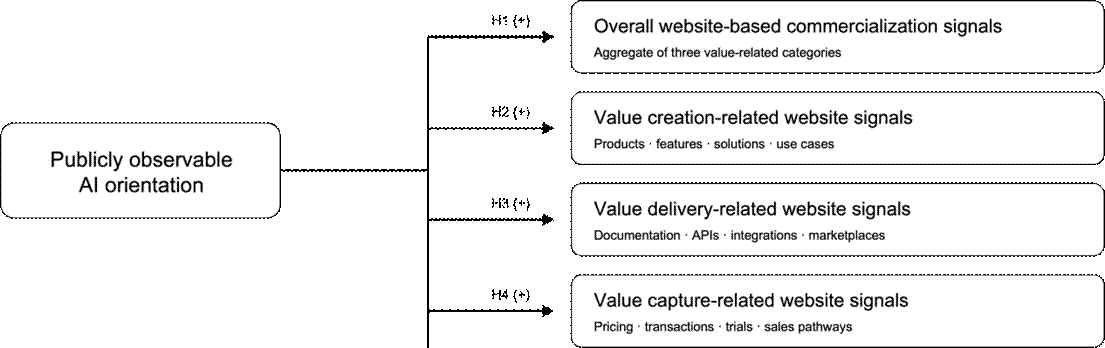
Fig. 1. Conceptual framework
Source: Authors’ own elaboration.
3. Methodology
3.1 Research Design
This study uses a firm-level, cross-sectional archival design to examine the association between public AI orientation and website-based commercialization signals among YC-affiliated AI-related startups. Public AI orientation is measured using classification labels and keyword matches in YC profiles, while commercialization signals are identified on official company websites. Four outcomes are examined: an aggregate signal score and three dimensional scores related to value creation, value delivery, and value capture.3.2 Data and Analysis Sample
The initial pool comprises 1,744 YC-affiliated firms identified through AI-related tags or categories, including artificial intelligence, generative AI, and machine learning. Restricting the 2026 YC snapshot to firms classified as both Early stage and Active yields a sampling frame of 1,247 startups. Sufficient website content was retrieved for 1,190 firms (95.4%), which constitute the analytical sample. The remaining 57 firms were excluded from outcome regressions because their website-based measures could not be constructed.Descriptive statistics, primary hypothesis tests, and principal robustness analyses use the common sample of 1,190 firms. The full sampling frame of 1,247 firms is retained for website-observability diagnostics and the selection model underlying the inverse probability weighting (IPW) analysis. This analysis assesses sensitivity to sample inclusion based on observed firm characteristics.
3.3 Variable Measurement
3.3.1 Dependent Variables: Website-Based Commercialization Signals
The dependent variables measure the breadth of website-based commercialization signals, grouped into three categories using the business model perspective.Value-creation signals comprise six indicators: product pages; feature pages; solution pages; use-case or customer-case pages; product- or service-related structured data in JavaScript Object Notation for Linked Data (JSON-LD); and AI-related calls to action. Value-delivery signals comprise four indicators: documentation pages; API, developer, or SDK interfaces; integrations or connectors; and marketplaces, plugins, or extensions. Value-capture signals comprise five indicators: pricing or plan pages; billing, checkout, or subscription mechanisms; demonstration requests or sales-contact pathways; trial or registration processes; and Offer-related JSON-LD structured data. Each indicator equals 1 when a qualifying signal is identified and 0 otherwise. Zero denotes non-detection rather than the absence of the corresponding business activity. A signal is invalidated when its first supporting Uniform Resource Locator (URL) belongs to a general content hub, such as a blog, news page, resource center, or article archive.
Indicators are averaged with equal weights within each category, and the resulting dimensional scores are standardized within the analytical sample of 1,190 firms. The aggregate score averages the three standardized dimensional scores and is subsequently standardized within the same sample. Higher scores represent broader observed signal coverage, not commercial effectiveness or performance. A sensitivity specification excludes the AI-related call-to-action indicator and reconstructs the value-creation and aggregate scores.
3.3.2 Independent Variable: Public AI Orientation
Public AI orientation measures the prominence of AI-related and technical information in YC profiles. The index combines three counts: AI-related classification labels, AI-related dictionary matches, and technical dictionary matches. Classification labels comprise AI, artificial intelligence, generative AI, and machine learning, counted across tags and industry fields. YC profile text combines short descriptions, long descriptions, tags, and industry lists. Preprocessing strips Hypertext Markup Language (HTML) tags and script/style content, replaces selected entities, and normalizes whitespace. Case-insensitive regular expressions count all dictionary matches, including repeated occurrences and matches from different expressions within the same phrase.The AI dictionary includes AI, artificial intelligence, machine learning, deep learning, generative AI, large language model and its abbreviation (LLM), computer vision, natural language processing and its abbreviation (NLP), neural network, foundation model, agentic, AI agent, autonomous agent, model training, and inference. The technical dictionary includes algorithm, model, data, dataset, training, inference, prediction, predictive, automation, computer vision, natural language, agent, robotics, synthetic data, analytics, and workflow. Selected expressions accommodate singular and plural forms. Each count is transformed using log(1 + x) and standardized within the sampling frame of 1,247 firms.
AI Orientationᵢ = 0.375 × z [log(1 + AI tag countᵢ)] + 0.3125 × z [log(1 + AI keyword countᵢ)] + 0.3125 × z [log(1 + technical keyword countᵢ)]
z denotes standardization using the corresponding component’s mean and standard deviation within the sampling frame. The weights are operational choices, with an equal-weight alternative examined in the robustness analyses.
3.3.3 Control Variables
The empirical models include firm-level controls for organizational characteristics associated with public AI orientation and website-based commercialization signals. Firm age is measured in years from the YC-recorded launched_at timestamp to the observation reference date. Team size is log-transformed to account for differences in organizational scale. Hiring status and nonprofit status are included as additional controls, while industry fixed effects account for differences across recorded industry categories.A supplementary specification includes the logarithm of one plus the number of unique eligible internal website URLs as a control for website crawl scope. This variable measures the amount of website material available to the retrieval procedure. The adjustment assesses whether the estimated associations persist after accounting for differences in the opportunity to detect commercialization signals across websites.
3.4 Empirical Model and Estimation
Ordinary least squares (OLS) models estimate the conditional association between public AI orientation and the aggregate commercialization-signal score and its three dimensions. For each outcome k, the specification is:SignalScoreᵢₖ = αₖ + βₖAIOrientationᵢ + γₖ′Controlsᵢ + δₖ,industry(i) + εᵢₖ
SignalScoreᵢₖ denotes the standardized aggregate or dimensional score for startup i. AIOrientationᵢ is the YC-based index, Controlsᵢ contains the firm-level controls defined above, and δₖ,industry(i) represents industry fixed effects. The coefficient βₖ captures the conditional association with the corresponding outcome rather than a causal effect. Heteroskedasticity-consistent standard errors (SE) with the HC3 leverage adjustment are reported. Benjamini–Hochberg-adjusted p-values (BH q) address multiple testing across H2–H4. Pairwise coefficient comparisons and a joint two-degree-of-freedom Wald test assess differences across dimensions using heteroskedasticity-robust inference.
Robustness analyses examine alternative measurement and modeling choices. Models using unstandardized dimensional shares and grouped-binomial specifications assess sensitivity to outcome specification. Alternative AI-orientation measures use equal component weights, keyword frequencies per 100 description words, and untransformed counts. Additional models control for description length and website crawl scope. Cook’s distance and standardized coefficient changes after deleting individual observations (DFBETAs) assess influential observations, while winsorization of the raw index at the 99th percentile and exclusion of its upper 1% assess sensitivity to extreme values. A further specification excludes the AI-related call-to-action indicator and reconstructs the affected outcome scores.
Inverse probability weighting assesses selection associated with website observability. A selection model uses the full sampling frame of 1,247 firms and includes AI orientation, firm age, logarithmic team size, hiring status, nonprofit status, and industry classification. Stabilized weights are constructed from the estimated observability probabilities, truncated at the 1st and 99th percentiles, and applied to the outcome models for the 1,190 firms with observable websites.
Figure 2 summarizes the measurement design and analytical sample construction.
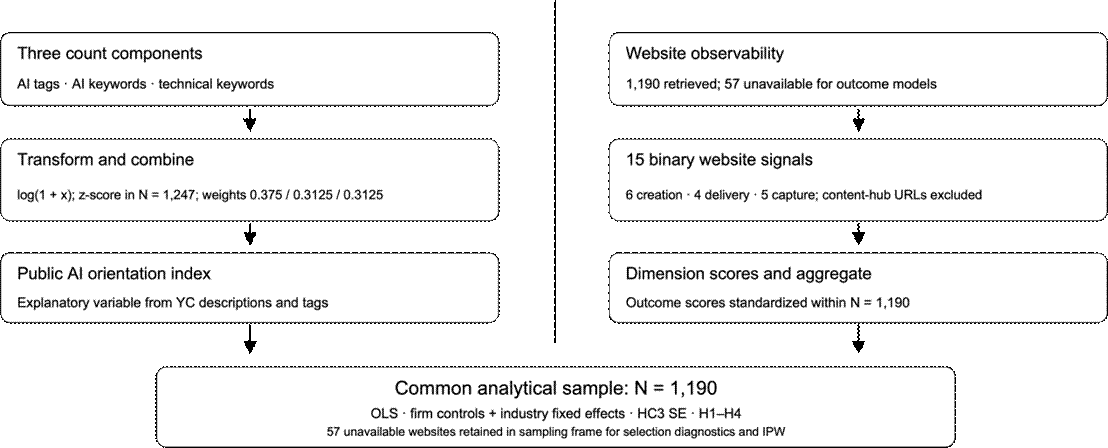
Fig. 2. Source separation measurement design and analysis samples.
Source: Authors’ own elaboration.
4. Results
4.1 Analytical Sample and Distributional Diagnostics
The analytical sample comprises 1,190 startups with retrievable website content, representing 95.4% of the 1,247 active, early-stage firms in the sampling frame. The remaining 57 firms are retained for website-observability diagnostics and the selection analysis. Table 1 reports descriptive statistics, including standard deviations (SD), and Pearson correlations (r). The log-count AI-orientation index has a mean of −0.004 and a standard deviation of 0.700. The four commercialization-signal scores have means of approximately zero and standard deviations of one following standardization. Their correlations with public AI orientation are positive, ranging from 0.098 for value-capture signals to 0.158 for the aggregate score.The untransformed AI-orientation index is positively skewed, with skewness of 5.11 and excess kurtosis of 70.87. Log-count transformation reduces these values to 0.74 and 0.56, respectively. The unstandardized dimensional scores are discrete and positively skewed, with zero observations accounting for 45.2% of value-creation scores, 64.5% of value-delivery scores, and 48.0% of value-capture scores. These features motivate the supplementary outcome specifications reported below.
Table 1. Descriptive Statistics and Bivariate Associations (N = 1,190)
|
Variable
|
Mean
|
SD
|
Min
|
Max
|
r with AI
orientation
|
|
AI orientation, log-count
|
−0.004
|
0.700
|
−1.055
|
3.600
|
1.000
|
|
Aggregate commercialization signals
|
0.000
|
1.000
|
−0.969
|
3.658
|
0.158
|
|
Value creation signal
|
0.000
|
1.000
|
−0.858
|
3.551
|
0.149
|
|
Value delivery signal
|
0.000
|
1.000
|
−0.647
|
3.281
|
0.136
|
|
Value capture signal
|
0.000
|
1.000
|
−0.839
|
2.899
|
0.098
|
|
Firm age
|
2.813
|
2.010
|
0.118
|
14.568
|
−0.035
|
|
Log
team size
|
1.826
|
0.881
|
0.000
|
6.909
|
0.027
|
Source: Authors’ calculations.
4.2 Primary Tests of H1–H4
Table 2 reports the primary OLS estimates for the common sample of 1,190 startups, including firm-level controls and industry fixed effects, with HC3 standard errors. The table also reports 95% confidence intervals (CI) and coefficients of determination (R²). Public AI orientation is positively associated with the aggregate commercialization-signal score (β = 0.163, p < 0.001), supporting H1 in the primary specification.Positive associations are also observed for value-creation signals (β = 0.150, p < 0.001), value-delivery signals (β = 0.151, p = 0.001), and value-capture signals (β = 0.094, p = 0.021). All three remain statistically significant after Benjamini–Hochberg adjustment, supporting H2–H4 in the primary specification. The sensitivity of these findings is examined in Section 4.4.
Given the AI-orientation index’s sample standard deviation of 0.700, a one-standard-deviation increase corresponds to increases of approximately 0.114 standard deviations in the aggregate score, 0.105 in value-creation signals, 0.106 in value-delivery signals, and 0.066 in value-capture signals. These estimates indicate positive but modest conditional associations.
Table 2. Primary Tests of H1–H4
|
Hypothesis and outcome
|
β (HC3 SE)
|
95% CI
|
p / BH q
|
R²
|
Assessment
|
|
H1
Aggregate signal score
|
0.163 (0.041)
|
[0.082, 0.245]
|
<0.001 / —
|
0.151
|
Supported
|
|
H2
Value-creation signals
|
0.150 (0.042)
|
[0.067, 0.232]
|
<0.001 / 0.001
|
0.135
|
Supported
|
|
H3
Value-delivery signals
|
0.151 (0.046)
|
[0.062, 0.241]
|
0.001 / 0.001
|
0.090
|
Supported
|
|
H4
Value-capture signals
|
0.094 (0.041)
|
[0.014, 0.175]
|
0.021 / 0.021
|
0.099
|
Supported
|
Source: Authors’ calculations.
4.3 Comparison Across Commercialization-Signal Dimensions
The coefficient for value capture is numerically smaller than those for value creation and value delivery. The differences among the three-dimensional coefficients are not statistically distinguishable. The joint HC3 Wald test does not reject coefficient equality across the dimensions, χ²(2) = 2.58, p = 0.275.The difference between the value creation and value delivery coefficients is close to zero (difference = −0.002, p = 0.973). The creation–capture difference is 0.055 (p = 0.181), while the delivery–capture difference is 0.057 (p = 0.222).
4.4 Robustness Analyses
The robustness analyses assess sensitivity to alternative AI-orientation measures, additional controls, influential observations, and website observability. Equal component weights retain positive and statistically significant associations across all four outcomes, as reported in Table 3. Controlling for description length preserves significance for the aggregate, value-creation, and value-delivery scores, while the value-capture estimate does not meet the 5% threshold (β = 0.083, p = 0.053).Controlling for website crawl scope likewise retains significant associations for the aggregate, value-creation, and value-delivery scores, but not value capture (β = 0.051, p = 0.136). Excluding the AI-related call-to-action indicator preserves positive associations with the reconstructed aggregate score (β = 0.149, p < 0.001) and value-creation score (β = 0.114, p = 0.007).
Results are more sensitive to alternative predictor construction. With untransformed counts, only the aggregate and value-delivery associations remain significant; with keyword frequencies per 100 description words, only value delivery remains significant at the 5% level. Winsorizing the raw index at the 99th percentile or excluding its upper 1% produces positive, significant estimates across all outcomes. Inverse probability weighting retains this pattern. Grouped-binomial models also yield positive dimensional associations, with p < 0.001 for value creation, p = 0.001 for value delivery, and p = 0.018 for value capture.
Overall, value delivery shows the most consistent association across the reported specifications. Support for the aggregate, value-creation, and value-capture outcomes depends more on measurement choices and additional controls.
Table 3. Summary of Robustness Analysis
|
Specification
|
H1 Aggregate
|
H2 Creation
|
H3 Delivery
|
H4 Capture
|
|
Primary
log-count index
|
0.163***
|
0.150***
|
0.151***
|
0.094*
|
|
Equal
component weights
|
0.166***
|
0.155***
|
0.152***
|
0.095*
|
|
Description-length
control
|
0.141**
|
0.112*
|
0.147**
|
0.083+
|
|
Website-exposure
control
|
0.114***
|
0.110**
|
0.115**
|
0.051
|
|
Untransformed-count
index
|
0.135**
|
0.100
|
0.158***
|
0.070
|
|
Keyword
rate per 100 words
|
0.079+
|
0.030
|
0.106*
|
0.055
|
|
Raw
index winsorized at 99%
|
0.186***
|
0.175***
|
0.165**
|
0.110*
|
|
Raw-index
upper 1% excluded
|
0.191***
|
0.168***
|
0.184***
|
0.110*
|
|
Inverse
probability weighting
|
0.164***
|
0.148***
|
0.153***
|
0.095*
|
Source: Authors' calculations.
5. Discussion
The findings indicate that startups with stronger public AI orientation display a broader range of commercialization signals on their websites in the primary specification. This association connects external technological positioning with publicly presented commercial arrangements, consistent with the business model perspective on technology commercialization [14, 26].
Product descriptions, features, and use cases communicate proposed customer benefits, linking technological positioning with value propositions [18, 27]. Documentation, developer interfaces, and integration information explain how offerings are accessed and implemented. The consistent association with value-delivery signals complements research emphasizing delivery processes and external coordination in AI commercialization [6, 25].
The value-capture category combines disclosed monetization arrangements with commercial engagement routes: pricing and subscription information describe payment arrangements, while demonstrations, trials, and sales contacts provide entry points for prospective customers.
5.1 Theoretical Contributions
This study contributes to research on AI entrepreneurship by examining public AI orientation as external technological positioning. Whereas existing research emphasizes organizational readiness and internal capabilities [17, 21], this study examines how AI positioning relates to commercial information presented to external audiences. It distinguishes publicly communicated positioning from the resources and practices underlying AI capability.The three-dimensional analysis provides a differentiated account of commercialization signals. The value-delivery association is more consistent across specifications, while the other outcomes are more sensitive to measurement choices and additional controls. The study also offers a methodological contribution by combining YC profiles with independently collected website signals. Organizing these signals through the business model perspective supports systematic comparisons of public commercial presentation across startups, while retaining the distinction between observable information and underlying operations.
5.2 Practical Implications
These research findings offer valuable insights for founders and managers of startups that need to communicate information about their technical products and commercial arrangements to external audiences. For startups that highlight artificial intelligence (AI) in their public positioning, it is crucial to ensure that their websites clearly articulate product features, intended use cases, technical accessibility, and opportunities for commercial collaboration. Elements such as product details, use cases, technical documentation, integration interfaces, and sales-related information collectively shed light on the nature of a company’s business. When a firm’s technical positioning aligns with its publicly disclosed commercial information, it helps potential customers and partners better understand the intended applications of its AI-driven products and services, as well as how to access them.Furthermore, these findings underscore the distinction between "monetization arrangements" and "pathways for commercial collaboration." Publicly available pricing and subscription details reflect a company’s revenue-generation model, whereas features like demo requests or registration options represent potential avenues for customer acquisition. This distinction is particularly significant for companies that rely more on bespoke contracts or negotiated pricing rather than standardized, publicly listed offerings.
5.3 Research Boundaries and Future Research
This study has limitations. The cross-sectional research design employed does not allow for the establishment of causal relationships. Furthermore, the analysis does not rule out confounding by unobserved firm characteristics.The metrics used in this study are based on public records from YC and information from company websites. Signals derived from websites primarily reflect how firms choose to present their commercial arrangements to the outside world, and the extent of information provided on these websites varies across firms. Future research should combine website data with surveys, interviews, and operational records to enhance measurement validity. Additionally, longitudinal studies should further explore how a firm’s "public-facing AI orientation" and "business model characteristics" evolve over time.
6. Conclusion
This study uses a sample of 1,190 early-stage and active AI startups affiliated with YC to explore the relationship between their AI positioning and their website-based commercialization signals. AI positioning is measured using YC profile records, while commercialization signals are identified on company websites. Empirical results show that, under the main model settings, there is a positive correlation between a company's AI positioning and its aggregate commercialization-signal score. Robustness analyses reveal that the association between public AI orientation and value-delivery signals remains statistically significant across the reported specifications, whereas the associations with value creation and value capture are more sensitive to these variations.
These findings shed light on how the external technological positioning of AI startups relates to the way they present their commercialization arrangements. By distinguishing between value creation, value delivery, and value capture, this study offers a multidimensional perspective for analyzing business model characteristics via company websites. Furthermore, the integration of YC records with digital signals from corporate websites demonstrates the use of publicly available digital footprints for firm-level empirical research. Future research should incorporate longitudinal and operational data to further clarify how these observable characteristics evolve over time in relation to the development and implementation of business models.
Страница обновлена: 11.11.2026 в 10:49:53
Public AI orientation and website-based commercialization signals among AI startups
Sun Y.Journal paper
Journal of Economics, Entrepreneurship and Law
Volume 17, Number 1 (January 2027)