
The digital ruble as a factor in financial market transformation: modeling the effectiveness through the lens of macroeconomic and marketing impacts
Гринько Е.Л.1  , Гарагуц М.А.2 , Алесина Н.В.1 , Семёнкина И.А.3
1 Севастопольский государственный университет, Севастополь, Россия
2 Российский экономический университет им. Г.В. Плеханова - Севастопольский филиал, Севастополь, Россия
3 Финансовый университет при Правительстве Российской Федерации, Москва, Россия
Статья в журнале
Вопросы инновационной экономики (РИНЦ, ВАК)
опубликовать статью | оформить подписку
Том 16, Номер 3 (Июль-сентябрь 2026)
Introduction
In the settings of global digitalization and macroeconomic instability, research into central bank digital currencies (CBDCs) is becoming vital for modernizing the monetary system. The primary goals of CBDCs are to optimize payment systems, strengthen monetary sovereignty, and ensure financial stability [25, 26].
CBDCs are a targeted instrument of government regulation, which combines technological advantages of digital payments with centralized control. Their implementation implies improving cybersecurity, user privacy, and interaction with traditional financial institutions, along with tackling socio-psychological and ethical issues [37, 38]. Currently, researchers and regulators are actively working on legal issues of CBDC development, as well as institutional mechanisms for their interaction and integration into the economy [11, 19, 20, 43]. In Russia, the digital ruble project has been aimed to meet these challenges, developing the general trend of increasing cashless payments and digitalization of the financial sector [1, 2, 3, 5].
To date, the problem of assessing the impact of CBDC implementation has received scant attention in the research literature. Existing research primarily focuses on isolated analyses of technological, legal, or macroeconomic aspects and development dynamics [14, 15, 16], while multifaceted approaches that allow for a comprehensive assessment of socioeconomic, technological, and industry-specific impacts remain inadequate [28, 33, 34]. It is important to note that the implementation of CBDC is based on fundamental economic theory, including the active use of the monetary principle of “money as memory” [32, 33].
The authors of this study sought to develop a concept for a comprehensive model for assessing the effectiveness of CBDC implementation and partially applying it to analyze the prospects of the digital ruble. To this end, the following tasks were completed: analyzing the current status and regulatory framework of the digital ruble project; developing the structure of the comprehensive assessment model; defining key indicators and targets for each block of the model; identifying the main implementation risks within the context of the proposed model; and formulating practical recommendations for the regulator's application of the model.
Materials and methods
The concepts and reports of international regulators, including the Financial Stability Board (FSB), the Bank for International Settlements (BIS), the International Monetary Fund (IMF), and the Organization for Economic Co-operation and Development (OECD), which contained the guidelines for the creation and application of CBDC, served as the study's theoretical and informational foundation [25, 26, 34, 37, 38]. The "Concept of the Digital Ruble" (2021) [1, 2], reports for public consultations [1, 2], regulations on the digital ruble platform [3, 5], statistical data and payment systems reflecting the processes of digitalization of the Russian Federation's financial sector [4, 5], and data from the All-Russian Public Opinion Research Center (VTsIOM) [7, 8] served as the foundation for the legal and analytical basis of the digital ruble.
Methodological approaches to assessing the transformation of monetary systems, in particular the “money is memory” concept, are set out in the works of N.R. Kocherlakota (Kocherlakota, 1998) [33], and the studies of C. Kahn, F. Rivadeneyra, and T. Wong, which are devoted to the issues of justifying the issue of CBDC [32].
The analysis of CBDC architectural models and their applicability in Russian conditions are presented in the works of D.A. Kochergin (Kochergin, 2024; Kochergin, 2022; Kochergin, and others, 2023) [14, 15, 16].
This study continues the work of the authors (Grinko, and others, 2024) [9] on the study of digital currencies and financial technologies, developing approaches in the field of fintech analysis, methodology for evaluating digital financial instruments, and risk analysis (Grinko & Garaguts, 2025) [10].
The methodological framework of the study is based on a systematic approach, which views CBDC as a component of a complex socio-economic and technological system. The work employed a range of mutually complementary methods.
The possible risks related to the deployment of a CBDC were organized using a categorical risk analysis technique. This framework made it possible to go from a basic listing to an organized system of manageable difficulties by identifying risks, classifying them by source and correlating them with the respective blocks of the assessment model.
Elements of statistical analysis were used to process secondary data on the dynamics of non-cash payments, the market value of the fintech industry, and the results of sociological surveys, which provided a quantitative basis for a number of indicators [40, 42, 44, 45].
The developed comprehensive model is a synthesis of these methods. Its adaptability, is ensured by the ability to adjust the set of indicators and their weighting coefficients depending on the phase of the CBDC lifecycle and specific assessment objectives.
The expert assessment approach is potentially applicable for future model verification. Although a complete empirical validation of the model is not possible due to the current stage of research's reliance on the accuracy and transparency of official data, this does not diminish the model's conceptual and practical significance for strategic planning and monitoring.
Since a detailed calculation with precise quantitative indicators is beyond the scope of this conceptual study, the authors did not intend to do so. The model's indicator target values are based on available official data and verified expert assessments, trend analysis, and available pilot data [7, 8].
The development of the model enabled a fundamental assessment of the sustainability of the digital ruble project. The proposed model aims to create a structured framework for evaluation that can and should be updated with relevant data and enhanced through subsequent testing and monitoring.
Results
1. Digitalization of the financial sector and the digital ruble project in Russia
The Russian Federation plays a major role in the advancement of digital payment systems and financial technologies. Russia ranks third in the world with an 82% penetration rate of fintech solutions, according to the Global FinTech Adoption Index [38]. A study of changes in the share of non-cash payments [27, 30, 42, 44, 45] demonstrates a clear and stable upward trend. Russia's payment system has advanced to a mature stage of digital development from the standpoint of statistical analysis. In these circumstances, the introduction of the digital ruble is seen as a logical next step that develops established and extensively utilized payment procedures rather than as a radical transformation. The increasing prevalence of non-cash payments is corroborated by a monitoring survey conducted by the Russian Public Opinion Research Center (VTsIOM), which indicates that over 68% of respondents in 2024 reported being aware of the forthcoming full-scale implementation of the digital ruble (VTsIOM, 2026) [7, 8]. The development of cashless payments and the extensive digital engagement of consumers demonstrate acceptance and behavior adaptability of key economic actors.
Based on a comprehensive study of existing regulatory legal acts and the potential for their practical implementation, the general system of regulatory and legal support for the digital ruble in the Russian Federation is provided (Table 1) [1, 2, 3, 4, 5]. The deadlines for the official launch of the digital ruble are regularly revised. This is determined by the need to adjust the financial, economic, and political strategies for implementing the project, including accounting for the evolution of consumer behavioral patterns. Currently, the Central Bank of the Russian Federation is testing the technology using real transactions with the digital currency, which corresponds to the pilot phase before its full-scale launch [3, 5].
Table 1: The system of regulatory and legal support for the CBDC in the Russian Federation.
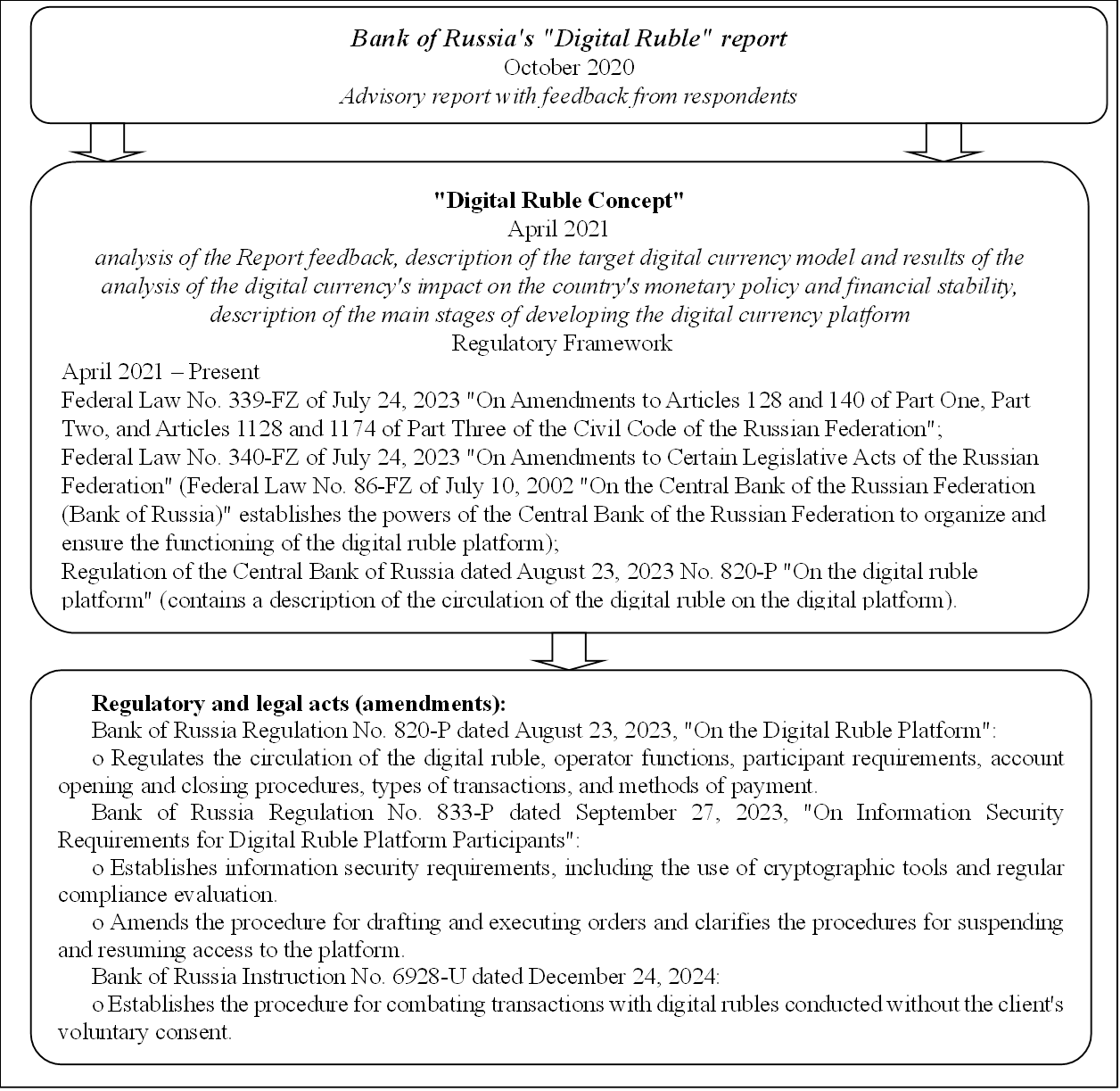
Source: (The Bank of Russia, 2026) [1, 2, 3, 4, 5].
The digital ruble pilot project began on August 15, 2023. Thirteen Russian commercial banks and more than 600 clients directly participated in testing the operations [3, 5]. Another 19 commercial banks, which have signed agreements with the Central Bank of the RF to participate in the pilot project, are in the process of configuring their own systems for the project. All participants in the pilot project noted the project's functionality and ease of use. The CB of the RF is systematically implementing a digital national currency, gradually expanding the platform's functionality (Table 2). The CB’s publication "Key Directions for Financial Market Development for 2024–2026", "Key Directions for Financial Market Development for 2026–2028" places emphasis on the digitalization of the financial sector and user security [4].
Table 2: Strategic projects of digital transformation of the financial market, according to the «Main directions of digitalization of the financial market for 2022-2024».
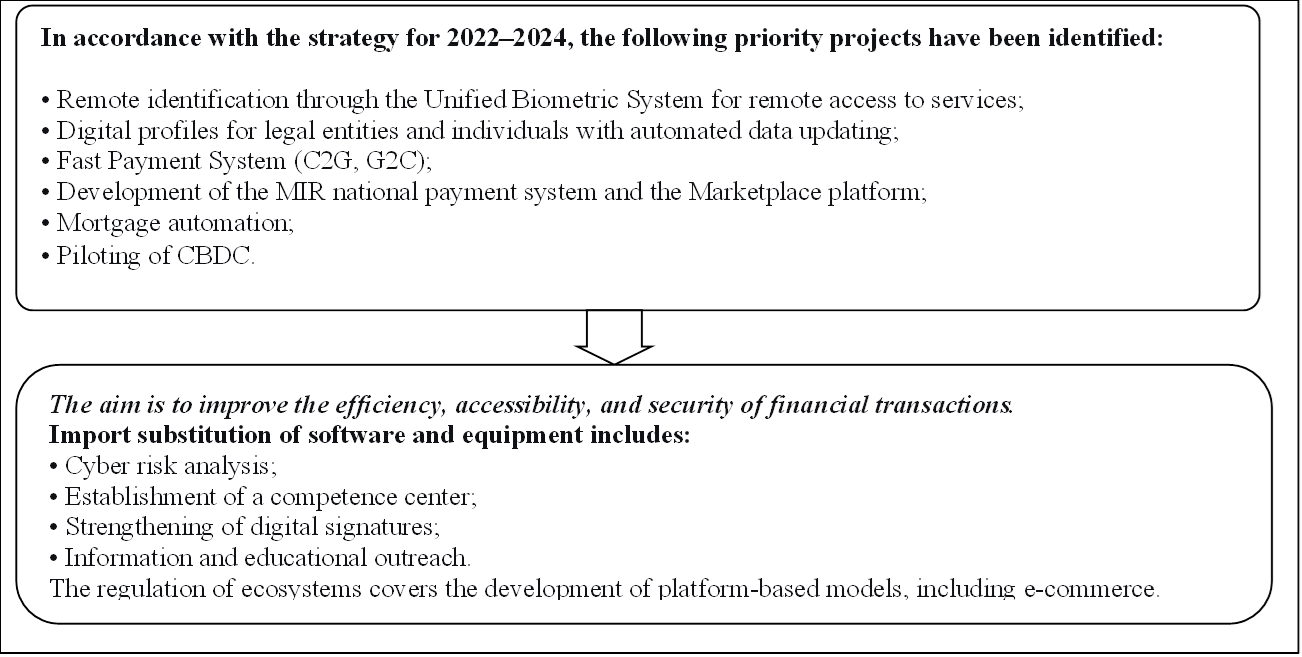
Source: (The Bank of Russia, 2021) [6].
The application of AI technologies in the financial sector is a global trend that, while offering a wide range of opportunities may also be accompanied by violations of ethical norms and unlawful acts.
In Russia, AI in the financial sector is actively used for big data analysis, generating offers for financial products and services based on previous customer interactions, creating chatbots, managing risks, credit scoring, etc. According to the Deputy Chairman of the Executive Board of Sberbank, the decision to issue consumer loans is made by AI in 99.9% of cases, and the decision to issue business loans is made by AI in 81% of cases. The scope of AI is constantly expanding (Kochergin, and others, 2023) [16]. Biometric and bioacquiring technologies also occupy a special place in the development of the Russian financial sector. These technologies are being developed by JSC "Center for Biometric Technologies" and JSC "National Payment Card System" as part of a pilot project [23]. Bioacquiring capabilities are currently implemented in the new version of the SBPay mobile app and are available to users who have registered their biometric data on the Gosuslugi Biometrics website. Although biometrics is the most promising and one of the most reliable information security technologies, many users view it with distrust and caution (Unified Biometric system, 2026) [23].
In the financial sector, the adoption of cloud technologies is mainly focused on supporting business scalability, reducing operational expenses, addressing outsourcing considerations, and managing the storage and ongoing accessibility of extensive data volumes [6]. Thus, Russia is demonstrating significant progress in the digitalization of its financial sector, particularly in the context of the implementation of CBDC. However, cautions steps taken by the regulator stress the need for a reliable system for assessing potential effects and risks, which determines the relevance of the suggested model.
2. The concept of a comprehensive model for assessing the effectiveness of CBDC
The academic discourse of CBDC is characterized by a substantial methodological gap. This gap stems from the lack of unified approaches that would allow for a comprehensive assessment of the effectiveness of CBDC implementation [14, 15, 16, 34]. In studies previously cited by the authors, as well as in recent publications [33, 39], the importance of taking into account financial literacy and behavioral factors when forming a mechanism for implementing CBDC, the geopolitical component and macroeconomic conditions that determine the development of CBDC are emphasized [31].
The adaptive nature of the model enables dynamic adjustment of both indicator composition and weighting coefficients depending on the phase of CBDC’s development and the particular policy goals of regulatory authorities. The proposedmodel is structured into five interconnected analytical blocks, each representing a distinct dimension of the digital currency's impact on the economy and society (see Fig Table 3) [17, 22, 24, 36, 42].
For the purposes of this study, we defined marketing effects as shifts in consumer behavior, the structure of demand for financial services, and their promotion channels driven by the impact of digital currency.
Furthermore, it is plausible to connect macroeconomic dynamics with market participants' marketing strategies by measuring indices of trust, prevalence, and speed of adaption in the retail segment. These results are highly likely to be significant.
Table 3: Comprehensive model for assessing the effectiveness of digital currency implementation (using the example of the digital ruble).
|
A Comprehensive Model for Assessing the
Effectiveness of Digital Currency Implementation (using the digital ruble as an
example)
| ||
|
1.
Macroeconomic performance
| ||
|
Indicator
|
Calculation
method /
Data source |
Target
value (for Russia)
|
|
Impact
on the money supply (M2)
|
Central
Bank Metrics: Comparing M2 and GDP Growth Dynamics Before and After CBDC
Implementation
|
Stability
or predictable change in the structure of M2 without sharp fluctuations.
|
|
Velocity
of money (V)
|
V
= GDP / М2
|
Increase
in V by 5-10% in the medium term due to increased calculation efficiency.
|
|
Reducing
the operating costs of the financial system
|
Expert
assessment by the Central Bank, data from banks: Savings on issuance,
transportation of cash, and transaction processing
|
Reducing
costs by 1.5-2% of GDP
|
|
Degree
of economic monetization
|
М2
/ GDP
|
Maintaining
or increasing the level of monetization, indicating the deepening of the
financial system.
|
|
Structural
liquidity ratio (SLR)
|
Σ(Balances
on ruble accounts of individuals and individual entrepreneurs in commercial
banks) / Σ(Balances in CBDC digital wallets).
|
Stability
or expected minor change within a given range.
|
|
The
share of operational cash turnover of legal entities and government agencies
in CBDC
|
Σ(Volume
of transactions in digital rubles between legal entities/with the
participation of government agencies) / Σ(Total volume of non-cash payments
of legal entities and government agencies in rubles).
|
Stability
or expected minor change within a given range.
|
|
Dynamics
of instant (H2) and current (H3) liquidity standards in the banking sector
|
The
calculation methodology and target indicators are set by the Central Bank.
There has been no statistically significant deterioration (decrease) in the
average standards compared to the previous period of CBDC implementation.
| |
|
2.
Socioeconomic performance
| ||
|
Indicator
|
Calculation
method /
Data source |
Target
value (for Russia)
|
|
Financial
accessibility index (according to the Central Bank methodology)
|
Central
Bank data: Dynamics of the comprehensive indicator of affordability (CIAF) by
region.
|
Stability
or predictable change in the structure of M2 without sharp fluctuations.
|
|
Number
of new users of financial services
|
Population
with access after CBDC) - Population with access before CBDC
|
Attracting
2-3 million new users from financially excluded citizens
|
|
Level
of trust and readiness to use
|
Regular
surveys (VCIOM): Share of respondents willing to use CBDC
|
Increase
in the share of ready-to-use products from 31% to 50+% within 3 years after
launch.
|
|
CBDC
share in retail payments
|
Data
from the Central Bank and banks: (Volume of transactions in CBDC / Total
volume of retail transactions) * 100%.
|
Achieving
a share of 10-15% within 5 years after mass implementation.
|
|
CBDC
savings usage index
|
Proportion
of users employing the digital ruble mainly for savings
|
This
indicator allows us to assess the impact of behavioral shifts among the
population. Even if overall liquidity remains unaffected, the widespread
perception of the digital ruble as a more reliable instrument could alter the
structure of banks' liabilities.
|
|
3.
Economic and technological
performance
| ||
|
Indicator
|
Calculation
method /
Data source |
Target
value (for Russia)
|
|
The
volume of cross-border payments in CBDC
|
Data
released by the Central Bank pertaining to platform-based transactions.
|
Sustainable
growth has been observed following the integration of foreign banks in
January 2025.
|
|
Integration
into international CBDC alliances
|
Qualitative
assessment: Engagement in pilot initiatives and the signing of memorandums.
|
Active
participation in up to two international projects aimed at facilitating
cross-border settlements with CBDC.
|
|
Level
of technological reliability and cybersecurity
|
The
number of successfully repelled cyberattacks, the platform's uptime
(according to the Central Bank).
|
No
major failures and successful repulsion of >99% of cyberattacks.
|
|
The
use of offline transactions.
|
Central
Bank data: Share of offline transactions in total volume
|
A
share of 5-10%, which will confirm the currency's accessibility for the
population without stable internet.
|
|
4.
Innovative and architectural performance
| ||
|
Indicator
|
Calculation
method /
Data source |
Target
value (for Russia)
|
|
The
number and volume of transctions using smart contracts
|
Central
Bank platform data: Statistics on launched and executed smart contracts.
|
Active
use (thousands of contracts) in payment automation (rent, utilities, fees).
|
|
Implementation
of targeted financing programs
|
Monitoring
payments with special tags (e.g., "maternity capital," "social
benefits").
|
Control
over the intended use of funds without burdensome reporting requirements.
|
|
Automation
of tax payments
|
The
share of tax deductions that are automatically paid when specific
requirements are met in a transaction (e.g., automatic payment of personal
income tax when selling real estate).
|
Reducing
the administrative burden on businesses and the Federal Tax Service,
increasing tax collection.
|
|
A
comprehensive integrated indicator for assessing the level of digitalization
in risk management
|
The
metric combines sub-indices for digital technology risks, economic
efficiency, digital maturity, and technological efficiency, all of which are
composed of a subset of formative indicators. The input data is derived from
existing reporting structures and expert evaluations.
|
The
process involves using a modular system to pinpoint critical weaknesses in
the risk-management ecosystem under review, enabling the subsequent
optimization and refinement of the digitalization strategy. The final phase
is the deployment of a new ecosystem that incorporates iterative monitoring,
allowing for its permanent adaptation to new and evolving risks.
|
|
5.
Industry and target performance
| ||
|
Indicator
|
Calculation
method /
Data source |
Target
value (for Russia)
|
|
Effectiveness
for the target group (e.g. "International students")
|
Student
surveys;
Share of universities accepting CBDC; Volume of tuition payments in CBDC. |
Awareness
increased from 30% to 70%;
University connection statistics; 20% of tuition payments |
|
Implementation
in small and medium-sized businesses (SMEs)
|
Central
Bank data: Number of SMEs conducting transactions in CBDC; average
transaction volume.
|
The
share of SMEs using CBDC will increase to 25% within 3 years.
|
|
Participation
in real estate transactions
|
Share
of real estate transactions settled in CBDC.
Average transaction settlement time (from contract signing to funds crediting). Volume of CBDC transactions in the real estate market. |
Transaction
share: 10-15% in the first 3 years.
Reduction in settlement time from 3-5 days to 1 day. Increased transparency and reduced risk of fraud. |
|
Use
in the implementation of government orders
|
Share
of government contracts paid for in CBDC.
Volume of budget funds channeled through CBDC for government procurement. Reduction in tender and payment times through smart contracts. |
Share
of government contracts: 20-30% at the mass implementation stage.
Reduction in payment terms for completed work by 30%. Increased transparency and accountability in the use of budget funds. |
|
Use
for payment of state benefits
|
Ministry
of Finance/Social Fund data: Share of benefits paid in CBDC.
|
Achieving
a 30-50% share to reduce costs and increase transparency
|
|
Profitability
of the operating unit of retail banks
|
Changes
in banks commission income from transfers and payment transactions (adjusted
for the general trend of digitalization).
|
This
indicator allows us to assess the impact of behavioral shifts among the
population. Even if overall liquidity remains unaffected, the widespread
perception of the digital ruble as a more reliable instrument could alter the
structure of banks' liabilities.
|
|
The
share of "aggregator banks" in the CBDC ecosystem
|
The
number and volume of transactions processed by banks actively developing
additional CBDC-based services (e.g., smart contracts for auto-payments,
loyalty integration).
|
The
indicator assesses the ability of banks to adapt and create new value by
transforming their activities.
|
The impact of CBDC on the banking sector deserves special attention. Since the digital ruble's architecture assumes its issuance through commercial banks (a two-tier model), the regulator does not expect a direct, immediate shock to the banking system's liquidity. However, to monitor structural shifts, changes in customer behavior, and the long-term transformation of banking in general and systemically important banks in particular, specialized indicators have been included in the relevant blocks of the model (Table 5) [4, 7, 8].
Table 4: Impact of CBDC on the Banking Sector
|
Indicator
|
Purpose and Essence
|
Methodology (calculation and sources)
|
Target value
|
|
Macroeconomic block
| |||
|
Structural liquidity ratio (SLR)
|
Ratio of traditional bank
account balances to digital wallet holdings (system-wide, Central Bank data).
Captures the pilot's emphasis on the digital ruble as a retail cash
alternative, tracking potential liquidity shifts between storage forms
|
Σ (Balances in ruble accounts of
individuals and sole proprietors in commercial banks) / Σ (Balances in CBDC digital wallets)
Sources: Digital Rubble Platform (Central Bank of the Russian Federation), statistics from the payment system of the Bank of Russia. |
A constant or predictable minor change
within a given range.
|
|
Share of operational cash turnover of
legal entities and government institutions in CBDC.
|
Measures the displacement
of traditional non-cash money by programmable CBDC liabilities in operational
turnover, tracking CBDC's progression from pilot to foundational
infrastructure for commercial/public settlements (smart contracts,
transparency) and assessing its integration into real-sector and governmental
financial flows
|
Σ (Volume of digital ruble transactions
between legal entities/involving government institutions) / Σ (Total volume of non-cash payments by legal entities and
government institutions in rubles).
Sources: Digital Ruble Platform (Central Bank of the Russian Federation), statistics from the payment system of the Bank of Russia. |
Stable or predictably marginal change
within a defined range; growth signals real-sector and public-finance CBDC
integration, serving as a key metric for supply-chain smart contracts,
procurement/budget automation, and settlement cycle efficiency
|
|
Dynamics of instant (N2) and current
(N3) liquidity standards in the banking sector.
|
Weighted average N2/N3 ratios across
RUB-credit institutions, acting as a stability barometer to detect indirect
CBDC repercussions on liability structures and liquidity, thereby directly
linking CBDC implementation with prudential oversight for timely risk
identification.
|
N2 — the ratio of a bank's highly
liquid assets to liabilities on demand accounts.
N3 — the ratio of liquid assets to total liabilities.
The calculation methodology and target values are established by the Central
Bank (The Bank of Russia, 2026).
Sources: Official statistics of the Bank of Russia, Form 0409135 "Report on Compliance with Liquidity Ratios." |
Absence of a statistically significant
deterioration (decline) in the average values of the ratios relative to the
period preceding the introduction of CBDC.
|
|
Socio-economic block
| |||
|
CBDC savings usage index.
|
A mixed-method
indicator of behavioral shifts, measuring CBDC adoption as a store-of-value
versus payment instrument; assesses bank liability-structure impacts via
household preferences, enabling early role-transformation detection,
stability risk monitoring (absent direct outflows), and preventative
macroprudential policy formulation.
|
Composite index measuring the proportion
of users employing CBDC primarily for savings, constructed from complementary
survey-based and operational (wallet balance/transaction) data, triangulated
with Bank of Russia household deposit statistics. Sources: VTsIOM/NAFI;
Central Bank platform; Bank of Russia deposit data."
|
Target: stable or predictably marginal
variation; sharp, fundamentally unjustified increases signal incipient
disintermediation of liquid savings from the banking system, even when
formally retained via intermediary accounts
|
|
Industry block
| |||
|
Profitability of the operational unit of
retail banks
|
Digitalization-adjusted variance in bank payment/transfer
fee income, serving as a proxy for CBDC revenue effects and institutional
adaptation, with client cost savings potentially compressing bank tariffs
|
Analysis of the deviation of actual bank
commission income trends from transfers and payments from the expected trend,
adjusted for the overall digitalization process.
Sources: Digital Ruble Platform (Central Bank of the Russian Federation) and Bank of Russia payment system statistics. |
Target: absence of sharp, unwarranted
decline; sustained deterioration would indicate negative CBDC impacts on
retail banking profitability, mandating institutional adaptation and
CBDC-service innovation.
|
|
Share of "aggregator banks" in
the CBDC system
|
Quantitative metric
of commercial bank innovativeness in deploying CBDC-based value-added
services (beyond basic transfer/storage), gauging institutional adaptability
and value creation via operational transformation
|
Proportion (by quantity and value) of
CBDC transactions executed through banks with approved value-added service
offerings (smart contracts, automated products) relative to aggregate CBDC
turnover. Sources: Central
Bank Digital Ruble Platform; Bank of Russia payment statistics.
|
Sustained
upward trend signals successful bank adaptation, ecosystem innovation, and
CBDC transformation from payment instrument to a broader service platform.
|
The proposed model concept not only substantiates the theoretical foundations but also provides a practical mechanism for implementing the proposed methodology. The presented tool is flexibly adapted to different stages of CBDC implementation and is applicable both for analytical work and for the formation of strategic decisions by the regulator and government agencies.
The practical value of the comprehensive model lies in its applicability for tracking the progress of the digital ruble implementation, improving regulatory measures, and forecasting the long-term socio-economic effects of digital transformations in the financial sector [33, 34, 37].
Developing a comprehensive assessment model based on the presented logic has practical value in assessing the macroeconomic impact of implementing the digital ruble and the resulting consumer behavior patterns. The derived data forms the basis for improving regulatory instruments and mitigating the socioeconomic impacts of digital transformation.
3. Financial technology trends and financial risks
A thorough evaluation of the digital ruble's efficacy would be premature at this point. However, the Central Bank should immediately start researching the experience of other countries and regions that have made much more progress in implementing digital currency than Russia. Analyzing such international practices would enable timely refinements in the development of the national digital currency, increasing its efficiency and mitigating potential risks related to its use [9, 10, 11, 12, 13, 14, 15, 16]. A systematic and detailed analysis of the risks is presented in Table 5.
Table 5: The risk of using digital technologies
|
Risk group
|
Details
|
|
Cybersecurity risks
|
The risk of increased shadow money
laundering and financing of illegal activities associated with the anonymity,
partial anonymity of digital payments, and unauthorized access of criminals
to digital wallets.
|
|
The risk of expanded surveillance and
the exploitation of digital currency user data for political, financial, and
other purposes, associated with absolute government control of digital
currencies. The risk of double-spending, associated with the possibility of
fraudulent use of the same digital currency, represented by an electronic
file that can be duplicated or counterfeited, in multiple payments. The
emergence of new types of malware and hacker attacks.
| |
|
High-probability
cyber risks, substantiated by global pilots, necessitate systemic assessment
of impacts on consumer confidence and digital trust. Institutional threats
(AML, double-spending) scale with architectural choices—privacy levels,
access models, and functional allocation—rather than the underlying DLT,
rendering them mitigable via regulatory and technical refinements. This controllability fundamentally distinguishes CBDCs from
decentralized crypto assets.
| |
|
Technological and operational risks
|
Risk of poor digital platform
performance and connection instability.
Risk of technological failures in the digital system, including incorrect algorithms for creating, storing, and processing data (which may lead to leakage of personal and biometric data). |
|
Technological risks,
moderately probable yet highly impactful during early deployment, arise from
platform or algorithmic failures that disrupt transactions and entrench
negative user perceptions, constraining adoption. More amenable to mitigation
than cyber threats through pilot-phase experimentation, these risks are
effectively contained via phased rollouts and limited initial functionality,
thereby curtailing systemic disruptions and regulatory reputational harm.
| |
|
Economic and macro-financial
risks
|
Economic risks. Liquidity outflow from the national currency
Distribution/transmission effects of economic and financial shocks Unpreparedness of financial institutions and businesses and lack of funding for its development. |
|
Macrofinancial risks. The risk of
transforming banks' operating models: not a direct liquidity outflow, but a
change in traditional sources of income (payment fees) and the need to invest
in integration with the CBDC platform and the development of new products. This
risk can be assessed using industry-specific indicators.
| |
|
Risks of low social acceptance
(social-behavioral)
|
Risks associated with public rejection
or low trust in the digital ruble as a new form of money.
Personal data and control. Technological wariness. |
|
Primary rejection
drivers encompass digital stratification (insufficient literacy among elderly
and remote demographics), privacy and surveillance concerns (state monitoring
and loss of financial autonomy, amplified by historical fiscal-control
precedents), and technological skepticism (fears of fraud, system failures,
asset inaccessibility, and top-down compulsion, fostering psychological
resistance).
| |
However, the presented structuring of threats and risks is generalized and requires deeper analysis, taking into account three key aspects: the likelihood of risks materializing, the extent of their potential impact on the stability of the financial sector, and the capacity of regulatory institutions to monitor and mitigate them [14, 15, 16]. A simple list of possible negative scenarios, without assessing these parameters, does not provide a clear understanding of which threats are the most serious and require major concern from supervisory authorities. In this model, risk assessment and ongoing monitoring are conducted using special indicators.
Persistently low readings or values exceeding predefined thresholds would indicate the need for regulatory intervention, prompting measures such as adjustments to information policy, the expansion of educational initiatives, revisions to the digital ruble's design, and other appropriate actions.
Results
The study substantiated the relevance of developing a comprehensive model for assessing the effectiveness of digital ruble implementation and established its conceptual framework. It was qualitatively demonstrated that the model, by integrating macroeconomic, socioeconomic, technological, and sectoral dimensions of analysis, enables the systematic structuring of key objectives, indicators, and risks associated with the use of digital currencies.
Given the long-term and transformative nature of digital currency implementation, it is prudent during the testing and pilot phases to concentrate efforts on refining the monitoring and risk management framework in order to support the project's future scalability. Nonetheless, this research does not elaborate on the methodology for empirically validating all model indicators using representative data - an aspect that necessitates further investigation as the pilot phase advances.
High-quality descriptions and benchmarks were provided for key indicators within the five blocks of the digital ruble implementation model. This information allows the regulator to plan in advance the reporting and analytics system necessary for monitoring the implementation progress.
The transition to structured methods for assessing performance and risk management could become a driver for improving the validity and balance of decisions regarding the digital transformation of the monetary system.
Discussion
The key challenge of implementing digital currencies is managing multifaceted risks while maintaining financial stability. However, unlike fragmented approaches that focus on isolated technical or monetary aspects, this work offers an integrated assessment tool.
The findings of this study highlight a methodological aspect specific to the stage of transition from concept to practice, which requires the regulator (the Bank of Russia) to make a difficult choice between strict control of all system parameters and providing space for market innovation.
The advantages inherent in the application of a comprehensive model include, on one hand, the capacity to articulate clearly defined goals and targets for digital ruble implementation, thereby contributing to a reduction in regulatory uncertainty.
On the other hand, it creates a basis for coordinated action by various departments of the regulator and commercial banks to manage identified risks. These opportunities are fundamental in light of the strategic objectives related to safeguarding financial sovereignty and advancing the digital transformation of the monetary system.
The difficulty of guaranteeing the required quality and completeness of data for calculating some indicators in the early stages is one of the basic obstacles of adopting this strategy. The study demonstrated the need for sustainable data collection mechanisms that guarantee their comparability over time and the objectivity of indicators for decision-making.
The model requires developing indicator calculation methods that balance analytical value with the operational costs of collecting them. Furthermore, it is necessary to formalize the processes for interpreting monitoring results.
Particular attention should be devoted to the impact of CBDCs on the banking sector, extending beyond direct liquidity outflows and considered within the context of a cluster-based model of financial service provision. Depending on the strategic approach adopted by banks, the degree to which bank profitability is affected may vary considerably. However, if model data is properly utilized in strategic planning, substantial optimization of banking operations can still be achieved.
Conclusion
In order to support digitalization processes, the introduction of CBDC, and the continued development of financial technologies, the Bank of Russia is taking conceptual and strategic steps that will increase their stimulating role and improve the effectiveness of financial services in the real economy and in satisfying the needs of the population.
The Central Bank is designated as the regulator, operator, and creator of the system for issuing and circulating the digital ruble in accordance with the draft laws filed to the State Duma. As a result, the Central Bank is given the primary right and authority to create a credit and financial system that uses the digital ruble. This situation appears logical from the standpoint of government regulation, but it raises many questions regarding the formation of the future financial and credit architecture.
Within the scope of this research a concept of a comprehensive model for assessing the effectiveness of CBDCs, specifically the digital ruble, was developed and substantiated. The suggested model is comprehensive in character and differs from standard analytical approaches. It enables an integrated consideration of the impact on macroeconomic stability, socioeconomic processes, technological development, and individual economic sectors, with a focus on the banking sector. This provides the regulator with a structured tool for monitoring, risk control, and strategic planning.
The presented method has substantial practical potential and improves the current methodological framework for evaluating the digital currency. Its application could contribute to improving strategic planning, risk management methods, and the performance monitoring system for digital projects implemented by monetary authorities.
Prospects for further research involve the detailed refinement of methodologies for calculating specific indicators and the empirical validation of the model using more representative data as pilot projects progress. The practical value of this study lies in providing the Bank of Russia and the academic community with an operational framework to facilitate a transition from theoretical discourse on the fundamental feasibility of CBDCs to the active management of their effective and secure implementation.
From a practical perspective, effectiveness implementation of the digital ruble through the proposed model forms the preconditions for the development of marketing activities.
Monitoring consumer confidence, digital money velocity, and non-cash payment share enables the identification of marketing trends, development of tailored instruments for financial institutions, as well as optimization of promotion channels based on customer behavioral changes. The proposed model offers a valid foundation for both monitoring and strategic marketing planning.
Страница обновлена: 21.08.2026 в 12:46:17
The digital ruble as a factor in financial market transformation: modeling the effectiveness through the lens of macroeconomic and marketing impacts
Grinko E.L., Garaguts M.A., Alesina N.V., Semyonkina I.A.Journal paper
Russian Journal of Innovation Economics
Volume 16, Number 3 (July-september 2026)