Оценка влияния зеленой энергетики на выбросы CO₂ национальной электросети Узбекистана: цифровая трансформация принятия решений
Джуманов А.А.1,2  , Гафурова М.М.3
1 Фармацевтический технический университет, “BioPharma City” биотехнологический и фармацевтический научно-производственный хаб, Ташкент, Узбекистан
2 Международный Вестминстерский университет в Ташкенте, Ташкент, Узбекистан
3 АО «O‘ztransgaz», Ташкент, Узбекистан
Скачать PDF | Загрузок: 5
Статья в журнале
Экономика Центральной Азии (РИНЦ, ВАК)
опубликовать статью | оформить подписку
Том 10, Номер 2 (Апрель-июнь 2026)
Эта статья проиндексирована РИНЦ, см. https://elibrary.ru/item.asp?id=92224236 [92224236]
Аннотация:
В данной работе разработана гибридная модель для оценки влияния зеленой энергетики на выбросы СО2 Национальной электросети Узбекистана. Моделирование входных данных показало, что модели электроснабжения и потребления каждого региона в разные месяцы представлены различными типами распределения в соответствии с характером наблюдаемых данных. Разработанная гибридная имитационная модель позволила проанализировать возможные варианты развития национальной электроэнергетической сети с учетом ряда национальных энергетических проектов, таких как внедрение дополнительных гидроэлектростанций, фотоэлектрических электростанций и атомных электростанций, а также увеличение потребления промышленной и электромобильной энергии и рост населения. Результаты показали, что добавление зеленой энергии снижает выбросы CO2 от традиционных электростанций, но только если одновременно снижаются потери энергии в сети.
Ключевые слова: электросеть, цифровое моделирование, гибридная имитационная модель, зеленая энергия, выбросы CO2, предписывающая аналитика
JEL-классификация: Q42, Q53, O33, C61
Введение
Как известно, управление бизнесом и обеспечение его конкурентоспособности, особенно на международном уровне, становится все более сложной задачей. Традиционно характеризуемая как локальная, затем региональная, затем национальная, конкуренция теперь стала глобальной. Крупные, средние и малые предприятия находятся под давлением глобальной конкуренции. Барьеры, которые защищали компании в их географических местах с помощью тарифов и транспортных расходов, больше не защищают. Следовательно, потребность в основанных на фактах, более эффективных и быстрых решениях, сейчас важна как никогда. В этих суровых рыночных условиях аналитика, т.е. внедрение современной методологии цифровой трансформация принятия решений, обещает предоставить руководителям информацию, необходимую для принятия более эффективных и быстрых решений, что улучшит их конкурентоспособность на рынке. Предписывающая аналитика в настоящее время широко воспринимается как спаситель или помощник руководителей высшего уровня в сложностях глобальной деловой практики. Следует также рассмотреть отдельный подход к имитационному моделированию и потенциал построения гибридной модели [8]. Гибридные модели могут объединять агентно-ориентированную модель и модель системной динамики для моделирования «сетей генерации и хранения возобновляемой энергии» на микроуровне [2]. Подобное моделирование включает компоненты генерации и потребления электроэнергии на уровне дома и динамически связывает информацию о графике с сетью. Данная работа может быть использована соответствующим образом для моделирования сетей электропередачи на макроуровне, то есть на национальном уровне страны. Способ интеграции двух различных подходов моделирования, системной динамики и агентно-ориентированных моделей был фундаментальным для построения модели электрической сети Узбекистана.
Литературный обзор
Задача моделирования гибридной имитационной модели для крупномасштабных систем генерации электроэнергии была решена путем интеграции моделей системной динамики и дискретно-событийного имитационного моделирования [11]. В этой работе модель системной динамики использована для представления непрерывного потока энергии, а дискретно-событийная имитационная модель представляет процесс принятия решений. Данная гибридная модель представляет операционную модель, которая имитирует будущий годовой баланс электроэнергии, баланс выбросов CO2, импорт и экспорт электроэнергии, а также оптовую цену электроэнергии. Авторы работы пришли к выводу, что в Баварии (Германия) весьма вероятно возникновение дефицита генерирующих мощностей, если будет слишком много внимания уделяться возобновляемым источникам энергии, и предположили, что строительство новых газовых электростанций весьма важно для покрытия возможного дефицита генерирующих мощностей, вызванного растущим спросом в будущем. Естественно, они признают, что это приведет к увеличению выбросов CO2. Этот пример учтен при проведении эксперимента на примере Узбекистана.
Имитационная компьютерная модель интеллектуальной сети возобновляемых источников энергии может быть разработана на основе методологии дискретно-событийной имитационного моделирования [9]. Данное исследование сосредоточено на принятии решения в обеспечении необходимой мощности системы генерации электроэнергии на микроуровне. Разработанная адаптивная система генерации электроэнергии, основанная на данных о спросе, оказалась полезной при построении стохастической энергетической модели.
Было опубликовано несколько работ, описывающих гибридные имитационные модели с приложением в энергетическом секторе. Работа солнечных генераторов и накопительных устройств также можно моделировать путем создания гибридной операционной модели на основе методов системной динамики и агентно-ориентированного моделирования [10]. Индивидуальный спрос на электроэнергию в домохозяйствах представлен агентами. Потребность в тепле, связанная с использованием газа, не учитывается. Домохозяйства не имеют регенеративных энергетических систем и не разделены на компоненты. Они не могут работать вместе в локальной сети.
Гибридная имитационная модель на основе системной динамики и дискретно-событийной системы успешно используется для анализа сети жилых домов, оснащенных различными технологическими альтернативами, такими как солнечные модули, микросистемы комбинированного производства тепла и электроэнергии и системы хранения электроэнергии [2]. Гибридные имитационные модели также могут интегрировать агентно-ориентированную модель и модель оптимизации роя частиц для создания инструмента принятия решений для будущих распределительных сетей с большим количеством децентрализованных генераторов электроэнергии [3].
Также существуют компьютерные инструменты для принятия решений в энергетическом секторе. В частности, исследованы 37 инструментов для анализа интеграции возобновляемых источников энергии [4]. Инструменты сравниваются по их природе (моделирование, оптимизация и т. д.), доступности (бесплатные для скачивания или коммерческие), географическому региону (локальный, национальный и глобальный) и временным шагам (годовые, почасовые, минутные).
Исследования энергетических систем на основе моделирования могут помочь в переходе к более устойчивой энергетической системе будущего путем выявления рисков и ошибок в расчетах.
Далее рассмотрим пример цифровой трансформации принятия решения в отраслевом масштабе с использованием имитационной гибридной модели Национальной электрической сети Узбекистана, которая интегрирует полный цикл выработки, передачи и потребления электроэнергии с различными сценариями развития системы – реализация проектируемых новых источников выработки электроэнергии, внедрение зеленой энергетики, расширение сети фолнучных панелей в хозяйствах, рост парка электромобилей и возможной подпитки домохозяйств от батарей электромобилей [1].
Уже давно стало общеизвестно, что важность «зеленой» энергетики GE (Green Energy) является предметом дискуссий. Страны по всему миру стремятся к углеродно-нейтральной экономике, и Узбекистан следует этому примеру. GE является одним из важных столпов политики, направленной на достижение углеродной нейтральности. В ее внедрение направляются огромные инвестиции, хотя рентабельность инвестиций в мегаватт-часах (МВтч) произведенной электроэнергии, естественно, низка по сравнению с другими типами электростанций, такими как тепловые и атомные, поскольку их использование зависит от погодных условий. Можно утверждать, что направление этих инвестиций на более традиционные электростанции для достижения стабильного и доступного производства электроэнергии может быть более социально целесообразным, поскольку это улучшит качество повседневной жизни граждан.
Методология
Для разработки гибридной имитационной модели Национальной сети электрообеспечения необходимые входные данные о предложении и спросе на электроэнергию в Узбекистане были получены из Координационно-диспетчерского центра «Энергетика» Министерства энергетики Республики Узбекистан. Данные предварительно обработаны с помощью ПО Microsoft Excel и его надстроек, таких как @Risk, а моделирование выполняется с помощью ПО AnyLogic Professional. Исследование также включило агрегированные данные на региональном уровне для четырнадцати регионов Узбекистана за период 2016–2021 гг. Все данные соответствуют данным о предложении, спросе и погоде. Данные со стороны предложения содержат информацию о мощности различных электростанций и их фактическую статистику по общему объему произведенной и выставленной к оплате энергии за каждый год. Разница между произведенной и выставленной к оплате энергией обозначается как потеря – EL (Energy Loss). Эти данные используются для моделирования производства электроэнергии для каждого типа электростанций. К типам реализованных электростанций относятся солнечные, ветровые, гидро- и тепловые электростанции. Данные о будущих запланированных проектах для солнечной и ветровой энергетики собираются и вводятся в модель как события, происходящие в определенную дату в рамках моделирования. Данные о спросе содержат информацию о том, сколько энергии потребляется ежедневно в каждом регионе. Они используются для моделирования того, сколько энергии потребляет каждый регион в час.
Данные о погоде содержат информацию о почасовых показателях температуры и радиации для каждого региона. Данные о температуре используются для моделирования экстремальных погодных условий, когда каждое домохозяйство в каждом регионе потребляет больше энергии, чем обычно, если температура в течение дня в моделируемой ситуации достигает определенного порогового значения. Данные о радиации Солнца используются для расчета энергии, вырабатываемой фотоэлектрическими панелями, установленными в домохозяйствах каждого региона, если в модели активированы энергосберегающие генераторы SG (Smart Grid).
Моделирование и анализ
Для целей моделирования входных данных полученные данные очищаются и обрабатываются таким образом, чтобы соответствовать одному и тому же уровню детализации данных, т.е. почасовым данным для почасового времени моделирования с соответствующей единицей измерения – мегаватт-час. Результаты предварительной обработки данных о спросе и погоде, а также аппроксимации их с конкретными типами распределения случайных чисел согласно предварительно определенными параметрами множества данных. Наилучшее соответствие модели распределения случайных чисел выбирался на основе информационного критерия Акаике (Akaike’s Information Criterion) [7].
Следует определить SG как технологическую возможность, в рамках которой домохозяйства в каждом регионе могут устанавливать свои фотоэлектрические панели на крышах для выработки электроэнергии и использования ее для собственного потребления. SG позволяет поставлять избыточную энергию в основную сеть для потребления другими домохозяйствами. Энергия, потребляемая домохозяйством непосредственно из SG, не зависит от EL из цепи. Также определим понятие электромобилей как транспортные средства, работающие на электроэнергии, накопленной в их накопителях, таких как батареи. Они представляют собой дополнительные потребности, которые потребляют энергию из сети.
Следует отметить, что общее потребление электроэнергии потребителем в МВтч растет быстрее, чем количество потребителей, что указывает на то, что каждый потребитель потребляет больше энергии, чем раньше. Данные о потреблении, потери и погодных условиях были предварительно обработаны для моделирования входных данных, и были рассчитаны соответствующие показатели с подходящей единицей измерения и функций распределения случайных чисел для каждого региона и по месяцам. Принято, что во всех регионах на каждые 10 000 потребителей приходится один агент. Например, в Ташкенте их 73, и их количество ежегодно увеличивается на 1,48%. 10,07% электроэнергии теряется до того, как до них доходит. В июне они потребляют от 3,08 до 3,9 МВтч электроэнергии в час. Их потребление ежегодно увеличивается на 1,009%.
Гибридная имитационная модель включила входные данные основных источников выработки электроэнергии – традиционных тепло- и гидроэлектростанций. Общая мощность существующих тепловых и гидроэлектростанций (ТЭС и ГЭС) составляет 15 046 МВт·ч, что, как предполагается, обеспечивает такую выработку электроэнергии круглосуточно, семь дней в неделю. Предполагается, что ТЭС производят 427 кг CO2 на каждый мегаватт-час электроэнергии [12].
В гибридной имитационной модели также были учтены входные данные по существующей и проектной выработке зеленой энергии на основе использования солнечных панелей и ветряных мельниц.
Согласно данным Министерства энергетики, в период с 2021 по 2024 год было запланировано строительство 11 солнечных электростанций общей мощностью в среднем 561 МВт энергии в час.
В дополнение, в период с 2023 по 2026 год запланирован ввод в эксплуатацию шести ветроэнергетических установок мощностью в среднем 1627 МВт энергии в час. Следует отметить, что эффективная выработка электроэнергии солнечными панелями и ветряными турбинами ниже их мощности, поскольку они могут производить энергию только при наличии солнца или ветра на месте установки.
В проекте используется параметр мощности каждого электромобиля в среднем 62 кВт·ч, что равно средней мощности всех доступных в мире электромобилей [5].
 Далее представлена гибридная имитационная модель
национальной сети электроэнергии, разработанная на прикладном программном
обеспечении AnyLogic 8. Компьютерная гибридная
имитационная модель состоит из агентно-ориентированной модели –
потребители электроэнергии, и модели системной динамики – сеть
производства и передачи электроэнергии (рис. 1).
Далее представлена гибридная имитационная модель
национальной сети электроэнергии, разработанная на прикладном программном
обеспечении AnyLogic 8. Компьютерная гибридная
имитационная модель состоит из агентно-ориентированной модели –
потребители электроэнергии, и модели системной динамики – сеть
производства и передачи электроэнергии (рис. 1).
Модель включает следующие компоненты, как показано на рисунке 1:
1) каждый тип электростанции (ТЭС, ГЭС и GE) генерирует электроэнергию, которая моделируется как входящий поток. В сети она накапливается как запасы в системной динамике;
2) объем потребления отображается как исходящий поток из запасов. Домохозяйства агентов в каждых четырнадцати регионах определяют объем потребления электроэнергии на основе ежемесячно изменяющегося базового уровня потребления в МВтч и стохастического поведения агентов, переходящих между состояниями, такими как активный, пассивный, отключенный и экстремальные погодные условия;
3) фотоэлектрические панели, установленные в каждом домохозяйстве, производят постоянное количество электроэнергии каждый час на основе общего количества часов излучения в сутки, которое моделируется как входящий поток. Количество часов с излучением в сутки для каждого региона рассчитывается на основе стохастической функции распределения, подобранной по историческим данным о погоде для каждого региона;
4) умная сеть SG, моделируемый как запас, позволяет потреблять энергию без потерь из энергии, вырабатываемой фотоэлектрическими панелями;
5) электромобили являются потребителями энергии и накопителями энергии для домохозяйств, которые моделируются как запасы.
Гибридная модель имеет следующие входные данные:
1) каждая область включает агенты агентно-ориентированной модели;
2) каждая область потребляет электроэнергию в стохастическом объеме согласно определенной функции распределения отдельной для каждого месяца;
3) производимый объем электроэнергии от источников термо- и гидроэлектростанций, зеленой энергии и SmartGrid;
4) всего мегаватт в час электроэнергии, потребленное агентом из сети;
5) потеря электроэнергии в процессе передачи;
6) время моделирования (CLOCK).
При этом входные переменные 1, 2 и 6 являются входными параметрами агентно-ориентированной модели и входные переменные 3, 4 и 5 – входные параметры модели системной динамики.
Все состояния агента связаны со стохастическими переходами, имитирующими различное поведение для каждого агента. Экстремальное погодное состояние запускается событием, которое отслеживает текущую температуру, генерируемую стохастически на основе данных о погоде в каждом регионе. Сообщение отправляется, когда температура ниже или выше 10% и 90% перцентиля соответственно. Общее потребление МВт.ч для каждой популяции в регионе, по сути, представляет собой взвешенное среднее соответствующего числа агентов в каждом состоянии, умноженное на базовую уровень потребления области.
Модель отслеживает следующие агрегированные ключевые показатели эффективности (KPI) по стране (рис. 2), такие как:
1) еженедельный уровень потребления и генерации МВт/ч;
2) почасовой уровень количества агентов в состоянии BO;
3) еженедельный уровень коэффициента EL (доля произведенной и потребленной энергии), коэффициент использования ТЭС;
4) ежемесячно обновляемые совокупные показатели генерации и потребления, а также потерю энергии;
5) общее количество CO2, произведенного ТЭС за период моделирования.
При моделировании внесены следующие допущения и логические предположения:
1) годовые изменения параметров, связанных с потреблением;
2) генерация зеленой энергии;
3) генерация ТЭС и ее выбросы CO2;
4) размер популяции агентов;
5) базовый коэффициент потребления;
6) общее потребление в сети.
Во-первых, количество популяций ежегодно увеличивается со среднегодовым темпом роста, специфичным для каждого региона. Потребление МВт.ч ежегодно увеличивается со среднегодовым темпом роста (CAGR), специфичным для каждого региона. Показатель EL не увеличивается ежегодно в каждом регионе. Базовым годом для расчета годового темпа роста является 2021 год. Прогностические параметры роста выработки электроэнергии солнечными панелями принято с 1,699 до 4,915 МВт.ч, ветряными мельницами – с 3,5 до 14,259 МВт.ч, и процента населения, владеющих EV – с 0,05% до 3,3% до 027 года в соответствии с проектными планами.
Во-вторых, солнечные панели и ветряные турбины вводятся в эксплуатацию в заранее определенное время в соответствии с будущими проектами. Они вырабатывают энергию со средней почасовой постоянной скоростью, определяемой владельцами проекта. Влияние погоды уже учтено в средней почасовой постоянной скорости и, следовательно, не моделируется моделью. Все энергосберегающие источники энергии будут внедрены к 2027 году.
В-третьих, мощность ТЭС и ГЭС фиксирована в любой момент времени моделирования. Скорость выработки энергии ТЭС обновляется каждый час на основе доступности энергии в сети. Выбросы CO2 рассчитываются линейно на основе энергии, вырабатываемой ТЭС. В среднем на каждый МВт.ч выбрасывается 427 кг CO2.
В-четвертых, агентами в популяции являются потребители, охватывающие как отдельные домохозяйства, так и предприятия. В каждом регионе на каждые 10 000 потребителей приходится один агент. Каждый регион имеет своего агента. Каждый агент в каждом регионе действует стохастически на основе тех же диаграмм переходов состояний, описанных выше. Ни один агент в регионе не имеет собственного поведения.
В-пятых, потребление МВт.ч одним агентом в каждом регионе аппроксимируется стохастической функцией на основе региональных ежемесячных данных за 2021 год. Агенты в Ташкенте, Самарканде, Фергане и Термезе имеют свою собственную стохастическую функцию. Предполагается, что другие регионы имеют ту же функцию, полученную из дифференциальных данных, рассчитанных на основе данных о потреблении по всему Узбекистану.
В рамках исследования были проведены три имитационных эксперимента на основе разработанной гибридной модели:
1) проверка модели на соответствие фактическим данным, чтобы убедиться, что ее поведение соответствует историческим данным;
2) анализ показателей модели, таких как объем выбросов CO2 и количество часов простоя в день, для 20 различных сценариев в период с 2022 по 2027 год;
3) сравнительная оценка эффективности изменений в количестве солнечных панелей и электромобилей в Узбекистане.
Для валидации (проверки) модели гибридная модель запускалась 100 раз с использованием различных начальных значений генератора случайных чисел для сравнения достоверности модели по сравнению с фактическими данными за 2021 год.
На вышеприведенной диаграмме (рис. 3) в правой части показана кривая с границей интервальной оценки вероятности потребления МВт.ч из 100 запусков с различными начальными значениями случайных чисел. Левая диаграмма отображает ежемесячный минимум, среднее и максимальное значения фактических данных потребления. Как видно из диаграммы, фактические и смоделированные данные соответствуют друг другу.
| |
В рамках исследования осуществлен сравнительный анализ смоделированных совокупных выбросов CO2 в тоннах за 2021 год с данными другой аналитической работы [6]. На основе сравнения этих данных с данными моделирования можно предложить, что общий объем выбросов CO2 от выработки электроэнергии находится на уровне 22,3% от всех выбросов углекислого газа страны.
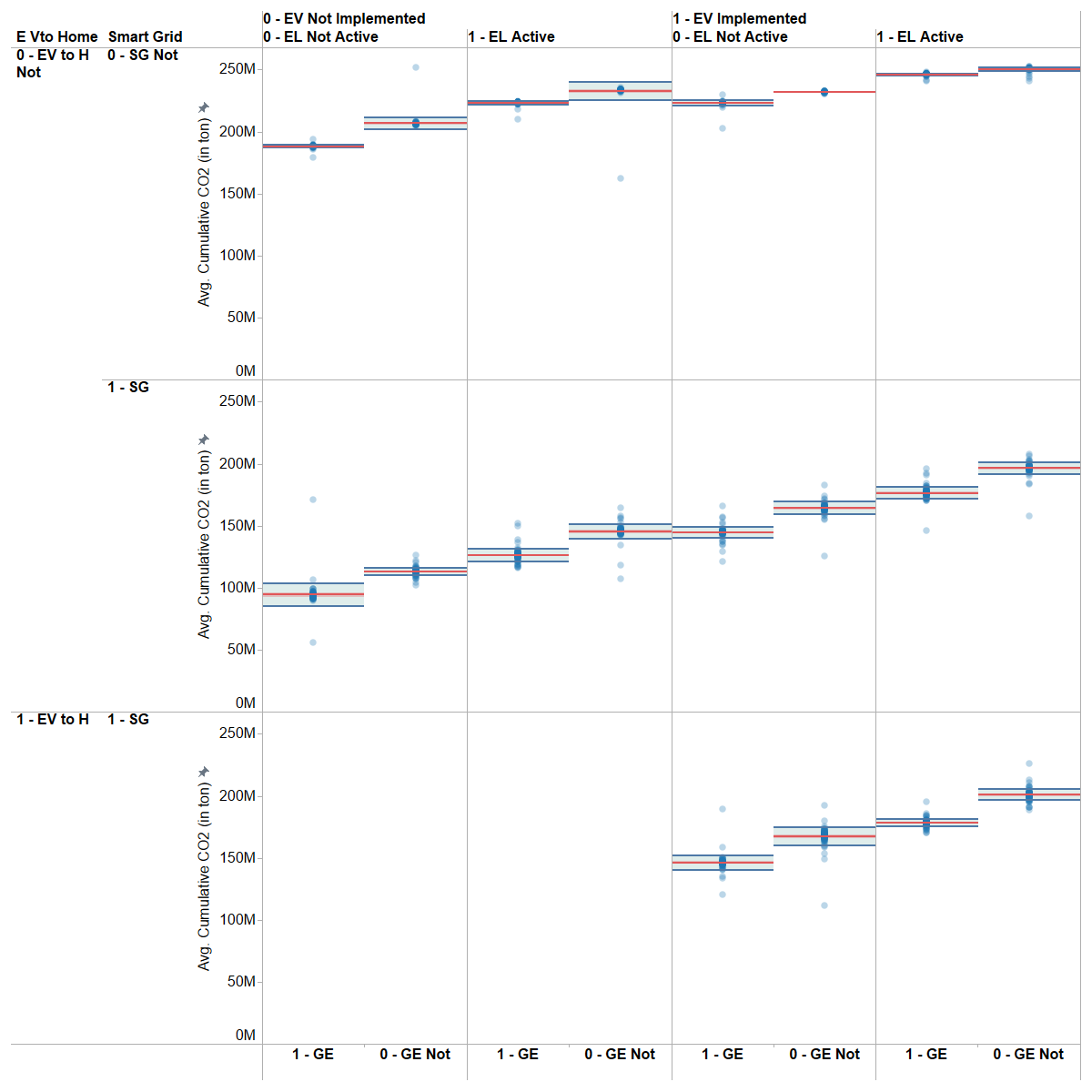
Осознавая адекватность компьютерной модели, осуществлен анализ сценариев на период 2022–2027 гг. со 100-кратным запуском оперативной модели. На диаграмме (рис. 5) 95%-ный доверительный интервал для среднего значения обозначен красной линией и полосой, а отклонение на 1 шаг выше и ниже стандартного отклонения от среднего значения обозначено синей линией и полосой. Как видно из диаграммы, вариация минимальна, что позволяет нам сделать вывод о статистической значимости результатов прогнозирования с имитационным моделированием.
Также определены результаты изменения сценариев выбросов CO2 (в тоннах) за период с 2022 по 2027 год (рис. 5).
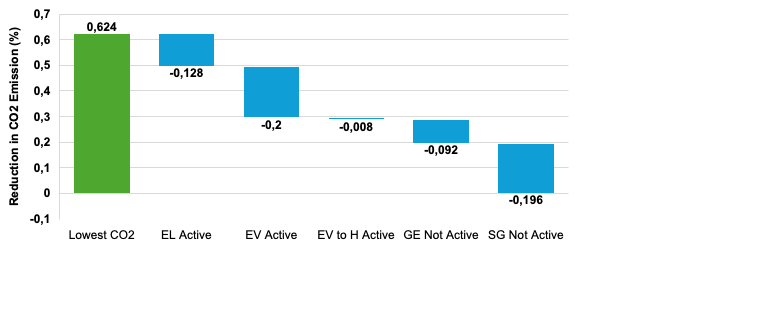
Результаты моделирования за период с 2022 по 2027 год (рис. 6) показывают, что наибольший совокупный объем выбросов CO2 наблюдается в модели без источников SG и зеленой энергии, но с потерей и электромобилями без функции зарядки домохозяйств от электромобилей (250 млн тонн CO2). Наименьший объем выбросов CO2 (94 млн тонн CO2) зафиксирован при наличии SG и зеленой энергетики, но без электромобилей и потери энергии из сети. Разница между этими двумя сценариями составляет снижение выбросов CO2 на 62,4%. Результат указывает на огромные возможности для сокращения выбросов CO2 (рис. 6).
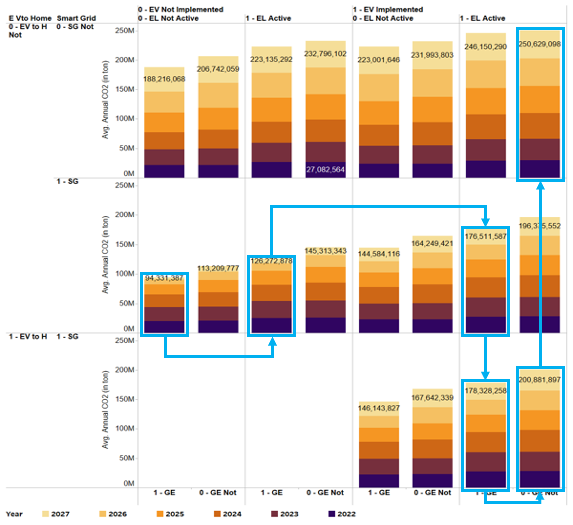 |
Рисунок 7. Выходные параметры моделирования по выбросам СО2 согласно различным сценариям
Источник: составлено авторами.
Как показано на рисунке 7, эффект от электромобилей и SG значителен. Эффект от потерь больше, чем от зеленой энергии. EL и GE оказывают существенное влияние на снижение выбросов CO2.
Для тех же сценариев, которые обсуждались ранее в части выбросов CO2 (рис. 7), среднее количество часов отключений относительно невелико, за исключением последнего сценария, где наблюдались самые высокие выбросы CO2.
Заключение
Исследуя результаты моделирования, можно прийти к мнению, что сценарии без SG показывают наибольшие доли отключений. Ожидается, что домохозяйства будут сталкиваться с отключениями все чаще и чаще с каждым годом. В худшем случае, к 2027 году граждане Узбекистана будут испытывать перебои в электроснабжении в течение 58% года. Хотя наличие зеленой энергетики и отсутствие электропотери несколько улучшают ситуацию, с учетом увеличения потребления, вызванного ростом парка электромобилей, положение остается мало обещающим: более 40% любого отдельного дня в году в Узбекистане в 2027 году будут испытывать перебои в электроснабжении. Даже если предположить, что влияние электромобилей на увеличение потребления минимально (EV=0), все равно перебои в электроснабжении будут наблюдаться в течение 10–20% каждого дня в году, что эквивалентно 2,5–5 часам повседневной жизни без электричества по всему Узбекистану.
Решением всех этих проблем представляется внедрение энергосистемы. При наличии электромобилей и электромобилей с функцией подпитки электричеством домохозяйств, согласно моделированию, ожидается минимальное количество перебоев в электроснабжении в 2027 году (2,8%). В этом оптимистичном сценарии Узбекистан, похоже, свободен от отключений с 2022 по 2026 год. Единственный относительно благоприятный сценарий без отключений – это, когда в модели отсутствует потеря электроэнергии и наблюдается увеличение потребления электроэнергии электромобилями, а все источники энергии успешно внедрены, что приводит к увеличению количества дней с отключениями на 1,48% в году. Это также может означать, что любые незначительные изменения без введения SG-политики приведут к массовым отключениям по всей стране в период моделирования.
На основе вышеизложенных исследований можно резюмировать, что цифровая трансформация принятия решений на основе подобных сложных компьютерных имитационных моделей содействует эффективной разработке наиболее оптимальных и подходящих для различных перспективных случаев сценариев развития не только отдельных хозяйствующих субъектов, но для отраслевого планирования и управления в целом.
Источники:
2. Bazan P, & German R. (2012). Hybrid Simulation Of Renewable Energy Generation And Storage Grids. Simulation Conference (WSC), Proceedings of the 2012 Winter: Date 9-12 Dec. 2012.
3. Biller, B., & Gunes, C. (2010). Introduction to simulation input modeling. Proceedings of the 2010 Winter Simulation Conference. Available from: doi:10.1109/wsc.2010.5679176
4. Connolly, D., H. Lund, B. V. Mathiesen, and M. Leahy, (2022). “A review of computer tools for analyzing the integration of renewable energy into various energy systems”. Applied Energy, 2010, 87 (4): 1059–1082. Electric Vehicle Database (2022). Useable battery capacity of full electric vehicles. Electric Vehicle Database. Available from: https://ev-database.org/cheatsheet/useable-battery-capacity-electric-car
5. Electric Vehicle Database (2022). Useable battery capacity of full electric vehicles. Electric Vehicle Database. Available from: https://ev-database.org/cheatsheet/useable-battery-capacity-electric-car
6. Friedlingstein, P., Jones, M. W., O'Sullivan, M., Andrew, R. M., Bakker, D. C. E., Hauck, J., le Quéré, C., Peters, G. P., Peters, W., Pongratz, J., Sitch, S., Canadell, J. G., Ciais, P., Jackson, R. B., Alin, S. R., Anthoni, P., Bates, N. R., Becker, M., Bellouin, N., Zeng, J. (2022). Global Carbon Budget 2021. Earth System Science Data, 14(4), 1917–2005. https://doi.org/10.5194/essd-14-1917-2022
7. Hamparsum B., (1987). Model Selection and Akaike's Information Criterion (AIC): The General Theory and Its Analytical Extensions, Psychometrika 52(3), February 1987, pp.345-370. DOI:10.1007/BF02294361
8. Heath, S. K., Brailsford, S. C., Buss, A., & Macal, C. M., (2011). Cross-paradigm simulation modeling: Challenges and successes. Proceedings of the 2011 Winter Simulation Conference (WSC), 2783–2797. https://doi.org/10.1109/WSC.2011.6147983
9. Jarrah, M., (2016). Modeling and Simulation of Renewable Energy Sources in Smart Grid Using DEVS Formalism. Procedia Computer Science, 2016, 83, 642–647. https://doi.org/10.1016/j.procs.2016.04.144
10. Mazhari, E. M., Zhao, J., Celik, N., Lee, S., Son, Y.-J., & Head, L., (2009). Hybrid simulation and optimization-based capacity planner for integrated photovoltaic generation with storage units. Proceedings of the 2009 Winter Simulation Conference (WSC), 1511–1522. https://doi.org/10.1109/WSC.2009.5429303
11. Pruckner, M., & German, R., A Hybrid Simulation Model for Large-Scaled Electricity Generation Systems. Proceedings of the 2013 Winter Simulation Conference.
12. World Bank, (2021). CO2 emissions from electricity and heat production, total (% of total fuel combustion, https://data.worldbank.org/indicator/EN.CO2.ETOT.ZS?name_desc=true
Страница обновлена: 28.09.2026 в 10:52:31
Download PDF | Downloads: 5
Assessment of the impact of green energy on CO₂ emissions of the national electricity grid of Uzbekistan: digital transformation of decision-making
Djumanov A.A., Gafurova M.M.Journal paper
Journal of Central Asia Economy
Volume 10, Number 2 (April-June 2026)
Abstract:
The article develops a hybrid model to assess the impact of green energy on CO2 emissions from the National Electricity Grid of Uzbekistan. Modeling of the input data showed that the models of electricity supply and consumption of each region in different months are represented by different types of distribution in accordance with the nature of the observed data. The developed hybrid simulation model made it possible to analyze possible options for the development of the national electric power grid, taking into account a number of national energy projects, such as the introduction of additional hydroelectric power plants, photovoltaic power plants and nuclear power plants, as well as increased consumption of industrial and electric vehicle energy and population growth. The results showed that adding green energy reduces CO2 emissions from traditional power plants, but only if energy losses in the grid are reduced at the same time.
Keywords: electric grid, digital modeling, hybrid simulation model, green energy, CO2 emissions, prescriptive analytics
JEL-classification: Q42, Q53, O33, C61
References:
Bazan P., German R. (2012). Hybrid Simulation Of Renewable Energy Generation And Storage Grids Simulation Conference (WSC), Proceedings of the 2012 Winte.
Biller B., Gunes C. (2010). Introduction to simulation input modeling Proceedings of the 2010 Winter Simulation Conference. doi: 10.1109/wsc.2010.5679176.
Bozdogan H. (1987). Model Selection and Akaikeʼs Information Criterion (AIC): The General Theory and Its Analytical Extensions Psychometrika. 52 (3). 345-370. doi: 10.1007/bf02294361.
CO2 emissions from electricity and heat production, total (% of total fuel combustionWorld Bank. Retrieved from https://data.worldbank.org/indicator/EN.CO2.ETOT.ZS?name_desc=true
Connolly D., Lund H., V. Mathiesen B., Leahy M. (2010). A review of computer tools for analyzing the integration of renewable energy into various energy systems Applied Energy. 87 (4). 1059-1082.
Friedlingstein P., Jones M.W., OʼSullivan M., Andrew R.M. et al. (2022). Global Carbon Budget 2021 Global Carbon Budget 2021. 14 (4). 1917-2005. doi: 10.5194/essd-14-1917-2022.
Gafurova M.M., Sobirov T., Makhkamov Dj.M., Djumanov A.A. (2026). Hybrid Simulation Modeling of National Electricity Grid in Uzbekistan Digitalization of management in organizational systems. 332-338.
Heath S.K., Brailsford S.C., Buss A., Macal C.M. (2011). Cross-paradigm simulation modeling: Challenges and successes Proceedings of the 2011 Winter Simulation Conference (WSC). 2783-2797. doi: 10.1109/WSC.2011.6147983.
Jarrah M. (2016). Modeling and Simulation of Renewable Energy Sources in Smart Grid Using DEVS Formalism Procedia Computer Science. 83 642-647. doi: 10.1016/j.procs.2016.04.144.
Mazhari E.M., Zhao J., Celik N., Lee S., Son Y.-J., Head L. (2009). Hybrid simulation and optimization-based capacity planner for integrated photovoltaic generation with storage units Proceedings of the 2009 Winter Simulation Conference (WSC). 1511-1522. doi: 10.1109/WSC.2009.5429303.
Pruckner M., German R. A Hybrid Simulation Model for Large-Scaled Electricity Generation Systems. Proceedings of the 2013Informs-sim.org. Retrieved from https://informs-sim.org/wsc13papers/includes/files/165.pdf
Useable battery capacity of full electric vehiclesElectric Vehicle Database. Retrieved from https://ev-database.org/cheatsheet/useable-battery-capacity-electric-car